
Toward Socially Aware Person-Following Robots: From Tracking to Interaction
Toward Socially Aware Person-Following Robots
This paper provides a comprehensive review of person-following robots, shifting the focus from technical locomotion to the "Socially Aware" design. It identifies critical gaps in Human-Robot Interaction (HRI) and proposes a user-needs layered design framework (extending the Hedonomic Pyramid) to systematically integrate social conventions into robotic behavior.
TL;DR
Building a robot that can follow a person is no longer just a computer vision challenge—it's a sociological one. This paper argues that the industry's failure to deploy assistive robots commercially stems from a lack of "socially aware" behavior. By reviewing 221 articles, the authors propose a User-Needs Layered Framework that moves robots from mere "tools" to "socially intelligent companions" that respect human personal space and context.
The "Social Gap" in Robotics
Most person-following research treats the human as a moving coordinate () to be chased. However, real-world utility requires the robot to understand why it is following. Is it a robotic suitcase helping a traveler? An IV-pole robot assisting a patient? Or a shopping cart in a crowded mall?
The authors found a startling lack of rigor in HRI research:
- Only 11% of papers performed proper user studies (n > 5).
- Most robots follow from behind, ignoring that side-by-side or front-following is often more natural for conversation or guidance.
- Designers rarely account for Proxemics—the study of human use of space—which varies wildly based on age, gender, and culture.
The Proposed Solution: The Hedonomic Framework
To bridge this gap, the authors adapt the Hedonomic Pyramid, a hierarchy of needs similar to Maslow’s, specifically for person-following robots.
1. The Pyramid of Needs
The core insight is that design must be bottom-up. You cannot aim for a "pleasurable experience" if the robot fails at "safety."
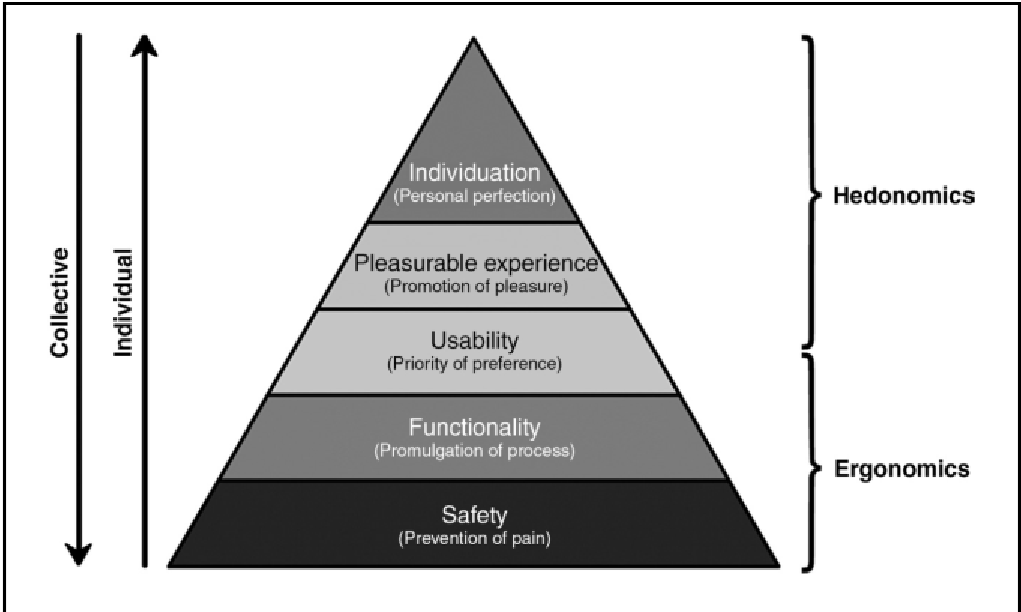
- Safety: Avoiding collisions and ensuring the user feels safe.
- Functionality: Can the robot actually perform its task (e.g., carrying a load)?
- Usability: Is the interaction efficient? Does the robot communicate its intent?
- Pleasurable Experience: Does the robot follow social norms (e.g., giving way to others)?
- Individuation: Can the robot adapt to this specific user's personality and mood?
2. Multi-Factor Influence
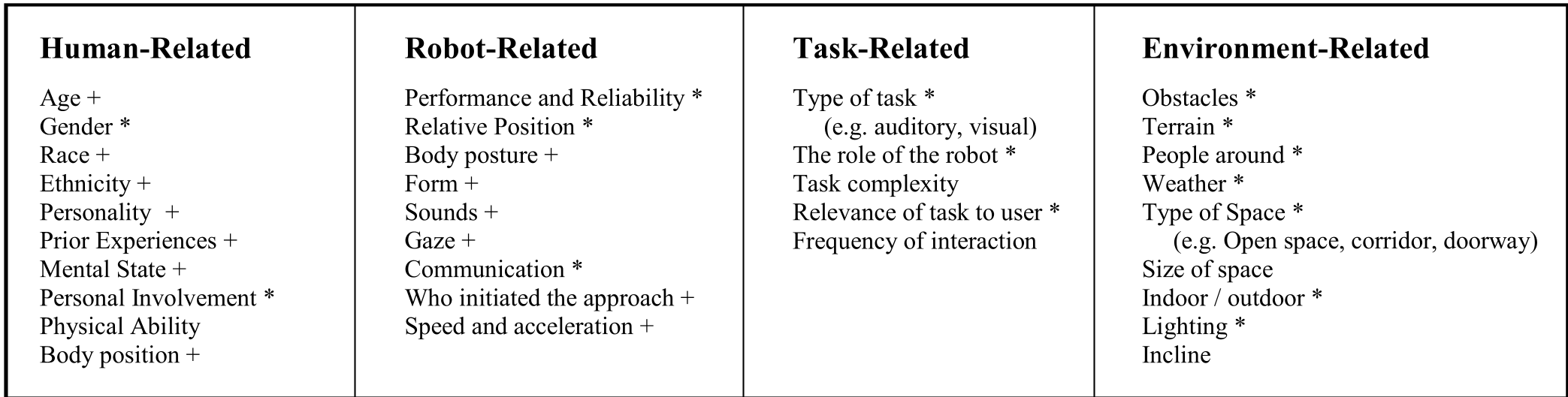
The framework categorizes influences into four pillars that affect every layer of the pyramid:
- Human-related: Age (children prefer more distance), Gender (males prefer side-approach), Personality (extroverts are more tolerant of close robots).
- Robot-related: Appearance (humanoid vs. mechanoid) and Communication cues.
- Task-related: Is the user distracted? Using a smartphone significantly changes how much a user cares about the robot's precision.
- Environment-related: Corridors vs. open spaces; crowds vs. solitude.
Deep Insight: Why Context Changes Everything
One of the most profound takeaways from the survey is that secondary tasks change human perception. If a user is playing a game on a smartphone while walking, they become more satisfied with the robot’s behavior even if it’s less precise. They "delegate" the safety task to the robot, increasing their trust but decreasing their awareness. This suggests that "social awareness" isn't a fixed setting but a dynamic negotiation between the robot and the human's current cognitive load.
Experimental Trends and Gaps
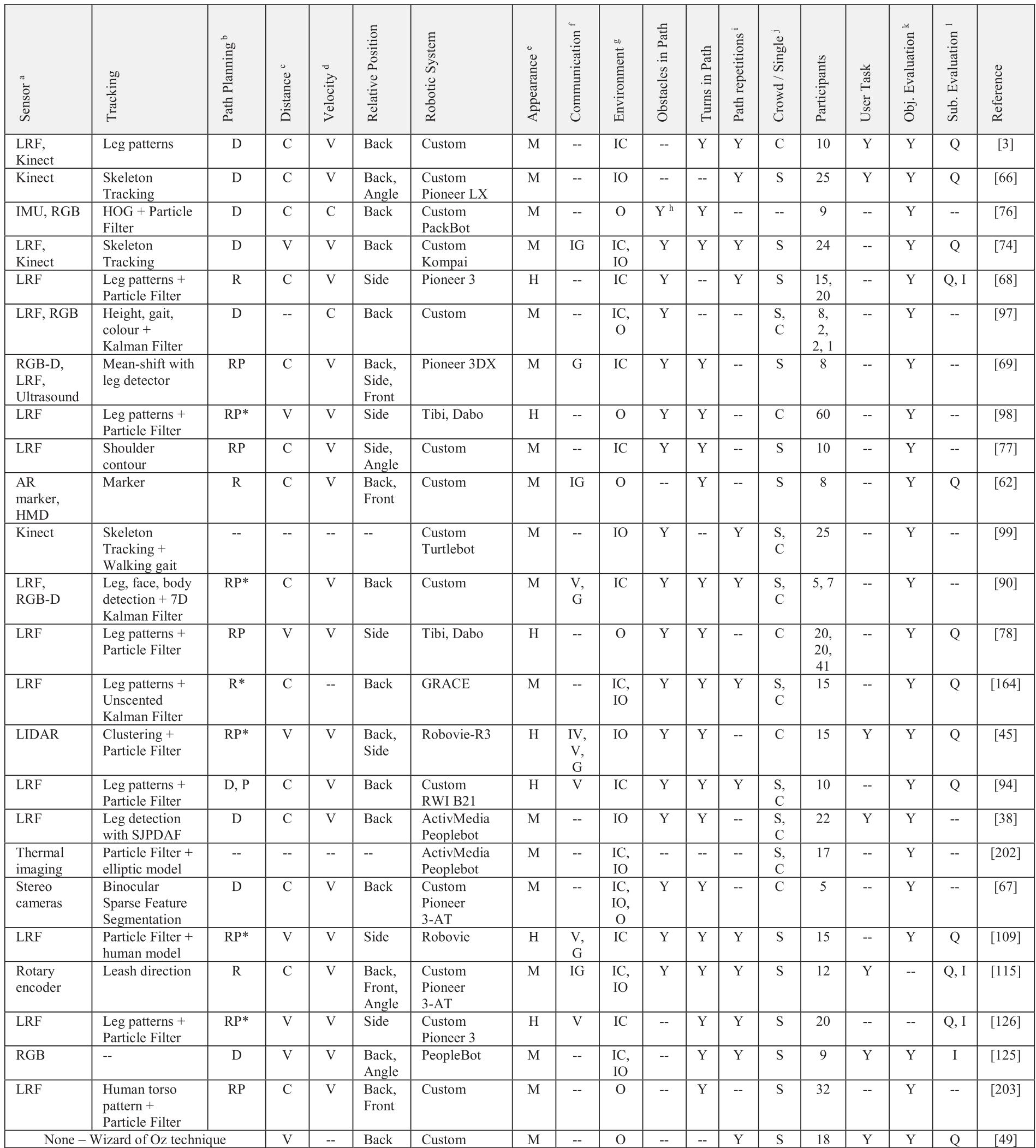
The paper provides a meta-analysis of existing user studies, tracking how sensors (LRF, Kinect, RGB-D) and strategies (Path-following vs. Direction-following) impact results.
Key Findings from Literature:
- Anticipative following (predicting the human's next step) is rated significantly more "human-like" and comfortable than reactive following.
- Direction following is generally preferred over "path following" (re-tracing the human’s exact footprints) because the latter looks mechanical and rigid.
Future Challenges: Benchmarking the Invisible
How do we measure "Pleasure" or "Social Awareness"? The authors conclude with an urgent call for benchmarking. Currently, every roboticist uses different Likert scales and custom metrics, making it impossible to compare a "social robot" from Lab A with a "service robot" from Lab B.
They propose:
- Iterative User Testing: Minimum 20 participants for validation, 5 for quick iteration.
- Standardized Reporting: Reporting not just algorithm accuracy, but participant age, experience, and the specific environment.
Conclusion
This paper serves as a manifesto for the next generation of HRI. As robots move from labs to sidewalks and hospitals, the "Socially Aware" framework provides the necessary roadmap to ensure these machines are not just functional, but welcome in our social spaces.
Disclaimer: This blog is based on the technical review "Toward Socially Aware Person-Following Robots" by Honig et al.