
Socially Aware Trust: Decoding Reliable Multimedia Delivery in D2D Networks
13543_Socially Aware Trust Framework for Multimedia Delivery in D2D Cooperative Communication.
The paper introduces a Socially Aware Trust Framework for multimedia delivery in D2D cooperative communications, utilizing a hybrid evaluation of Capability Trust and Social Trust. It employs a Three-Way Decision algorithm based on Naive Bayesian to effectively filter selfish relay users and optimize content distribution.
TL;DR
The explosion of multimedia traffic requires shifting some burden from Base Stations (BS) to Device-to-Device (D2D) relays. However, "selfishness" in these human-carried devices is a major bottleneck. This paper presents a hybrid trust framework that evaluates both a device's Capability (Can it help?) and its Social Intent (Will it help?), using Naive Bayesian logic to filter out unreliable nodes.
Background & Motivation: The Human Factor in D2D
In dense environments like concerts or stadiums, D2D communication is a savior for spectrum efficiency. But unlike fixed routers, D2D relays are held by humans with finite battery life and personal preferences. Existing SOTA methods often overlook the "social selfishness" of nodes—where a relay might refuse to forward data for a stranger but gladly do it for a friend.
The authors identify a critical gap: trust isn't a binary (0 or 1). It is a gradient influenced by physical hardware limits and social relationships.
Methodology: The Hybrid Trust Engine
The core of the paper is a hybrid model that splits trust into two distinct dimensions:
1. Capability Trust (From BS to Relay)
This is the "Hardware Check." It considers:
- Caching Capability: Does the device have space for the multimedia chunk?
- Processing Delay: How fast can the CPU handle the data?
- Transmission Rate: Calculated via the Shannon capacity, accounting for interference from reused cellular spectrum.
2. Social Trust (From Sender to Relay)
This is the "Relationship Check," analyzing three specific behaviors:
- Cooperative Behavior: Based on ACK messages and indirect recommendations.
- Altruistic Behavior: Based on "Interest Difference"—nodes are more likely to help if they are interested in the content themselves.
- Reciprocal Behavior: "You help me, I help you." Measured by the average reciprocity interval.
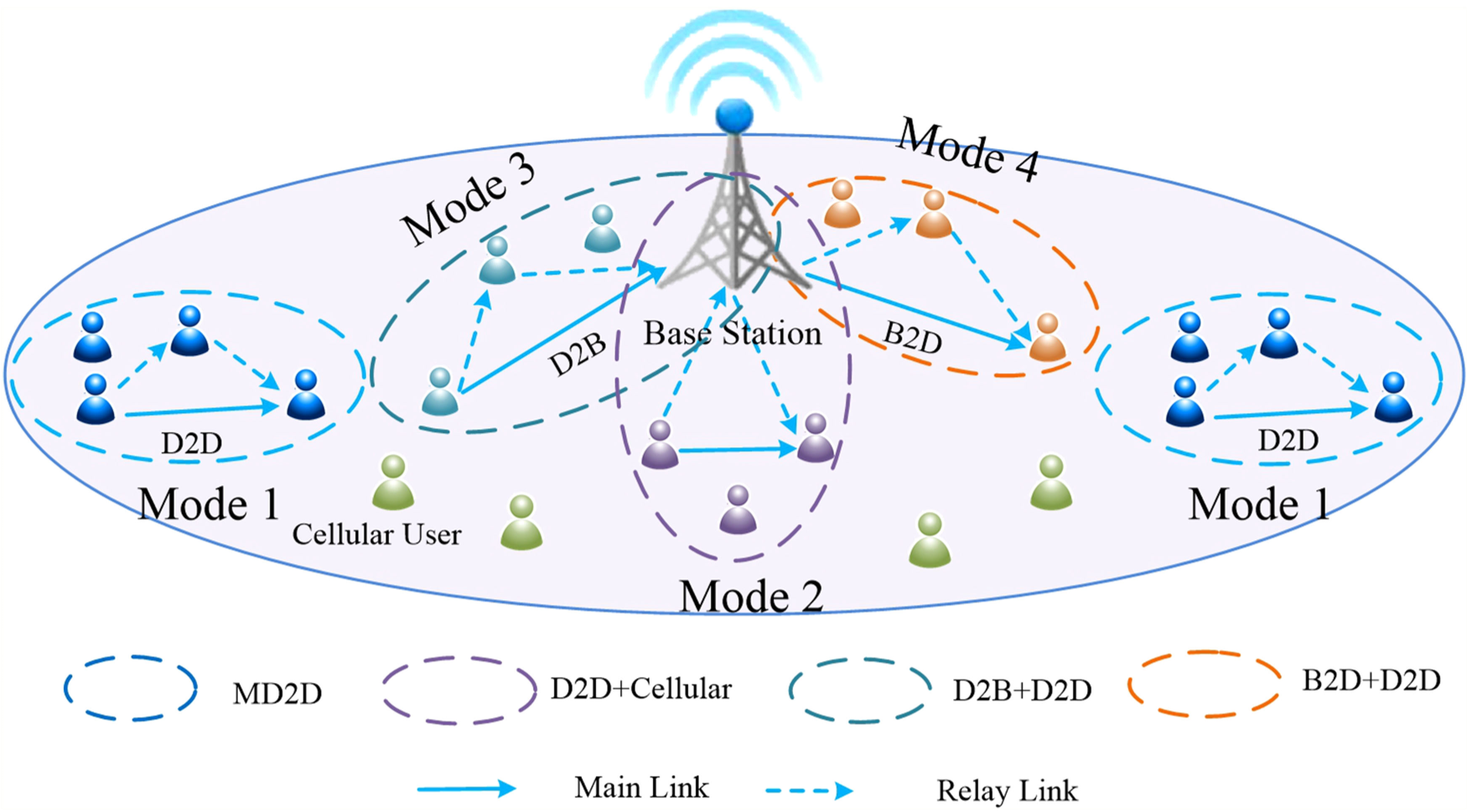 Figure: The overall hybrid trust model including record, computation, and decision phases.
The Decision Logic: Three-way Decision & Naive Bayesian
Instead of a simple "Yes/No" selection, the authors use Decision-Theoretic Rough Sets. Relays are classified into:
- Positive Region (PSO): Highly trustworthy; proceed with relay.
- Negative Region (NEG): Untrustworthy; reject.
- Boundary Region (BAD): Observed; needs more interaction to determine status.
Experiments: Real-World Validity
The team tested the framework against the Cambridge and Infocom datasets (real human mobility traces).
Key Breakthroughs:
- Selfish User Detection: The recognition rate for selfish users stays consistently high (80-90%), whereas baseline models (like SRSCN) plummet as the percentage of selfish users increases.
- Efficiency: The delivery success ratio is improved by nearly 10 percentage points compared to baselines in high-selfishness environments.
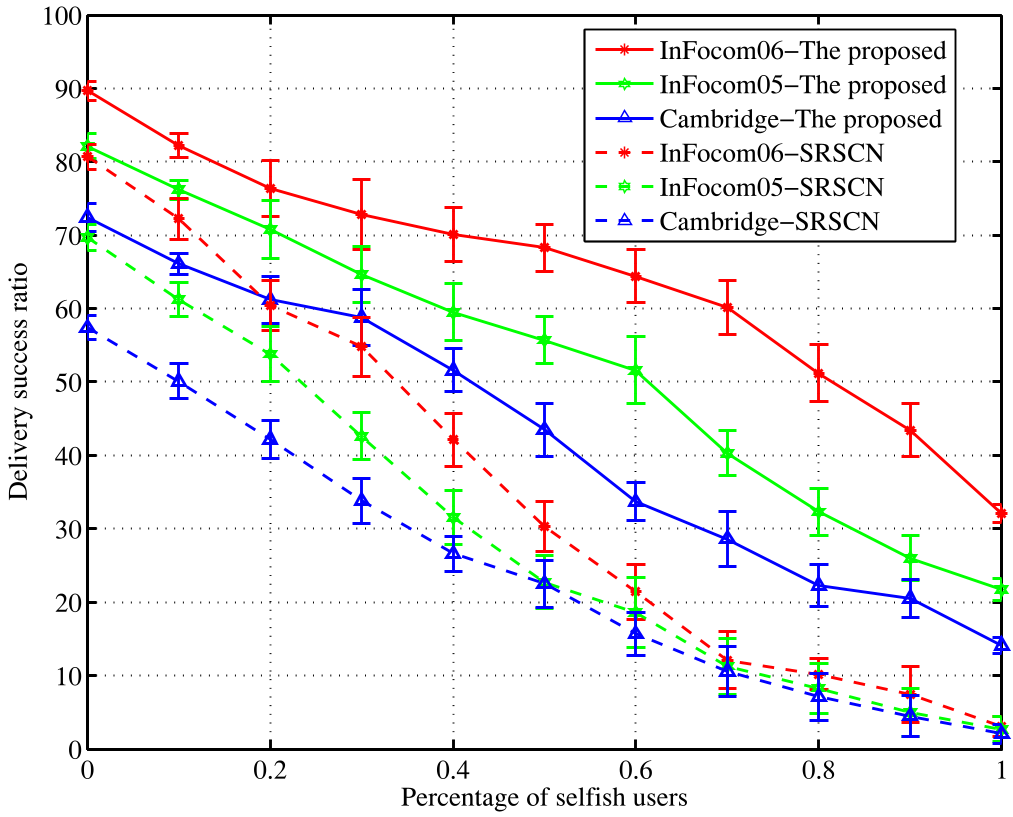 Figure: Delivery success ratio vs. Percentage of Selfishness.
Critical Insight & Conclusion
This paper succeeds because it treats D2D nodes as Social Entities rather than just signal repeaters. By quantifying "Altruism" through "Interest Matrices," the authors tap into the inherent psychology of user behavior.
Limitations: The model currently assumes the Base Station is always a "Trusted Entity." In decentralized or future 6G edge scenarios, this assumption may be challenged, suggesting that a move toward Blockchain-based decentralized trust or Federated Learning for privacy could be the next frontier.
Takeaway for Practitioners: When designing D2D or mesh protocols, hardware metrics are only half the battle. Incorporating historical interaction "Social Debt" is key to reducing overhead and increasing reliability.