
Socially-aware Video Recommendation: Leveraging Homophily and Semantic Crowdsourcing
Socially-aware video recommendation using users' profiles and crowdsourced annotations
This paper presents a socially-aware video recommendation framework that leverages "homophily"—the tendency of similar individuals to associate—by combining user profiles with crowdsourced semantic annotations. The system integrates Wikipedia-based semantic analysis and Facebook profile data to build a multi-level taxonomy of user interests, significantly improving recommendation accuracy over traditional Collaborative Filtering.
TL;DR
This paper introduces a hybrid recommendation framework that moves beyond simple "likes" and "ratings." By extracting semantic entities from user comments and Facebook profiles using Wikipedia as a reference, the system builds a deep interest profile. This approach exploits homophily (similarity attracts) to connect users with relevant videos and like-minded peers, effectively tackling the notorious "cold start" problem in recommendation systems.
The Motivation: Moving Beyond Discrete Signals
Most recommendation engines we use daily—like YouTube or Netflix—rely heavily on Collaborative Filtering (CF). While effective, CF has a fundamental flaw: it views users and items as IDs in a matrix. It doesn't truly understand why you like a video; it just knows you and User B both clicked it.
The authors argue that social networks offer a goldmine of semantic context through comments and profiles. By capturing the "why" behind an interaction, we can make better suggestions even when a new user hasn't rated anything yet (the Cold Start problem).
Methodology: The Semantic Bridge
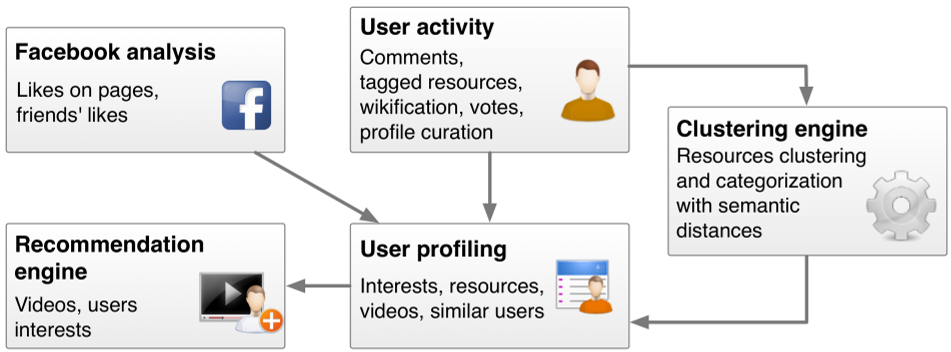
The core of this system is its ability to turn unstructured data (comments, tags) into a structured interest vector.
1. Crowdsourced Semantic Tagging
Instead of just relying on uploader tags, the system uses "crowdsourced annotations." When users comment on specific video frames, the system performs:
- Named Entity Detection: Identifying specific topics mentioned.
- Wikification: Linking terms to Wikipedia entries to resolve ambiguity (e.g., distinguishing "Java" the island from "Java" the language).
2. Building the Interest Profile
The system maps these entities to a taxonomy (e.g., Music -> Rock). To measure how "close" two topics are, it uses the Wikipedia Link-based Measure (WLM), which analyzes the link structure between Wikipedia articles.
3. The Recommendation Algorithm
Unlike standard CF which finds "neighbors" based on rating history, this algorithm finds neighbors based on Profile Similarity.
- Algorithm Logic: It calculates an interest similarity score between users. It then generates a neighborhood of the top similar users and weights their preferences to suggest new items to the target user.
Does it Work? (Experimental Results)
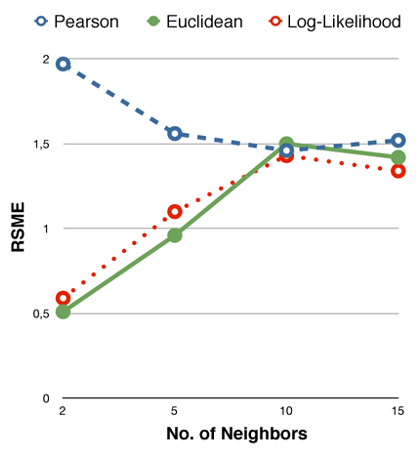
The authors evaluated the system using a dataset of 138 videos and 51 users. They measured success using Root Mean Square Error (RMSE)—lower is better.
- Metric Selection: They found that Euclidean distance was more stable than Pearson correlation for smaller datasets.
- The Big Win: The proposed "CF + Interest Similarity" approach crushed the baseline. At small neighborhood sizes (where users have few connections), the RMSE was reduced from 1.66 (Baseline) to 0.96 (Proposed). This proves that semantic profiles are far more predictive than sparse rating data.
Critical Analysis & Conclusion
Takeaway
The true value of this work lies in its hybrid nature. It doesn't discard Collaborative Filtering; it supercharges it with semantic knowledge. By using Wikipedia as a universal translator for interests, it bridges the gap between social interaction and content relevance.
Limitations
- Computational Overhead: Calculating WLM distances and performing real-time Wikification is expensive, though the authors suggest using Hadoop/Mahout for scalability.
- Privacy: The reliance on Facebook Graph API data raises modern privacy concerns that were less prominent in 2013 but are critical today.
Future Outlook
As we move into the era of LLMs, the "semantic extraction" part of this paper could be replaced by modern embeddings (like CLIP or BERT). However, the core insight—that social similarity (homophily) is a more powerful predictor than raw interaction—remains a cornerstone of modern social discovery algorithms.