
Spice: Reducing Mobile Social Media Latency via Social Friendship Clustering
Socially-Driven Learning-Based Prefetching in Mobile Online Social Networks
This paper introduces "Spice," a socially-driven learning framework for media content prefetching in Mobile Online Social Networks (OSNs). By leveraging social friendship clustering and a cluster-based Latent Bias Model (LBM), Spice predicts user click behavior to preemptively download images and videos, achieving state-of-the-art performance in service latency reduction.
TL;DR
The "Spice" framework revolutionizes how mobile devices handle social media feeds. By recognizing that you are more likely to click a photo from your best friend than a random brand, it uses social friendship clustering and machine learning to pre-download content. The result? An 80.6% reduction in loading times with negligible battery impact.
The "Friendship" Gap in Mobile Computing
Despite the jump to 5G, accessing high-resolution images and videos on platforms like Twitter or Facebook still feels sluggish. Traditional prefetching—downloading data before you click—is often a "shot in the dark" that wastes cellular data and battery.
The problem with prior SOTA (State Of The Art) methods, such as EarlyBird, is their lack of Social Intuition. They treat all shared links the same. However, the data reveals a "Power Law" in social behavior: nearly 85% of media clicks come from just 5% of a user's friends. Spice is built to exploit this specific social hierarchy.
Methodology: The Logic of Social Bias
Spice operates through a two-pronged strategy: Cluster-Based Prediction and Usage-Adaptive Scheduling.
1. Social Friendship Clustering
Using K-Means clustering, the system analyzes interaction frequency (tweets sent/received) to categorize contacts into three tiers:
- Cluster 1 (Close Friends): High interaction, highest click probability (64%).
- Cluster 2 (Familiar Friends): Moderate interaction.
- Cluster 3 (Acquaintances): Infrequent contact, lowest click probability (13%).
2. Cluster-Based Latent Bias Model (LBM)
The core prediction engine is an LBM that calculates a "Click Score" for every new tweet: This formula factors in the user's average click rate (), localized bias for specific friends (), and specific interaction features like whether a tweet was "Favorited" (which boosts click probability to over 98% for close friends).
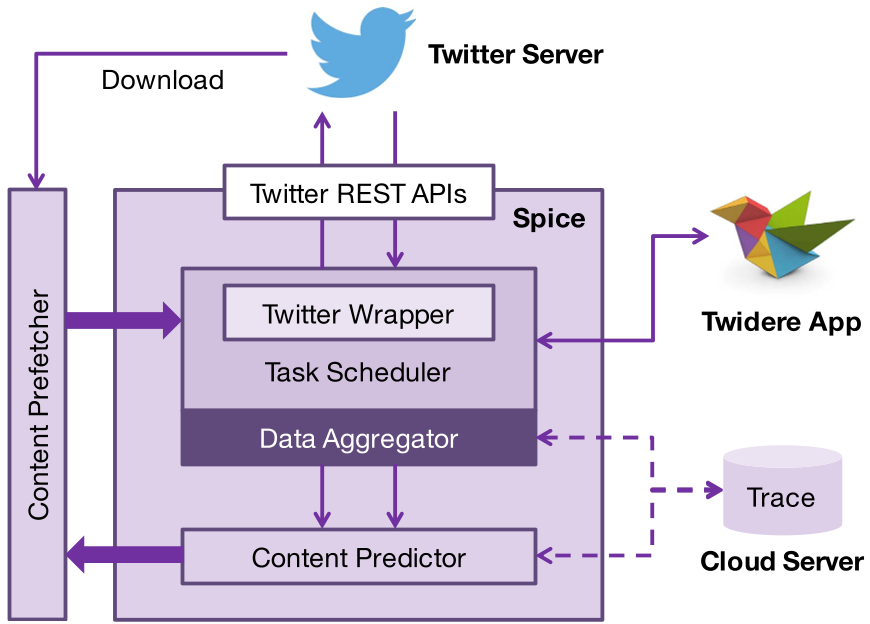 Figure 1: The Spice system architecture showing the flow from Data Aggregator to Content Predictor and finally the Prefetcher.
Experiments & Results: Performance at Scale
The authors tested Spice using real-world traces from over 17,000 Twidere users.
Prediction Accuracy
Spice’s cluster-based approach achieved 84.5% accuracy, a massive jump over the 63.8% achieved by standard linear regression. This proves that "Who" posted the content is a far stronger signal than "What" is in the tweet.
Delay vs. Resource Overhead
- Access Delay: Reduced by 80.6% on average.
- Energy Efficiency: By offloading the heavy lifting of ML training to a cloud cluster, Spice achieved a 1000x speedup compared to local training on a smartphone, while using only 0.02% of daily battery for data training.
- Data Usage: The adaptive scheduler is smart enough to download more aggressively on WiFi and conserve data on Cellular networks.
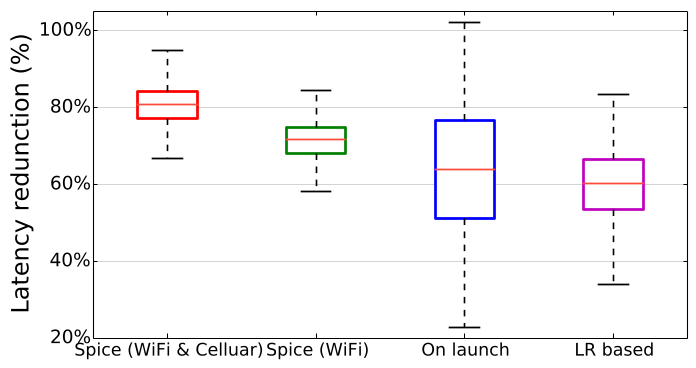 Figure 2: Lateral comparison of latency reduction across different prefetching strategies.
Critical Insight: Why Spice Wins
The brilliance of Spice lies in its Usage-Adaptive Scheduling. Instead of constant prefetching, it segments the day into four zones (Midnight, Morning, Afternoon, Night) and predicts the "App Launch Probability" (). If you rarely check Twitter at 3 AM, Spice sleeps. If you're a heavy user during your 1 PM lunch break, Spice prefetches aggressively. This context-awareness is what makes it practical for real-world devices.
Conclusion & Future Outlook
Spice proves that the next frontier in mobile Optimization isn't just better hardware, but socially-aware software. By treating our digital social circles as structured data, we can build systems that feel telepathic. Future work could extend this to "Moment" modules in apps like WeChat or even prefetching for VR/AR social environments where latency is a dealbreaker.
Takeaway: If a system knows your friends, it can predict your future interactions.