
Transitivity Demolition: How Breaking Triangles Triggers the Fall of Social Networks
SPECIAL SECTION ON SOCIALLY ENABLED NETWORKING AND COMPUTING
This paper introduces the Transitivity Demolition problem, focusing on identifying critical nodes and edges whose removal maximizes the destruction of connected triples (triangles) in complex networks. The authors propose DAK-n and DAK-e, high-performance approximation algorithms that achieve an (1 - 1/e) guarantee while maintaining near-optimal scalability on large-scale social networks.
TL;DR
Social networks don't just collapse due to a lack of connectivity; they fall when their "mutual trust" structures—represented by triangles—are systematically dismantled. This paper introduces DAK-n and DAK-e, two groundbreaking algorithms that can identify the most critical nodes and edges for network transitivity. By optimizing for triangle destruction with a 100x speedup over previous SOTA, this work provides a new lens for both protecting vital infrastructure and understanding the sudden decline of platforms like MySpace or Friendster.
The "Friend of a Friend" Vulnerability
While traditional network science focuses on connectivity (can point A reach point B?), social resilience relies on transitivity. A connected triple, or a triangle, represents a stable relationship where "a friend of your friend is also your friend." When these triangles break, information diffusion slows down, and community cohesion evaporates.
The authors argue that the fall of social giants like Friendster wasn't just about losing users, but about a "cascade of broken bonds" that destroyed the local clustering of the network. Identifying which specific elements (nodes or edges) are the linchpins of this clustering is an NP-complete challenge that previously required massive computational resources.
Methodology: The Logic of Discounting
The core innovation lies in the Discounting Algorithm (DAK). The problem is framed as a Max-k-Coverage task: we want to pick elements to cover (break) as many triangles as possible.
The Intuition behind DAK
Instead of re-counting triangles from scratch after every node removal (which is what naive greedy algorithms do), DAK maintains a "marginal gain" score for each element. When a node is removed, the algorithm only updates the scores of its immediate neighborhood.

This "local update" logic is mathematically proven to be highly efficient on Power-Law networks—the type of architecture most real-world social networks follow. On these graphs, the complexity of breaking triangles becomes identical to the complexity of simply counting them (), making it viable for billion-edge datasets.
Experimental Results: Speed Meets Quality
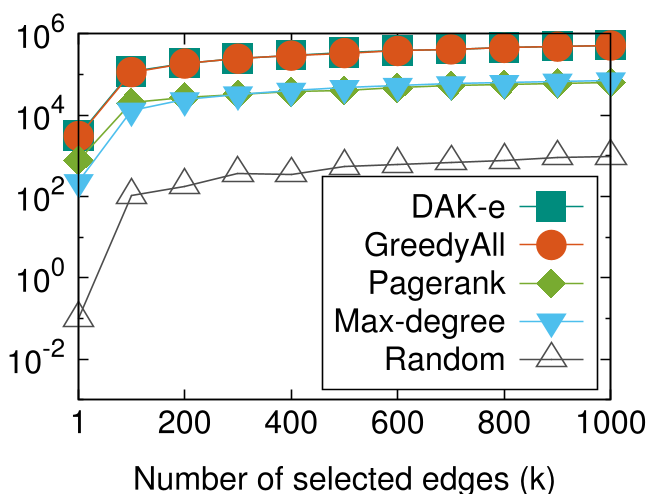
The authors tested their approach against GreedyAll, Pagerank, and Max-degree benchmarks across six diverse datasets, including Flickr and Orkut.
Performance Comparisons
- Speed: DAK algorithms were consistently 20x to 100x faster than GreedyAll.
- Quality: Despite the speedup, DAK-n and DAK-e matched the solution quality of the far slower exhaustive greedy methods, significantly outperforming Pagerank and Degree-based attacks.
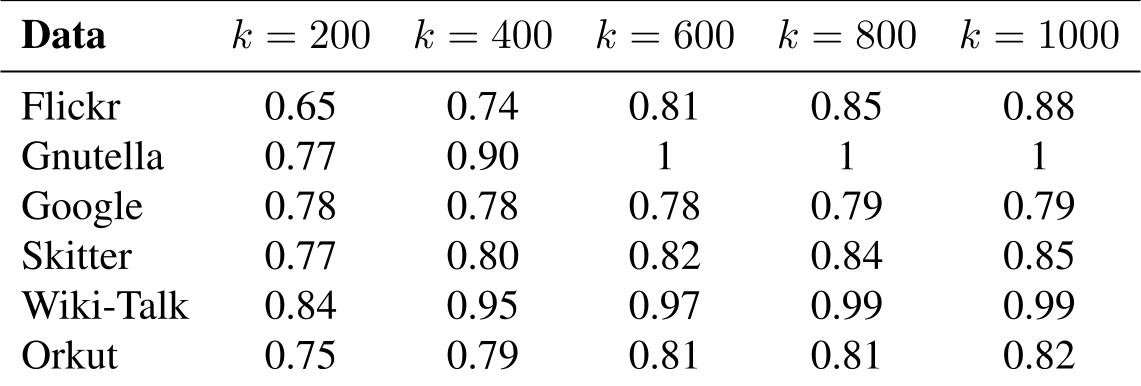
One of the most impressive findings is the Input-Dependent Bound. While the theoretical lower bound is the standard , the actual performance on networks like Wiki-Talk reached 95% to 99% of the optimal solution, as shown in the table below.
Critical Insight: Beyond Simple Connectivity
This work shifts the paradigm of "node importance." A node might not have the highest degree (number of friends), but it might be the "bridge" that completes hundreds of triangles. Deleting such a node is far more damaging to the network's social fabric than deleting a high-degree "hub" that doesn't contribute to local clustering.
Conclusion & Future Outlook
The Transitivity Demolition framework provides a potent tool for:
- Infrastructure Defense: Identifying which communication links are vital for stable routing.
- Platform Health: Helping social media companies identify "churn-sensitive" users whose departure could trigger a network-wide collapse.
- Counter-Terrorism: Finding the most efficient way to disrupt adversarial information networks.
The authors have successfully bridged the gap between complex graph theory and practical, scalable engineering, proving that even for NP-hard problems, a clever "discounting" strategy can make the impossible manageable.