
Socially-Aware D2D: Bridging the Gap Between Physical Proximity and Human Trust
3252_Socially-Inspired Peer Discovery for D2D Communications.
This paper proposes a social-aware peer discovery framework for Device-to-Device (D2D) communications. By integrating complex social metrics—Social Trust, Similarity, and Centrality—into a unified Utility Function, the method optimizes the selection of communication partners to enhance network reliability and efficiency.
TL;DR
This research moves Device-to-Device (D2D) communication beyond mere signal bars. By introducing a framework that evaluates Social Trust, Interest Similarity, and Network Centrality, the authors propose a peer discovery mechanism that ensures your devices connect not just to the closest person, but to the right person.
Background & Motivation
Most D2D protocols treats mobile devices as anonymous nodes. However, devices are carried by humans. If two people are strangers, they are less likely to share bandwidth or data (the "free-rider" problem). Conversely, if they share common interests or a history of interaction, the connection is more reliable. The core challenge is: How do we mathematically model "social value" to optimize a wireless link?
Methodology: The Social Utility Function
The authors break down social attributes into three quantifiable pillars, culminating in a comprehensive Utility Function:
1. Social Trust ()
Trust isn't binary; it's cumulative. The model calculates the strength of ties based on Contact Frequency (CF) and Contact Duration (CD). If users and meet often and stay together long, their trust score increases.
2. Interest Similarity ()
Using the overlap of metadata or preferences, the system calculates similarity. This ensures that a user interested in "Sports" is paired with others who might have relevant content to cache or share.
3. Node Centrality ()
Not all nodes are equal. Some are "social butterflies" (hubs). Using a Random Walk model, the framework identifies central nodes that are better positioned to relay information to the rest of the network.
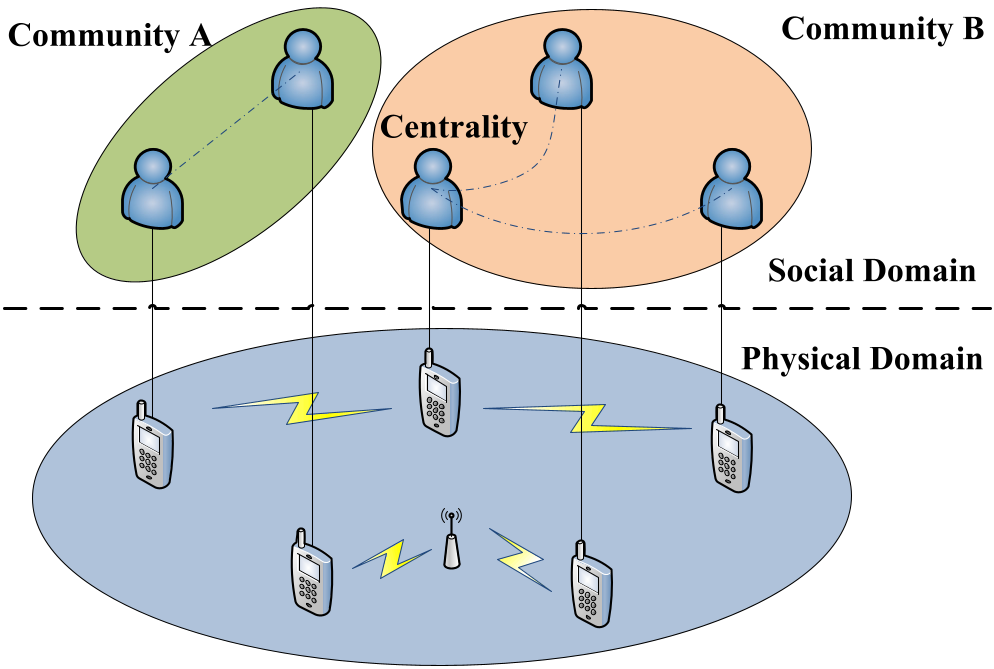
Unified Performance Analysis
The final decision is made by the Utility Function: By tuning , the network can prioritize security (trust) or content dissemination (similarity/centrality).
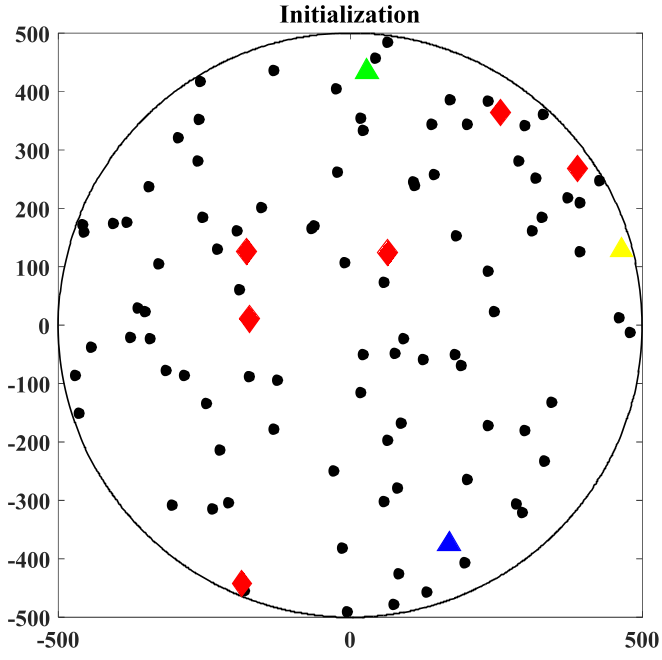
The results (as shown in the simulation charts) indicate that accounting for social ties reduces the "failure rate" of D2D handovers. When users have high social similarity, the probability of them moving in similar trajectories increases, leading to more persistent and high-throughput D2D sessions.
Critical Insight & Conclusion
The brilliance of this work lies in recognizing that physical mobility is driven by social intent. By mathematically formalizing trust and centrality into the peer discovery phase, the authors provide a pathway for more cooperative wireless ecosystems.
Limitations: The paper assumes that social metadata is readily available. In a real-world scenario, privacy-preserving techniques (like Differential Privacy) would be necessary to calculate these scores without exposing sensitive user history.
Future Work: Integrating this utility function into Reinforcement Learning (RL) agents could allow devices to dynamically learn the best weights in real-time based on battery life and network congestion.