
SocialMix: Shielding Identities in Trusted Social Conversations
SocialMix: Supporting Privacy-Aware Trusted Social Networking Services
This paper introduces SocialMix, a privacy-preserving framework for "Trusted Anonymous Social Networks" that ensures k-anonymity by shuffling message-user mappings. Unlike standard anonymous forums, it maintains a trusted social graph while preventing re-identification through message aggregation and timing analysis.
TL;DR
SocialMix is a novel framework designed for Trusted Anonymous Social Networks. It allows users to talk to their friends anonymously without being re-identified through message aggregation or timing analysis. By strategically placing "mix nodes" throughout the social graph, it achieves robust k-anonymity and scales privacy protection exponentially as messages travel further from the source.
The "Trust vs. Privacy" Paradox
In the world of Online Social Networks (OSNs), we usually face a binary choice:
- High Trust, Low Privacy: (e.g., Facebook) You know exactly who you are talking to, but every word is linked to your permanent identity.
- Low Trust, High Privacy: (e.g., Whisper) You are anonymous, but the lack of verified identities leads to low-quality interactions and misinformation.
The authors identify a critical gap: Trusted Anonymous Networks. Imagine a peer-review process or a support group for sensitive health issues; you trust the group, but you need your individual messages to be un-linkable. The core threat here isn't just a single leaked ID—it's aggregation. If an adversary sees 10 anonymous messages about "headaches" and "location: Pittsburgh," and they know Alice has chronic migraines and lives in Pitt, the anonymity is shattered.
Methodology: The Social Shuffle
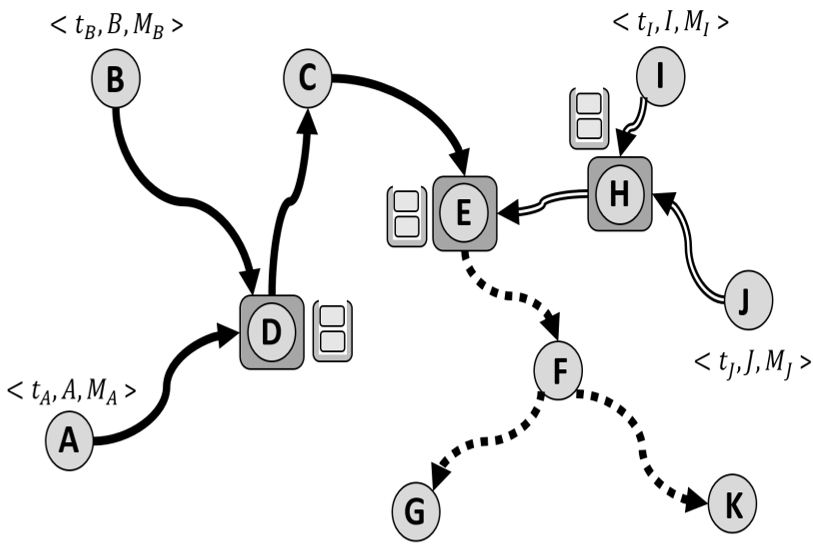
SocialMix counters aggregation by using Mix Nodes. Inspired by the mix-zones used in GPS privacy, these nodes act as buffers that shuffle incoming data packets to break the link between a sender and their message.
1. The Dual-Layer Architecture
SocialMix categorizes mix nodes into two types:
- Pre-mix (Event-driven): Operates at the first hop. It buffers messages from direct friends to ensure that even the first receiver cannot be 100% sure of the sender's identity.
- Post-mix (Intermediate): These act as high-capacity switches in the network backbone. As a message passes through post-mix nodes, its anonymity set grows by , offering stronger protection for distant users.
2. Defeating the "Time-Based Attack"
Standard FIFO (First-In-First-Out) buffers are useless against active attackers who monitor when a message is sent. SocialMix introduces a randomized exchange algorithm:
- Messages enter a buffer.
- When the buffer reaches size , the node randomly picks two messages.
- It swaps their timestamps and metadata.
- It releases one and keeps the other for the next round. This ensures the "stay time" of any message is completely random, maximizing Shannon Entropy.
Experimental Results
The researchers tested SocialMix on the famous Zachary’s karate club dataset.
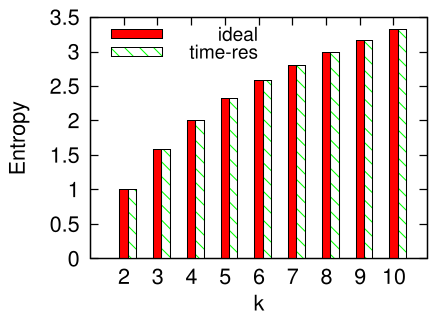
- Attack Resilience: The system successfully defeated time-based attacks, achieving entropy levels identical to an "Ideal Mix Node."
- Placement Efficiency: You don't need to turn every user into a mix node. By using Centrality-based placement (selecting nodes that are "social hubs"), the system reached a 90% anonymization rate using just two post-mix nodes.
Critical Insight & Perspectives
The brilliance of SocialMix lies in its topological awareness. Traditional k-anonymity is a static database property; SocialMix treats it as a dynamic routing property.
Limitations: While the "Stay Time" randomization is great for privacy, it introduces latency. High-security settings (large ) might make the social network feel "laggy," which could hurt user experience in real-time chat scenarios.
Future Work: The next frontier is likely Multi-modal Aggregation. Even if the timestamp is shuffled, if a user posts a photo with a unique background, the content itself allows for re-identification. Integrating SocialMix with differential privacy for image/text features would be the ultimate "Privacy-aware Trusted Social Service."
Conclusion
SocialMix provides a mathematical and structural blueprint for a future where we can be social without being "tracked." It shifts the focus from simply hiding a name to breaking the statistical patterns that truly define our digital footprints.