
SocialSDN: Bridging Social Circles with Secure, Side-Channel Resistant Tunnels
SocialSDN: Design and Implementation of a Secure Internet Protocol Tunnel Between Social Connections
SocialSDN is a novel networking tool that combines Social Networking concepts with Software-Defined Networking (SDN) to establish secure, peer-to-peer IP tunnels. It automates end-to-end encrypted (E2EE) connections between social contacts while providing built-in defenses against traffic pattern side-channel analysis.
TL;DR
SocialSDN is an open-source tool designed to make end-to-end encrypted (E2EE) networking as easy as adding a friend on a social network. By leveraging Linux namespaces and a modular UNIX pipeline, it establishes secure IP tunnels that not only encrypt data but also obfuscate traffic patterns to prevent side-channel leaks, even through restrictive NATs.
The Problem: Security vs. Usability vs. Metadata
In the current networking landscape, users face a "choose two" trilemma between Security, Usability, and Metadata Privacy.
- Complexity: Setting up OpenVPN or WireGuard requires technical knowledge of IP tables, port forwarding, and key management.
- NAT Barriers: Most home users are behind NATs, making direct P2P connections nearly impossible without complex relay setups.
- Side-Channels: Even if your traffic is encrypted, an adversary can "see" you talking. For example, in a VoIP call, the timing and size of packets reveal whether you are speaking or silent, potentially leaking the structure of a conversation.
Methodology: The Architecture of SocialSDN
The genius of SocialSDN lies in its modular pipeline design. It doesn't try to reinvent the wheel; instead, it chains together proven tools like socat, scapy, and NaCl (Networking and Cryptography Library).
1. Process-Level Isolation
Unlike traditional VPNs that change system-wide routing, SocialSDN uses Linux Network Namespaces. This allows a specific application (like a browser or a VoIP client) to live in its own tiny network world where its only "gateway" is the SocialSDN tunnel. This enables the tool to run without root permissions for the most part and prevents accidental data leaks to the public internet.
2. The UNIX Pipeline & Traffic Shaping
SocialSDN treats the network tunnel as a pipe. Data flows from the application through a series of "Gatekeepers":
- Outbound Gatekeeper: Takes raw IP packets, pads them according to a "Shaping Model," and encrypts them.
- Inbound Gatekeeper: Decrypts, verifies authenticity, and strips padding.
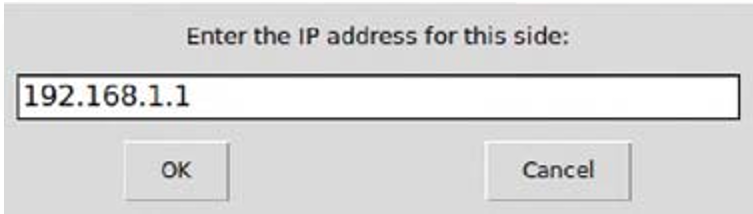 Fig 1: Step-by-step tunnel initiation and address assignment.
Defeating Side-Channel Analysis
The most impressive feat of SocialSDN is its ability to hide activity patterns. In a standard encrypted VoIP call, VBR (Variable Bit-Rate) codecs produce smaller packets during silence. An observer can easily map out the "rhythm" of a conversation.
SocialSDN introduces Traffic Shapers. For VoIP, it ensures that all packets sent over the wire are the same size and sent at constant intervals.
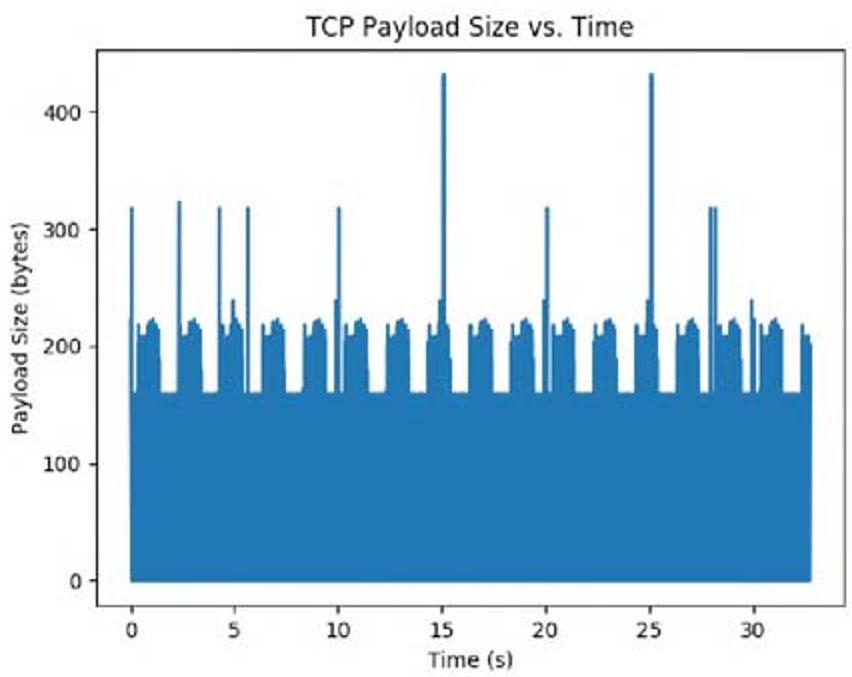 Fig 2: Without traffic shaping, encrypted packet bursts clearly reveal when a 256Hz tone is active vs. silent.
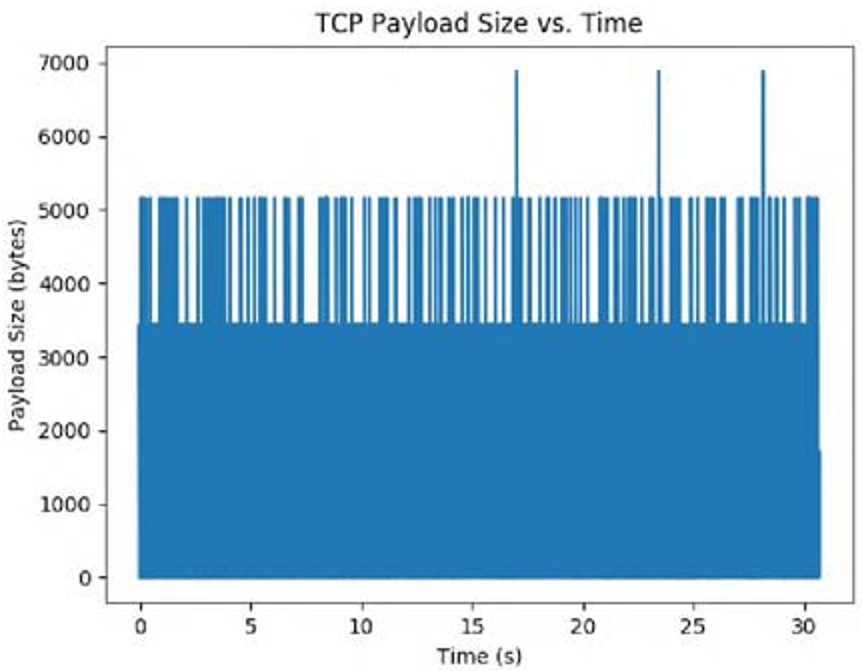 Fig 3: With SocialSDN's VoIP shaping, the encrypted stream is a "flat" constant flow, leaking zero information about the audio content.
Versatility: From VoIP to Docker
The authors demonstrated that SocialSDN isn't just for chat. It can be used to:
- Share localized Web Services: Like
droopyfor file sharing, without exposing the server to the whole internet. - Expose Docker Containers: By bridging a UNIX domain socket to the SocialSDN pipe, a developer can securely share a CouchDB or web app instance with a remote collaborator in seconds.
Critical Insight & Future Outlook
SocialSDN moves the needle by shifting the "Unit of Trust" from a Server/IP to a Social Contact. By integrating with identity platforms like Keybase, it solves the key exchange problem that plagues traditional P2P systems.
Limitations: The current implementation relies on Python and socat, which may introduce overhead for high-bandwidth applications (e.g., 4K video streaming). Future iterations moving these logic blocks into a compiled language or kernel-space (like WireGuard) would be a significant step forward.
The Takeaway: If you want to share a private network resource safely today, you shouldn't need a CCNA certification. SocialSDN proves that namespace isolation and social-based key exchange are the keys to the next generation of privacy tools.