
SocialST: Beyond Linear Trust—Enhancing Recommendation via Social Liveness and Power-Growth Relationships
SocialST: Social Liveness and Trust Enhancement Based Social Recommendation
The paper introduces SocialST, a social recommendation framework that enhances Probabilistic Matrix Factorization (PMF) by incorporating Social Liveness and Power-Growth trust enhancement. It outperforms traditional social recommendation baselines like SoRec and SocialMF on the Epinions and Ciao datasets.
TL;DR
Social recommendation systems often fail because they treat every social connection as equally influential and every user as equally "social." SocialST shatters these assumptions by introducing Social Liveness (how much a user actually cares about friends' opinions) and Trust Enhancement (prioritizing "Besties" over "Acquaintances" via power-growth functions). This approach yields significant accuracy gains (up to 8.5% RMSE improvement) and remains stable even when social data is extremely sparse.
Background: The Flaw in Social Assumptions
Traditional Social Collaborative Filtering (CF) usually follows a simple logic: if you are my friend, I will like what you like. However, in technical terms, most models (like SocialMF or SoRec) rely on two fragile anchors:
- Uniform Influence: They assume an inactive user is just as influenced by their social circle as a social butterfly.
- Linearity: They assume that if I trust Friend A twice as much as Friend B, Friend A's influence is exactly double. In reality, close ties have an exponentially higher impact on our decisions than weak ties.
Methodology: The Core Innovations
1. LivenessRank: Quantifying the "Social Pulse"
The authors argue that social influence should be a variable, not a constant. They designed the LivenessRank algorithm, a PageRank-inspired iterative process that calculates a user's Social Liveness (SL).
- Logic: A user has high liveness if they have many friends, or if their friends are "exclusive" (not shared with everyone else).
- Impact: In the SocialST model, the Social Liveness acts as a precision parameter (). High liveness forces the user's latent feature vector to stay closer to their friends' average, while low liveness allows the rating matrix to dominate.
2. Trust Enhancement: The Power-Growth Relationship
Instead of a linear mapping, SocialST uses a power coefficient : Where . This mathematical shift serves to amplify strong ties and suppress weak ties, mimicking the real-world "long-tail" distribution of human social behavior.
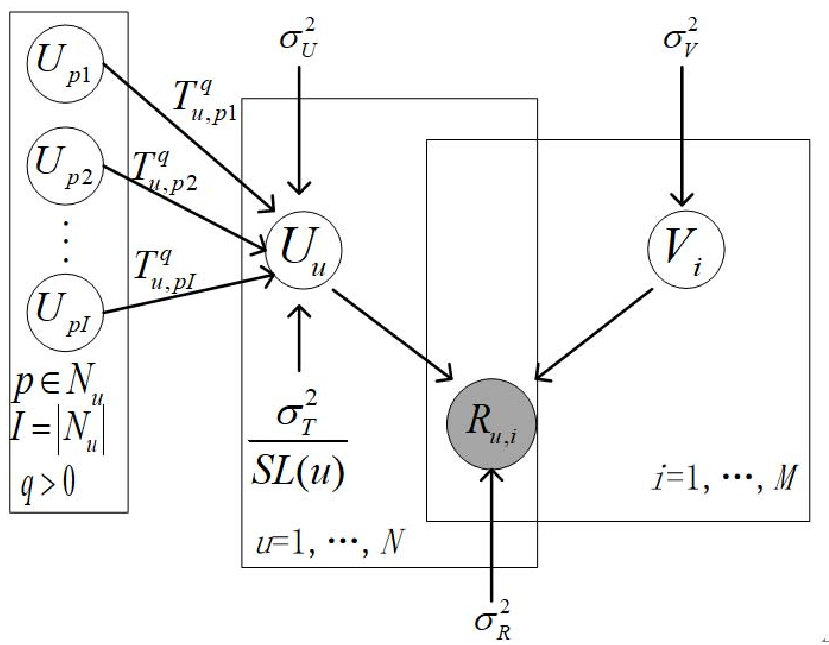 Fig 1: The SocialST Graphical Model. Note the inclusion of SL (Social Liveness) influencing the user latent features.
Experimental Analysis & Results
The model was tested against strong baselines (PMF, SoRec, SocialMF) on Epinions and Ciao.
Superiority over SOTA
As shown in the tables below, SocialST consistently achieves the lowest RMSE (Root Mean Square Error). At a dimension of 10, SocialST hit an RMSE of 0.9715 on Epinions, compared to SocialMF's 1.0415.
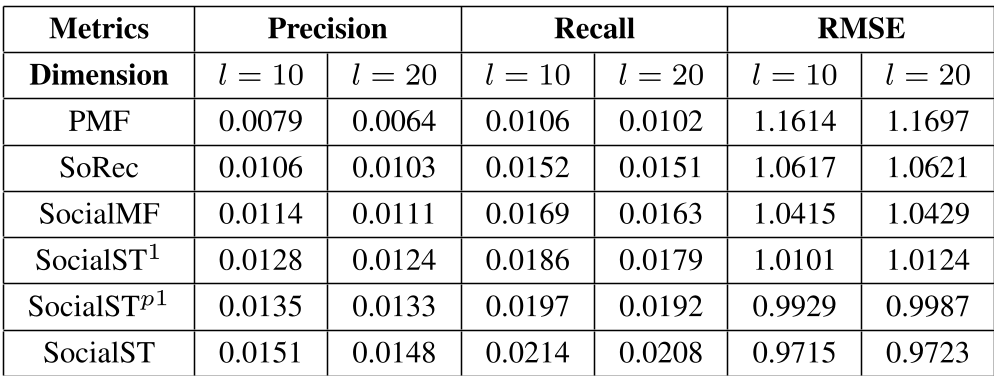 Table 1: Performance on Epinions. Higher Precision/Recall and lower RMSE indicate a better model.
Handling the "Data Desert"
One of the most impressive feats of SocialST is its performance under trust data sparsity. Even when 50% of the trust links are removed, SocialST outperforms the baseline PMF (which uses no social data), whereas SocialMF and SoRec actually perform worse than PMF because they overfit to the sparse, noisy social links.
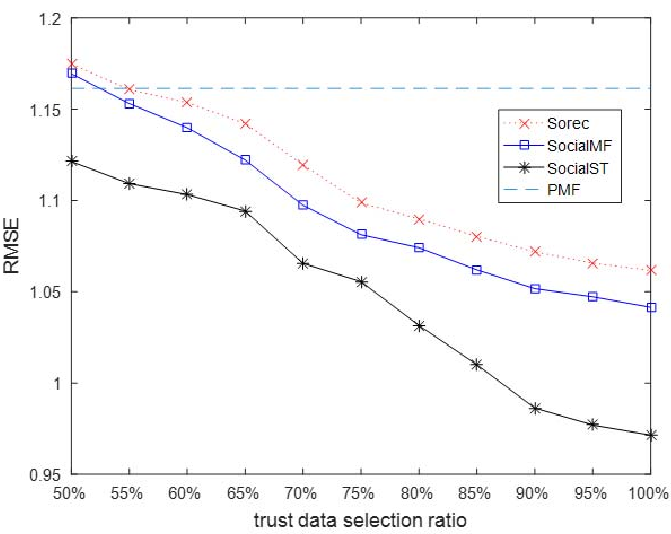 Fig 2: RMSE remained lower for SocialST even as trust data decreased to 50%.
Critical Insight & Future Outlook
SocialST proves that inductive bias matters. By baking the sociological reality of "exclusive close friends" and "varying social activity" into the loss function, the model filters out the noise inherent in modern social networks.
Limitations: Currently, the "Social Liveness" is static. In real applications, a user's liveness changes over time (e.g., being active during a holiday but silent during work months). Future iterations integrating temporal dynamics could lead to even more personalized "Real-time Social Recommendations."
Takeaway: If you're building a social recommender, stop treating every "Follow" or "Friend" as a linear weight. Use power dynamics to focus on the signals that actually drive behavior.