
SocialStory: Transforming Social Media Chaos into Structured Crisis Narratives
SocialStory: a social storyboard system for sharing experiences in emergencies
SocialStory is a social storytelling platform designed to aggregate, filter, and re-arrange multi-source social media content (Facebook, Twitter, YouTube, Flickr) into structured narratives during emergencies. It employs a journalism-inspired "Who, What, Where, When" pattern to transform scattered crisis data into coherent digital storyboards for citizen journalism.
TL;DR
SocialStory is a specialized web platform that empowers users to act as citizen journalists during emergencies. By aggregating fragmented data from sources like Twitter, Flickr, and YouTube, and applying a structured "4W" (Who, What, Where, When) journalism pattern, it enables the creation of cohesive digital storyboards. It moves beyond simple data collection to content synthesis and experiential sharing.
Academic Positioning: This work bridges the gap between Information Extraction (IE) and User Interface (UI) design, focusing specifically on the "re-arrangement" of social media data for crisis informatics—a domain where real-time accuracy and narrative structure are paramount.
Problem & Motivation
During crises, such as the 2007 California wildfires or the 2009 Red River Floods, social media becomes a primary information lifeline. However, the sheer volume and "noise" of Online Social Networks (OSNs) present a paradox: we have more information than ever, but less ability to make sense of it quickly.
The authors identify a critical gap: OSNs are built for publishing, not for archiving or synthesizing. Previous research highlights that while people are eager to report facts, they lack tools to re-use and link these fragments. SocialStory aims to solve this by providing a unified interface that turns raw data into human-readable stories.
Methodology: The "4W" Storytelling Pattern
The core innovation of SocialStory is its use of a Pattern-based Storyboard. Rather than a simple chronological feed, the system forces data into a meaningful structure based on classic journalism principles.
1. Data Aggregation & Filtering
The system pulls from four distinct APIs:
- Flickr: Visual data categorized as POIs on maps.
- YouTube: Video content with preview functionality.
- Twitter/Facebook: Textual feeds presented as lists.
2. The Re-arrangement Engine
Users engage in a two-step process:
- Linear Selection: Drag-and-drop relevant material from the global feed to a personal workspace.
- Structured Synthesis: Mapping items to the Who, What, Where, and When segments.
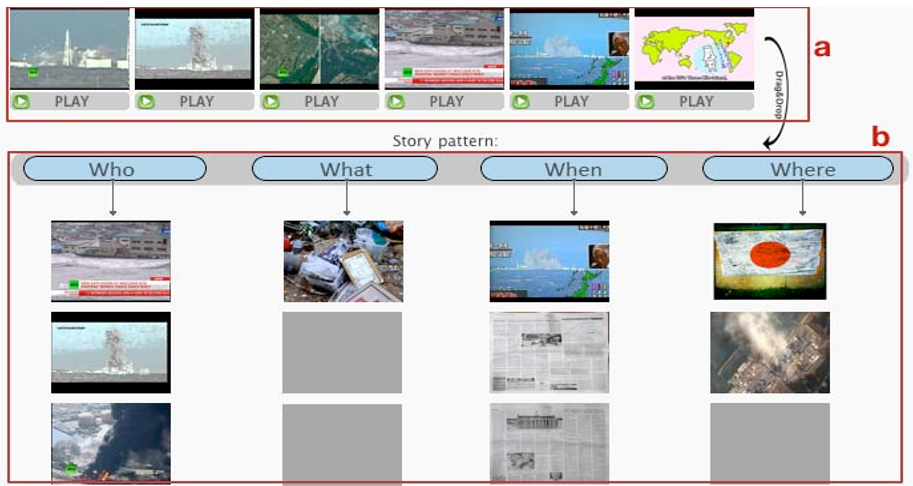 Figure 1: Transitioning from raw Internet material (a) to a pattern-based storyboard (b).
3. Automated Text Mining
To handle the high volume of text, SocialStory employs Pointwise Mutual Information (PMI) based on linguistic patterns. This allows the system to analyze sentiment and semantic orientation, automatically suggesting which part of the "4W" pattern a tweet or post belongs to, reducing the cognitive load on the user.
Experiments & Results: The Tohoku Earthquake Case Study
The authors validated the system using data from the 2011 Tōhoku earthquake. The system demonstrated that ordinary citizens could curate professional-grade reports by merging video of the tsunami (YouTube), photos of the damage (Flickr), and real-time community reactions (Twitter).
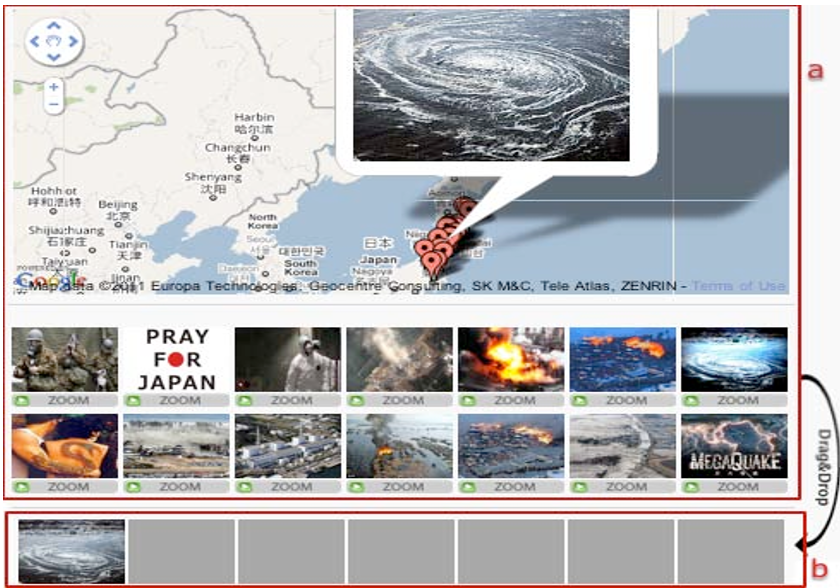 Figure 2: Example of a final story layout, resembling a digital magazine that integrates text, video, and imagery.
Key Findings:
- Natural Interaction: The 4W pattern was found to be intuitive for users without formal journalism training.
- Multimodal Integration: The ability to display geo-referenced images alongside textual opinions significantly improved situational awareness compared to viewing a single platform's feed.
Critical Analysis & Conclusion
SocialStory represents an early but significant step toward Collaborative Crisis Management. By focusing on "Information Re-arrangement," the authors correctly identify that the bottleneck in emergency response isn't a lack of data, but a lack of structure.
Limitations
- Verification: The system assumes the extracted material is truthful, leaving it vulnerable to misinformation (a major issue in modern OSNs).
- Scalability of Manual Selection: While drag-and-drop is intuitive, in the "Golden Hour" of a crisis, the volume of data might still overwhelm manual curators.
Future Outlook
With the rise of Large Language Models (LLMs), the "PMI-based" linguistic analysis used here could be replaced by generative AI to automatically summarize thousands of tweets into a narrative structure, while maintaining the human-in-the-loop storyboard interface for final verification.