
SocialTrust: Engineering Honesty in Social Commerce via Adaptive Incentives
SocialTrust: Adaptive Trust Oriented Incentive Mechanism for Social Commerce
SocialTrust is an adaptive incentive mechanism for social commerce that ensures opinion integrity by combining a Self-Adaptive Credibility Threshold Adjustment Mechanism (SACTAM) with a Borda count-based voting system. It effectively promotes user honesty and achieves SOTA performance in filtering malicious advisers while solving the newcomer "bootstrapping" problem via a broker-based reward system.
Executive Summary
TL;DR: SocialTrust is a dual-layered incentive framework designed to purge untruthful opinions from social commerce platforms. It introduces an adaptive "honesty barometer" that scales with market health and a prestige-based voting system that rewards truthful advisers with "Broker" status and economic perks.
In the academic landscape of Multi-Agent Systems (MAS), this work sits at the intersection of reputation systems and mechanism design, moving beyond static trust metrics to a dynamic, self-evolving governance model.
Problem & Motivation: The Fragility of Online Trust
The "Social" in Social Commerce is a double-edged sword. While buyers trust peer recommendations more than corporate ads, this trust creates a lucrative bait for malicious actors. Existing solutions usually rely on fixed thresholds—if an adviser's credibility is below 0.5, ignore them.
The authors' core insight is that a fixed threshold is a categorical error. In a highly volatile or "sick" market where scams are rampant, the threshold for trust must be strictly elevated. Conversely, in a healthy market, a slightly lower threshold might capture diverse, valuable niche opinions. Static systems suffer from high Information Asymmetry because they can't distinguish between a minor reporting error and a coordinated "badmouthing" attack.
Methodology: The SocialTrust Architecture
SocialTrust operates through a centralized oversight entity that manages two decentralized processes.
1. SACTAM (The Adaptive Brain)
Instead of a human setting the rules, the central server monitors Market Liquidity (Mliq) and Buyer Satisfaction. It calculates a performance metric —the harmonic mean of transaction success and volume.
- Logic: If market quality drops, the system broadens the threshold , forcing buyers to be more selective about whom they listen to.
2. The Voting & Broker Mechanism
This is the "stick and carrot" of the system.
- The Carrot: Top-voted advisers become Brokers. They gain social status and can charge newcomers a fee (10% of profit) for their expert reputation data.
- The Stick: Malicious users are publicly identified and "blacklisted," losing their ability to influence others or access high-quality feedback.
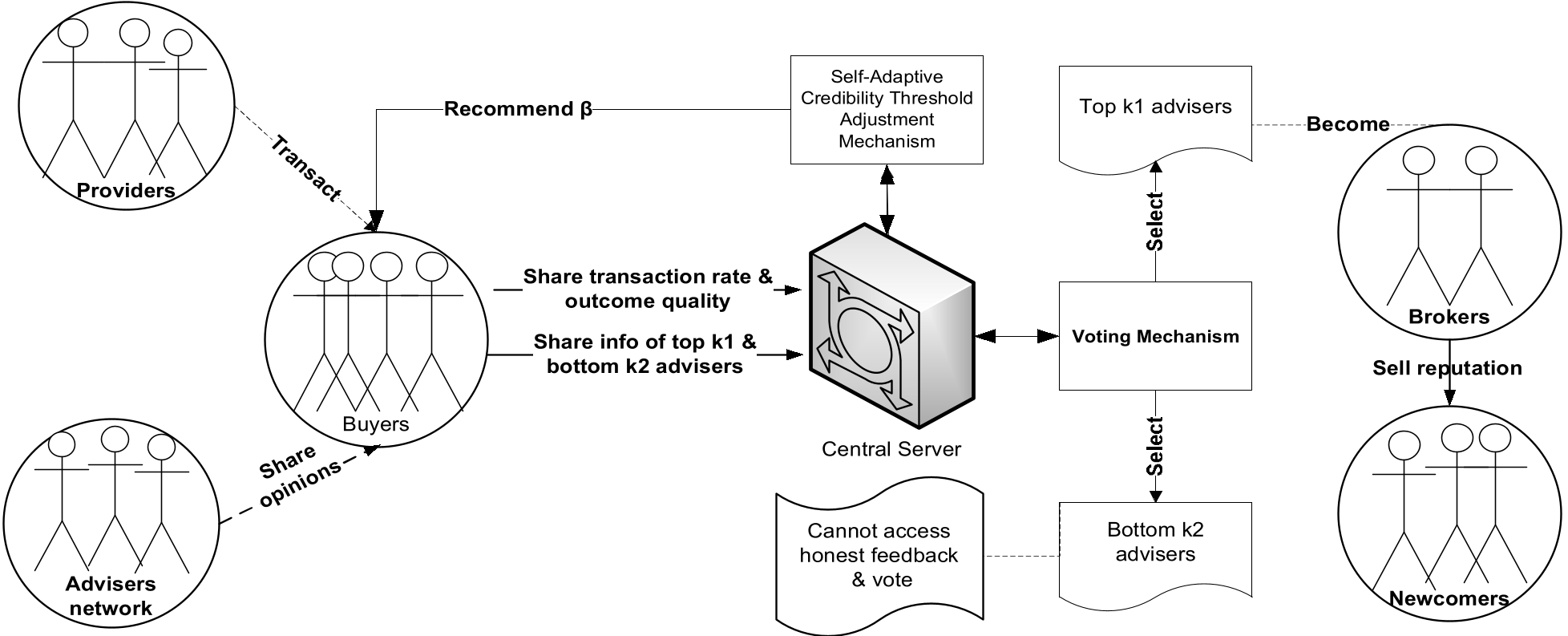 Fig 1: The SocialTrust workflow showing the feedback loop between buyers, brokers, and the central SACTAM server.
Experiments & Results: Proving Efficacy
The researchers simulated a 22-day marketplace with a 50/50 split of honest and dishonest agents.
Breaking the "Fixed Threshold" Paradigm
The most striking result is found in the Precision of Adviser Classification. As shown in the charts, the adaptive (calculated via SACTAM) allows honest buyers to almost perfectly identify and ignore malicious advisers over time, whereas the fixed-threshold baseline stagnates, leaving buyers vulnerable to "smart cheaters."
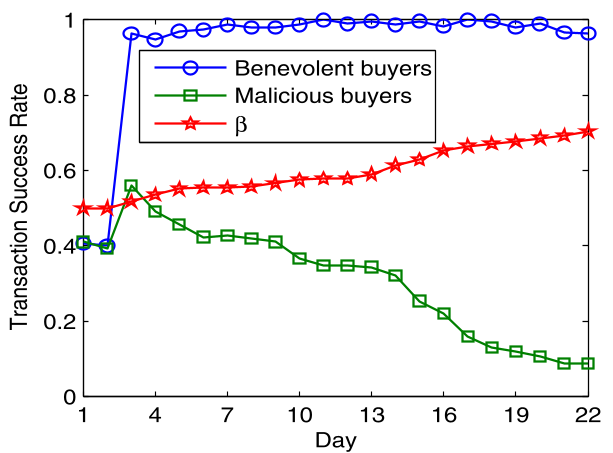 Fig 2: Accuracy of Buyers in Classifying Advisers. Note how the Adaptive approach (SocialTrust) trends toward 1.0 accuracy.
The Newcomer Advantage
One of the hardest problems in e-commerce is the Bootstrapping Phase—how does a new user make a safe purchase without a social network? By enabling Brokers to sell "trust as a service," SocialTrust allows newcomers to achieve high transaction success rates from Day 1, effectively bypassing the risky "trial and error" phase.
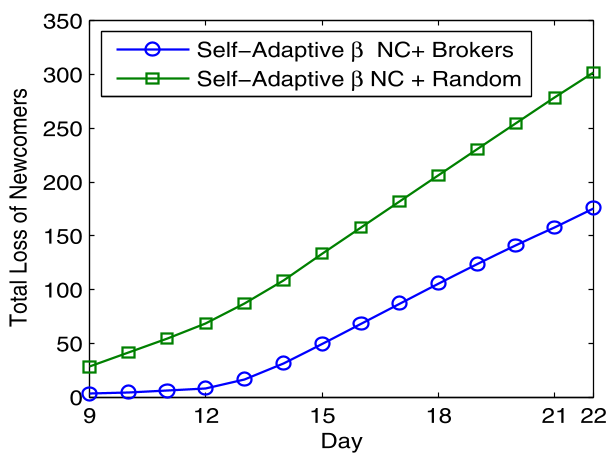 Fig 3: Profit comparison for newcomers. Those utilizing Brokers significantly outperform those relying on random selection.
Deep Insight & Conclusion
Takeaway
SocialTrust proves that trust is not a static property; it is a dynamic resource that requires active management. By introducing the "Broker" role, the paper successfully monetizes honesty, making it more profitable to be truthful than to be a "smart cheater."
Limitations & Future Work
The current model assumes a mostly cooperative central server. In a truly decentralized Web3 context, the role of the "server" would need to be replaced by a DAO (Decentralized Autonomous Organization) or a smart contract to prevent a single point of failure or corruption. Future research could explore how these adaptive thresholds respond to "shilling attacks" where malicious actors slowly build credibility before a massive exit scam.
Final Thought: SocialTrust provides a robust blueprint for the next generation of social commerce platforms where reputation is not just a star rating, but a fluid, incentivized currency.