
Ultimate Ecology: How Social Games and Biology Forge Resilient Ecosystems
How a Socio-Economic Game Can Evolve into a Resilient Ecosystem of Agents
The paper introduces "Ultimate Ecology," an agent-based model that integrates the Ultimatum Game (UG) into a self-regulating ecosystem. By combining socio-economic interactions with biological evolution (reproduction and mutation), the authors demonstrate the emergence of a stable, homeostatic society that responds resiliently to environmental perturbations.
TL;DR
"Ultimate Ecology" is a breakthrough model that places the famous Ultimatum Game into a living, breathing ecosystem. By linking an agent’s ability to survive and reproduce directly to their "energy" harvested through social cooperation, the researchers observed the spontaneous emergence of homeostatic stability and professional reproductive strategies (r/K selection) that mirror biological reality.
Problem & Motivation: Beyond Static Game Theory
For decades, Evolutionary Game Theory (EGT) has used games like the Ultimatum Game to explain why humans and animals cooperate. However, most models are "sterile": they use top-down fitness functions where the best players simply replicate.
In the real world, biology doesn't work that way. Agents have metabolic costs, they move through space, and they compete for finite, regenerating resources. The authors argue that we cannot understand Social Norms without understanding Ecological Dynamics. The "Ultimate Ecology" model seeks to bridge this gap by asking: Can a population survive if their only way to get food is a game of "fairness"?
Methodology: The Core Mechanics
The model uses an agent-based approach (NetLogo) where space is divided into patches with a constant energy influx (simulating sunlight).
1. The Horizontal Interaction (The Game)
To "harvest" energy from a patch, two agents must agree to share it. They play an Ultimatum Game:
- Proposer (): Decides how much to keep.
- Responder (): Decides the minimum they will accept.
- Failure: If the offer is too low, the energy is lost to both.
2. The Vertical Interaction (Evolution)
Unlike traditional models, reproduction only happens when an agent accumulates enough energy (Threshold ).
- Offspring Count (): How many children to have.
- Resource Inheritance (): What percentage of current energy to give to the children.
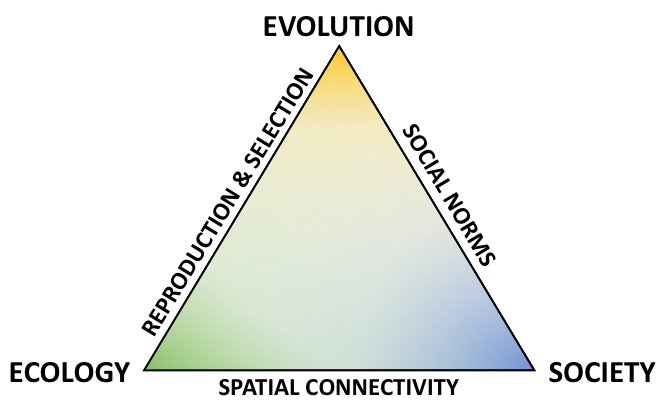 Fig 1. The fundamental feedback loop between Ecology, Evolution, and Society.
Experiments & Results: Emergent Strategies
Ecological Resilience
The system demonstrated a remarkable "carrying capacity." Even when the researchers slashed the energy influx by 66%, the population self-regulated and found a new equilibrium without going extinct. This proves that the Ultimatum Game can serve as a robust biological engine for population control.
The Birth of Fairness
The most striking finding was how the Reproduction Threshold () dictated social behavior:
- High (High Cost of Entry): Agents evolved to be fairer (). Because survival depended on long-term accumulation, risky "greedy" behavior was evolutionary suicide.
- Low (Easy Entry): Agents were more "rational" (greedy). They could afford to fail occasionally because reproduction was cheap.
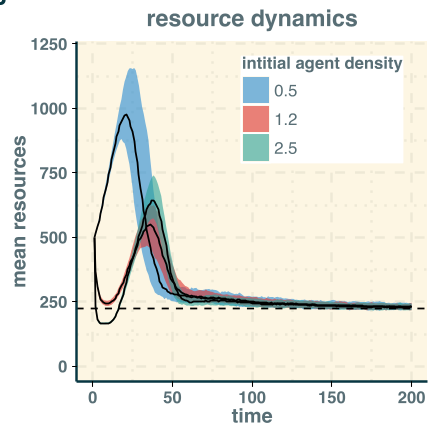 Fig 2. Population and Resource recovery after environmental shocks (Pertubations).
r/K Selection Emergence
The model naturally produced the two classic biological strategies:
- r-strategists: Many offspring, low individual investment. Emerged when birth was "cheap."
- K-strategists: Fewer offspring, high resource inheritance. Emerged when the environment was competitive and the cost of reproduction was high.
Critical Analysis & Conclusion: Why It Matters
This work demonstrates that Socio-Economic norms are not arbitrary; they are rooted in the physical and energetic constraints of the environment.
Takeaway: If you want to evolve a cooperative AI swarm, don't just reward "winning"—force the agents to manage a "metabolism" and "offspring" in a resource-limited world.
Limitations: The current model assumes a well-mixed population (random movement). Future iterations considering spatial clustering or "reputation" (knowing who is greedy before playing) would likely see even higher levels of cooperation, as seen in real-world human societies.
Future Outlook: The inclusion of migration and heterogeneous environments (seasons/terrain) could turn this model into a powerful simulator for cultural evolution and even the design of resilient decentralized robotic systems.