
Socio-Monetary Lures: Why Hybrid Incentives Rule the OSN Malware Jungle
The socio-monetary incentives of online social network malware campaigns
This paper investigates the efficacy of psychological incentives in Facebook malware campaigns (socware). By analyzing 3.5 million accounts, the authors compare pure social, pure monetary, and combined socio-monetary incentives, discovering that while social incentives are most common, socio-monetary combinations are significantly more effective at infecting users and sustaining campaigns.
TL;DR
Why do we click on suspicious links? Researchers analyzed 3.5 million Facebook accounts and found that while most malware uses social curiosity (the "social" lure), the real heavy hitters are hybrid "socio-monetary" campaigns. These combinations—like a friend challenging you to a game to win an iPad—last 136% longer and infect double the users. The secret lies in a biological survival strategy: flexibility over virulence.
Background: The Evolution of Digital Pathogens
Since von Neumann first conceptualized self-reproducing programs, we have viewed malware through a biological lens. However, Online Social Network (OSN) malware, or "socware," adds a layer of complexity: it requires a human host to choose to propagate it. The infection isn't just a code execution; it’s a psychological hack.
Current defenses often rely on keyword spotting or technical blacklists. This paper shifts the focus to the Incentive, the "Why" behind the click.
The Problem: The Specialist's Paradox
Malware developers face a dilemma. If they create a highly specialized lure (e.g., "Check who deleted you"), they gain high virulence among socially insecure users but fail to reach those motivated by profit. Conversely, a pure monetary lure ("Free iPhone") might be ignored by those who find it "spammy."
The researchers hypothesized that the most successful campaigns are those that can navigate a "mixed gene pool" of user psychological susceptibilities.
Methodology: Crowdsourcing the Taxonomy of Greed and Curiosity
The team leveraged MyPageKeeper, a tool that monitors Facebook news feeds, to identify 164,304 malicious posts. To understand the intent of these posts, they didn't just use AI; they recruited 226 humans on Amazon Mechanical Turk to classify the psychological triggers into a hierarchical taxonomy.
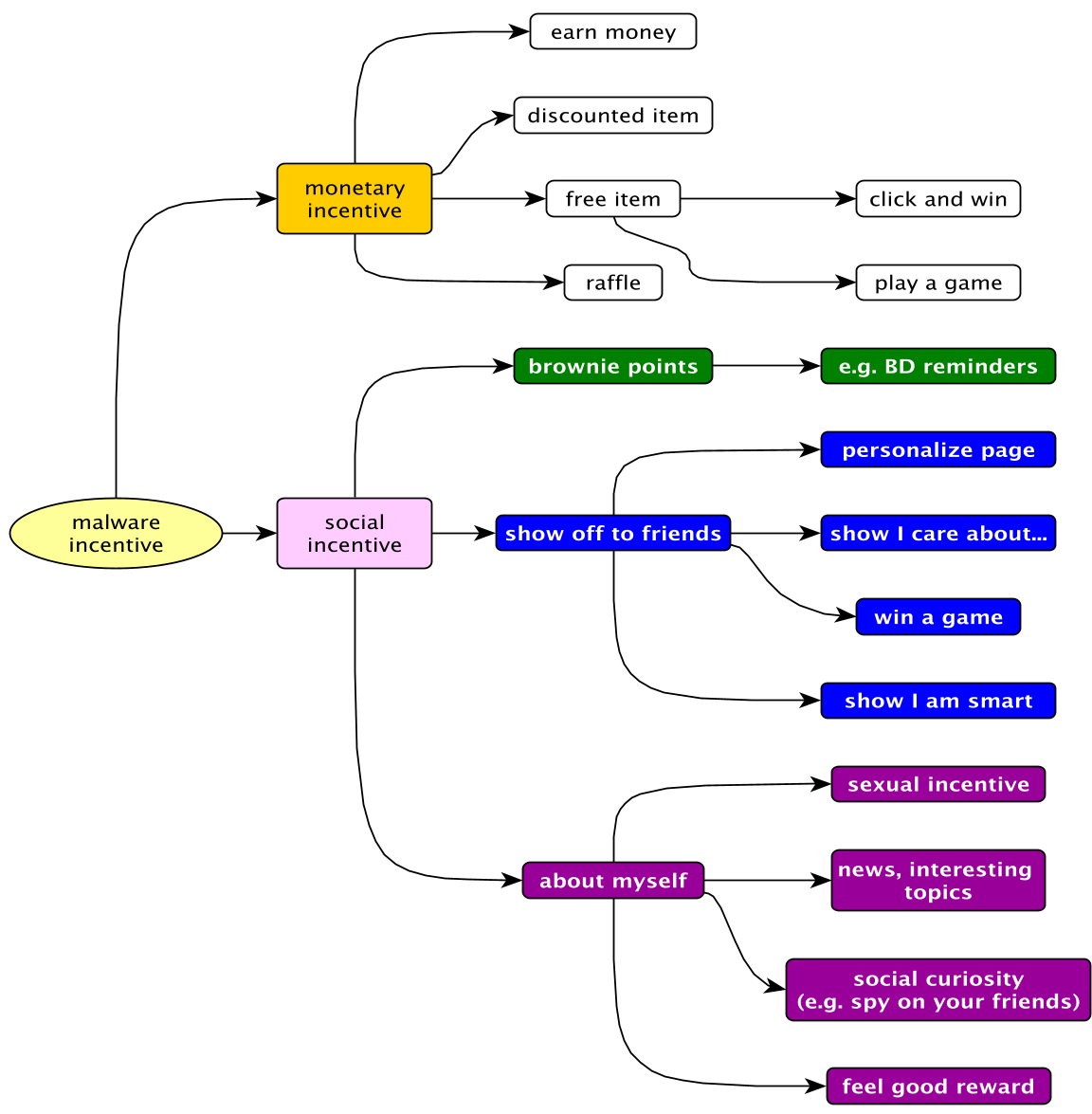
They categorized incentives into:
- Social: Curiosity, status, altruism (e.g., "See who viewed your profile").
- Monetary: Direct gains, discounts, prizes (e.g., "Win a Kindle").
- Socio-Monetary: A blend (e.g., a friend's game challenge with a prize).
Core Insight: The Percolation Effect
The most striking finding is that Socio-monetary campaigns are stochastically dominant. They don't just happen to do well; they consistently outperform pure incentives in both lifespan and reach.
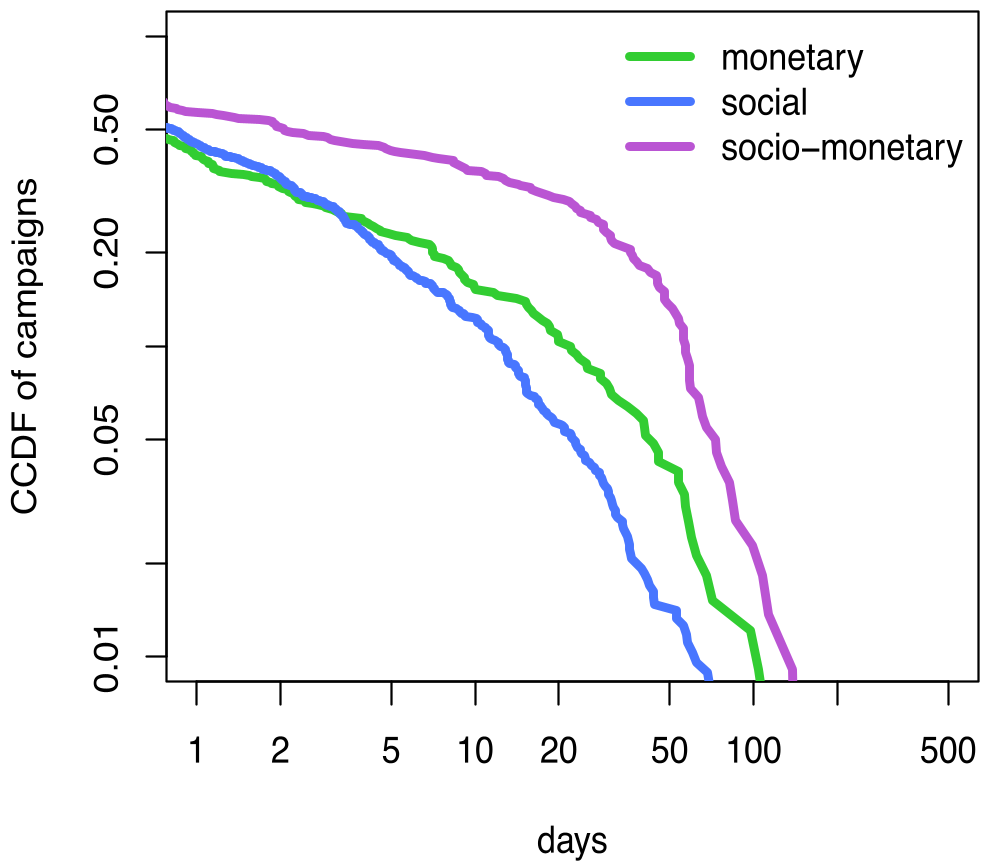
Why does this happen?
The authors point to a phenomenon in biological pathogens known as Percolation. In plant pathology, a single-strain crop (monoculture) is easily wiped out by a specialized pathogen (like the Great Famine of Ireland). Farmers now use mixed-strain crops to stop infection spread.
In the digital world, USERS are the mixed-strain crop. Some are "immune" to money lures but "susceptible" to social lures. A socio-monetary campaign acts as a flexible pathogen. It might not be as "infectious" to a single group as a specialized lure (lower virulence), but because it can traverse any user type, it finds more paths through the social graph.
Simulations: Flexibility Wins
To prove this, the authors ran SIR simulations on real trust networks (Enron and Epinions). They assigned users "preferences" (60% monetary, 40% social) and tested campaigns.
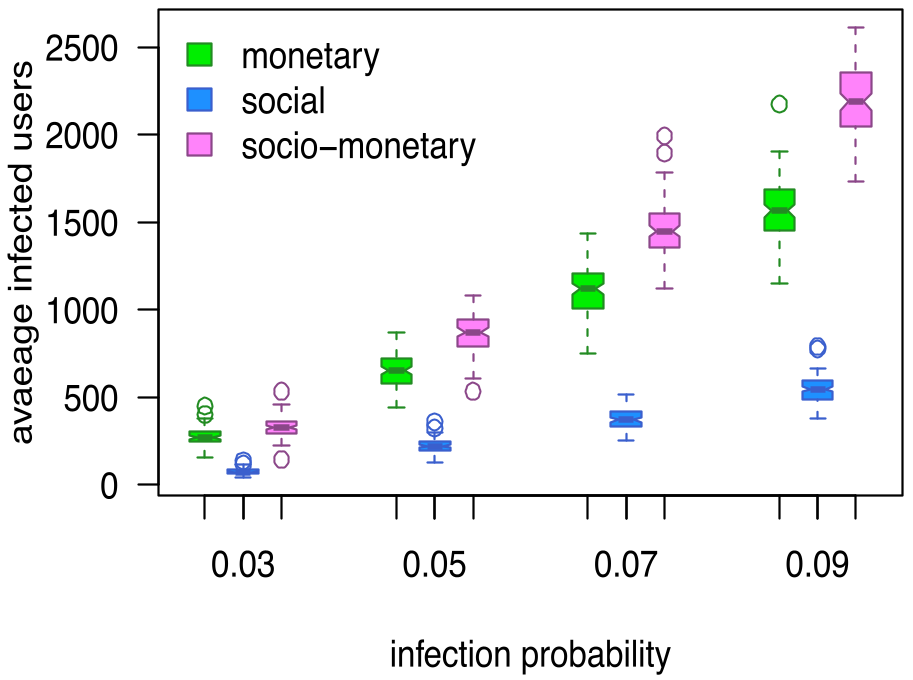
The results were clear: Even if a hybrid campaign has half the infection probability of a specialized one, it still generates larger cascades. The "path of least resistance" across the network is more important than the "strength" of the lure itself.
Critical Analysis & Future Outlook
Takeaway
For defenders, this study is a wake-up call. Social networks are not just a collection of computers; they are a collection of psychological profiles. Malware exploits the Social Capital of hijacked accounts to bypass our natural skepticism.
Limitations
- Data Aging: The data is from 2011-2012. While the psychological triggers (greed, curiosity) remain the same, UI changes and modern AI-driven spear-phishing likely use even more sophisticated blends.
- Classification Bias: Using Mechanical Turk for classification assumes that "turker" psychology reflects general OSN users.
The Path Ahead
Future research should investigate if modern Large Language Models (LLMs) are being used to "optimize" these socio-monetary blends in real-time. If malware can dynamically adjust its incentive based on a user's profile, the "percolation" will become near-perfect, making these campaigns nearly impossible to stop without deep behavioral analysis.
Academic Significance: This work bridges social psychology with network topology, proving that the diversity of a social network acts as its greatest defense—and that malware is evolving to overcome that defense through flexibility.