
Socio-Sentic Governance: Bridging the Gap Between Agriculture Policy and Public Sentiment
Socio-Sentic framework for sustainable agricultural governance
This paper introduces the Socio-Sentic framework, an intelligent analytic system designed for sustainable agricultural governance by mining public opinion from Twitter. Using the 'Pradhan Mantri Fasal Bima Yojana' (PMFBY) as a case study, it demonstrates how supervised machine learning can evaluate governmental policy acceptance, achieving a peak accuracy of 93.25% with SVM.
TL;DR
Sustainable agriculture is no longer just about crop yields; it is about accountable governance. This paper proposes the Socio-Sentic framework, an intelligent system that mines Twitter data to evaluate the "Pradhan Mantri Fasal Bima Yojana" (PMFBY) insurance scheme. By leveraging supervised machine learning—specifically SVM, which achieved 93.25% accuracy—the framework provides a real-time barometer for policy acceptance and government accountability.
Background Positioning: From E-Governance to S-Governance
In the landscape of modern administration, we are shifting from simple E-governance (digitizing services) to S-governance (socially-aware governance). This paper addresses the critical need for a feedback loop in agricultural policy-making. Agriculture contributes ~15% to India's GDP and supports 60% of its population; thus, the "human element" of these policies is a vital metric for sustainability.
Problem & Motivation: The Accountability Blind Spot
The authors argue that "Good Governance" according to the UNDP requires Responsiveness and Consensus Orientation. However, policymakers often operate in a vacuum. Why Twitter? Because it offers an unparalleled, low-cost, real-time platform to extract public sentiment. The challenge lies in turning unstructured, noisy tweets into a structured measure of policy success.
Methodology: The Socio-Sentic Architecture
The framework is built on two pillars:
- Socio: Utilizing the social web as a data source.
- Sentic: Exploiting natural language features for sentiment orientation.
The authors implemented a classic but robust Opinion Mining Pipeline:
- Data Collection: 1,008 tweets collected using hashtags like #PMFBY over two distinct phases (unveiling vs. launching).
- Pre-processing: Stemming and cleaning were used to isolate high-value attributes like premiums, rabi, drought, and welfare.
- Supervised Classifiers: Comparing Naive Bayes, SVM, MLP, kNN, and Decision Trees.
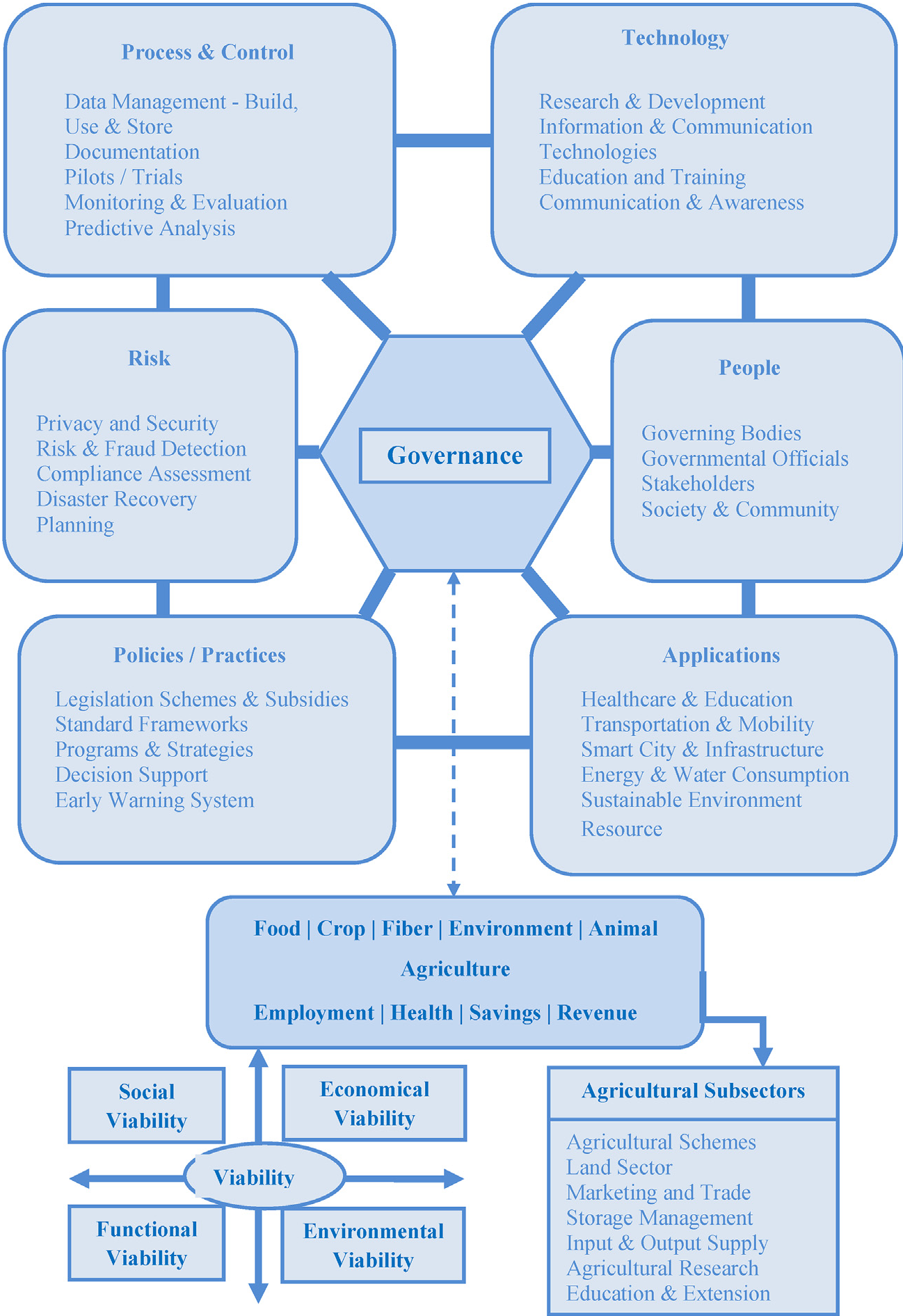 The model above illustrates the interconnection between governance modules and agricultural components.
Experiments & Results: SVM Dominance
The study compared five algorithms using Precision, Recall, and Accuracy.
| Technique | Accuracy | Precision | Recall |
|---|---|---|---|
| SVM | 93.25% | 90.78% | 97.70% |
| MLP | 92.46% | 90.97% | 97.70% |
| kNN | 90.87% | 89.74% | 92.36% |
| Naive Bayes | 68.65% | 89.47% | 53.43% |
The results clearly show that SVM provides the most crisp classification for this specific domain. Interestingly, the data revealed that only 2% of sentiments were negative, while a large portion (47%) were neutral—mostly informational updates from government bodies or media outlets.
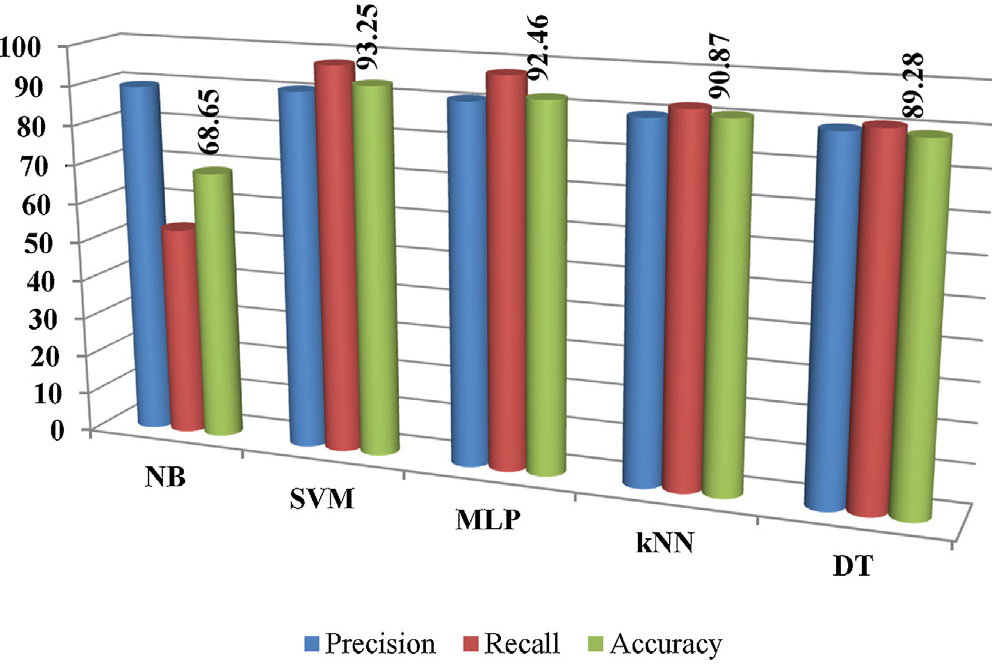 The bar chart highlights SVM's superiority in handling the high-dimensional feature space of tweet data.
Deep Insight & Conclusion
Takeaway
The Socio-Sentic framework proves that government intelligence can be successfully "crowdsourced" from social media. It transforms qualitative public chatter into quantitative metrics that define a policy's "social responsibility score."
Limitations & Future Work
While supervised learning is effective, the reliance on manual labeling for training data is a bottleneck. The authors suggest moving toward Ontology-based (concept-based) techniques to enable more granular classification (e.g., separating "complaints" from "general feedback"). Furthermore, shifting to Transformer-based models (like BERT) would likely handle the sarcasm and linguistic nuances of Indian English tweets even more effectively.
Final Thought
By treating citizen feedback as a primary data point for policy evaluation, this framework paves the way for a more democratic and sustainable agricultural future.