
Technologies of Cooperation: Re-engineering the Social Fabric of 4G
A Socio-Technical Framework for Robust 4G
The paper introduces a socio-technical framework called "Technologies of Cooperation" to guide the development of 4G wireless networks. It synthesizes historical social evolution with modern concepts like Reed’s Law to propose eight categories of cooperative systems (e.g., mesh networks, social software, knowledge collectives) that enable large-scale collective action.
TL;DR
The shift to 4G isn't just a hardware upgrade; it's a social evolution. This paper argues that by understanding historical cooperation—from hunter-gatherers to open-source software—we can design networks that leverage "Group Forming Networks" (GFNs). By moving away from centralized control toward open platforms, we unlock exponential value (Reed’s Law) and solve complex collective action problems.
Contextual Positioning
Written by pioneers at the Institute for the Future, including Howard Rheingold, this work serves as a foundational socio-technical manifesto. It bridges the gap between game theory (the prisoner's dilemma), economics (common-pool resources), and telecommunications. It effectively predicts the "Smart Mob" phenomenon and the rise of platform-based economies.
The Core Insight: Why Cooperation Trumps Control
The authors argue that throughput and bandwidth are secondary to technologies of cooperation. Historically, communication media grew from helping hunter-gatherers share protein to helping empires manage grain via writing.
The pivot point is the transition from Metcalfe’s Law () to Reed’s Law (). While Metcalfe captures the value of one-to-one connections, Reed identifies that the real "hockey stick" growth comes from the ability of users to form subgroups. If a network doesn't support easy group formation, it remains a linear utility rather than a thriving ecology.
Methodology: The Seven Levers of Cooperation
The framework breaks down cooperative systems into eight technology clusters—ranging from Self-Organizing Mesh Networks to Social Accounting Systems—and analyzes them through seven "tuning levers":
- Structure: Moving from static hierarchies to dynamic, emergent P2P networks.
- Rules: Shifting from coercive laws to locally determined, informal norms (e.g., "let the code decide" in Open Source).
- Resources: Treating spectrum and knowledge not as rivalrous private property, but as managed commons.
- Thresholds: Lowering the barrier to participation while raising the cost of "defection" or damage.
 Figure 1: The historical trajectory of human cooperation through communication media.
Analysis of Key Clusters
1. Smart Mobs & Social Mobile Computing
The paper highlights the convergence of mobile communication, social networking, and aware physical environments. The "Smart Mob" is the first-order ripple of this convergence, where text-messaging organizes political revolutions or urban games.
2. Social Accounting & Trust
How do you cooperate with strangers? Through Social Accounting Systems (e.g., eBay’s rating system, Amazon’s recommendations). Reputation acts as the "lubrication" for global commerce, effectively externalizing shared memory to reduce transaction risks.
3. Peer Production (The Third Alternative)
Referencing Yochai Benkler, the authors identify a "third mode of production" that is neither the firm nor the market. Open-source software like Linux proves that ad-hoc networks of individuals, motivated by diverse social signals rather than price, can outperform centralized corporations.
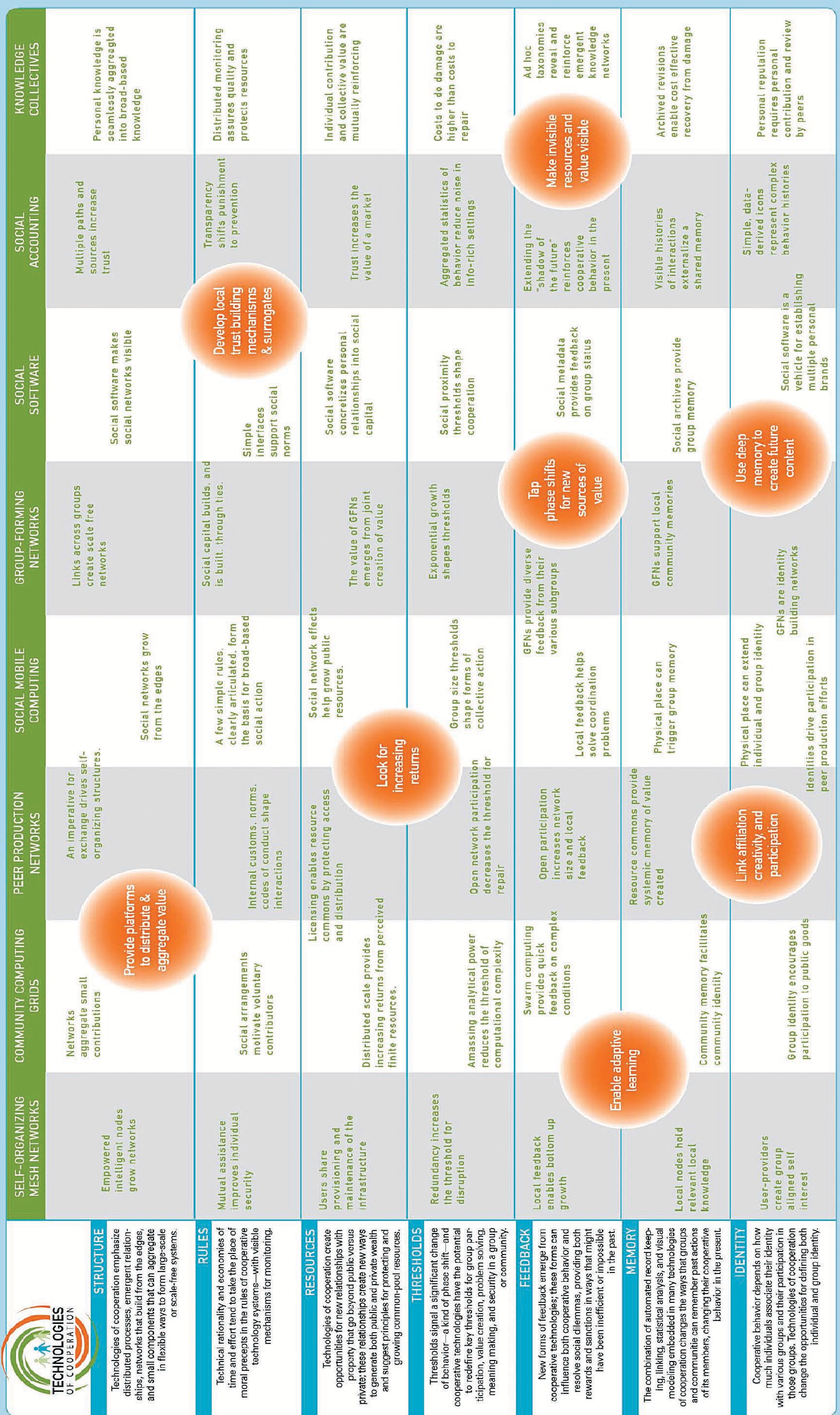 Table 1: Strategic dimensions for adjusting cooperative behavior across different technology clusters.
Critical Analysis & Conclusion
Takeaways for 4G/5G Architects
- Platforms over Systems: Don't design a rigid service; design a platform that allows users to build their own tools.
- Untapped Resources: Look for wasted capacity (like idle CPU cycles or unused mesh nodes) and create incentives to pool them.
- Identity is Participatory: Any tool that restricts identity expression or centralizes control over personal metadata will face "churn" and lack of loyalty.
Limitations
The paper is highly optimistic about the pro-social nature of these "mobs." While it acknowledges the potential for disruption, it perhaps underemphasizes the "dark side" of smart mobs (e.g., coordinate harassment or misinformation swarms) that we see in the contemporary social media landscape.
Future Outlook
As we move deeper into pervasive computing and IoT, the "societies of cognitively cooperating devices" (Mesh Networks) mentioned here are becoming reality. The challenge remains: can we build technical infrastructures that respect the delicate social protocols required to sustain the "Commons"?