
Beyond the Code: Why Social Bonds Trump Tech in Knowledge Sharing
A socio-technical approach to knowledge contribution behavior: An empirical investigation of social networking sites users
This study investigates the drivers of knowledge contribution behavior on Social Networking Sites (SNS) using a socio-technical approach. By analyzing 211 SNS users through Partial Least Squares (PLS) modeling, the paper identifies social system factors (ethical culture, social ties, sense of belonging) as primary predictors of user-created content (UCC).
TL;DR
What makes people share their knowledge online? Is it the security of the platform or the strength of their friendships? This empirical study by Chai and Kim reveals a surprising truth: in the world of Social Networking Sites (SNS), social systems—specifically social ties and a sense of belonging—are the real engines of knowledge contribution, while technical safeguards (structural assurance) have a negligible impact on a user's willingness to share.
The Socio-Technical Perspective: A Forgotten Balance
In the early days of IT management, organizations fell into the "technology trap"—assuming that if you build a robust database, people will naturally fill it with wisdom. This paper revisits Socio-Technical Systems (STS) Theory, which argues that any organization (or platform) consists of two interdependent subsystems:
- The Social System: The people, their ethical norms, and their relationships.
- The Technical System: The tools, tasks, and infrastructures.
The authors argue that for Knowledge Management to work on SNS, these two must be optimized together. However, their research specifically sought to find which side of the scale carries more weight for the modern user.
Methodology: Mapping the User's Mind
The researchers proposed a model where Ethical Culture, Social Ties, and a Sense of Belonging act as social triggers, while Structural Assurance (the legal and technical safety of the platform) acts as the technical trigger.
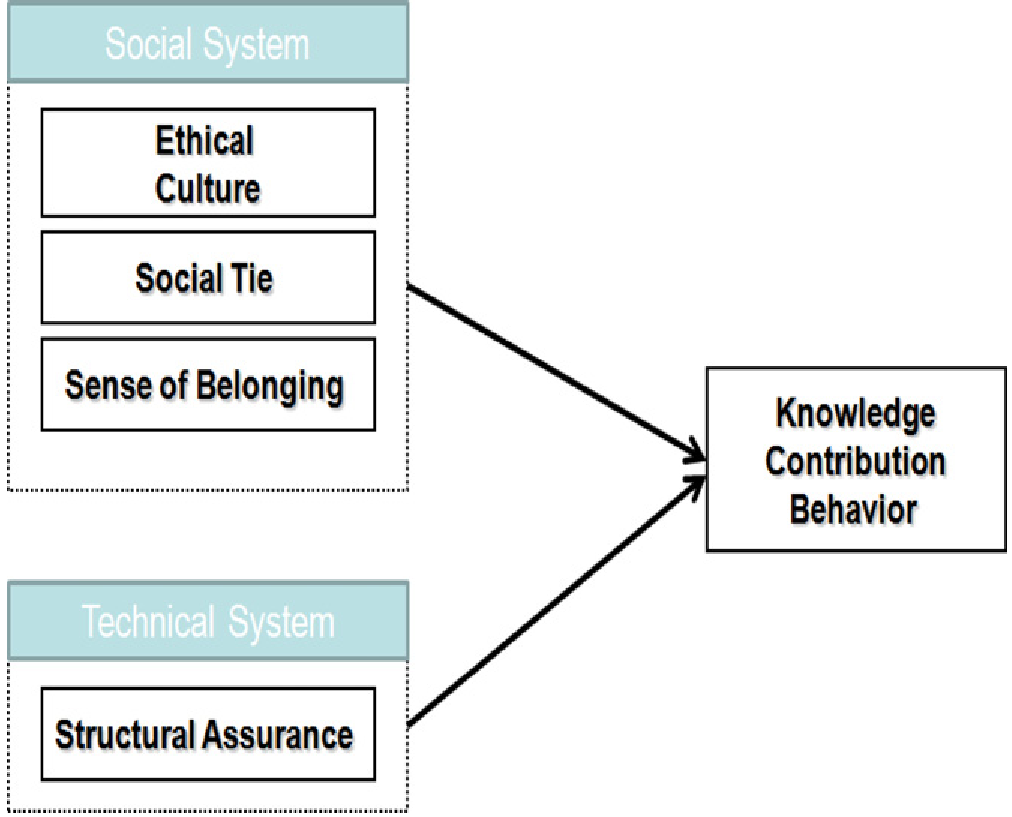
Using a survey of 211 active SNS users and analyzing the data via Partial Least Squares (PLS), they tested how these factors influenced "Knowledge Contribution Behavior" (KCB)—defined as the frequency of posting feedback, sharing experiences, and uploading useful documents.
Key Insights: Social Gravity
The results provide a clear hierarchy of influence:
1. The Power of "Belonging" and "Ties"
Social ties proved to be a massive predictor of behavior. When users spend time interacting and getting to know others on a personal level (Social Ties, β=0.369), they feel a much stronger obligation and desire to share. This, in turn, fuels a Sense of Belonging (β=0.600), which acts as a secondary catalyst for contribution.
2. Ethical Culture as bedrock
The study found that an "Ethical Culture"—the shared norm that users should be truthful and respect sources—significantly influences both the sense of belonging and the behavior itself. If a community feels "right" and respectful, users are more likely to invest their intellectual capital there.
3. The "Technical Indifference" Paradox
Perhaps the most striking finding: Structural Assurance of the SNS and the Internet had no significant relationship with knowledge sharing.
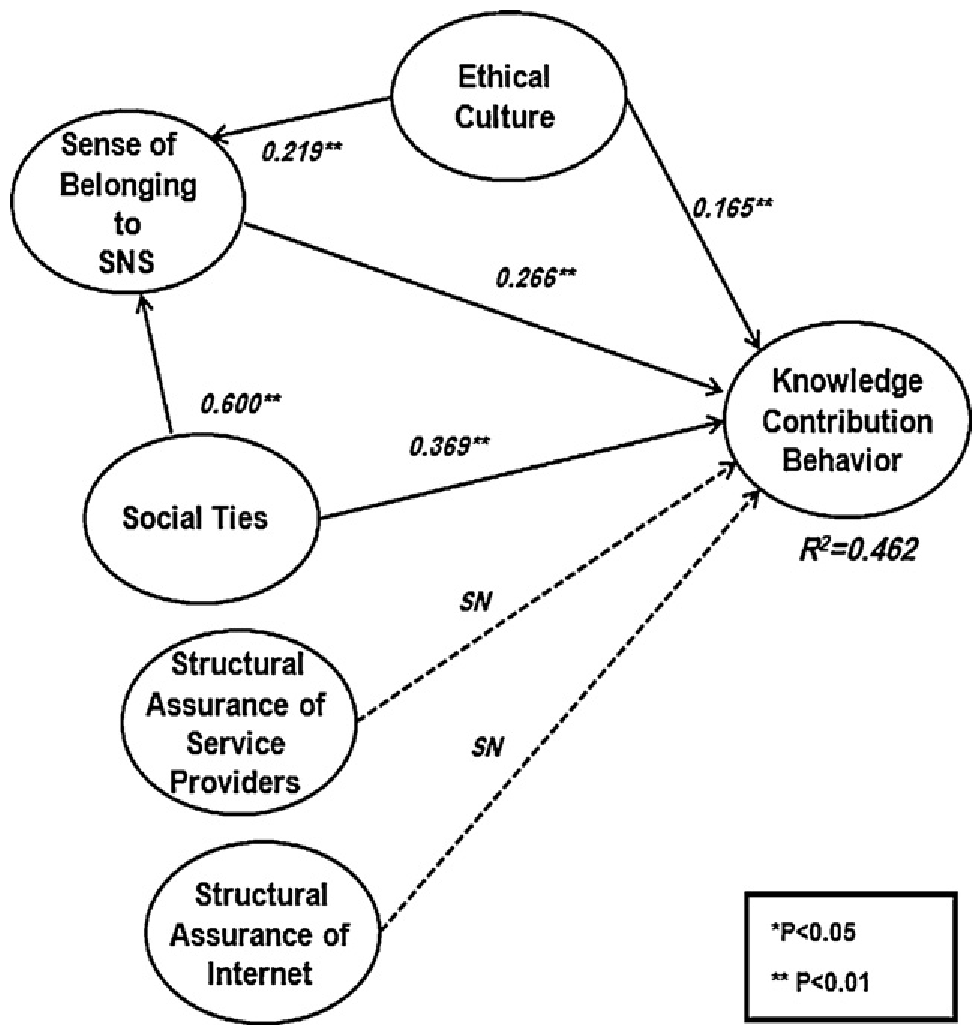
While users value privacy and security, the presence of these safeguards doesn't actually motivate them to share more. It seems security is a "hygiene factor"—its absence might cause harm, but its presence isn't what drives the creative spark or the urge to help others.
Critical Analysis & Conclusion
This paper offers a vital lesson for platform architects and community managers: Community is not a technical problem.
- Value-First Insight: Most SNS providers over-invest in UI/UX and encryption while under-investing in features that facilitate "deep" social ties. To increase contribution, platforms should focus on bulletin boards, interest groups, and ethical guidelines that make users feel like they are part of a trusted tribe.
- Limitations: The study's sample (college students) represents a demographic naturally "comfortable" with tech, which might explain their indifference to structural assurance. Older or more risk-averse demographics might yield different results.
- Future Outlook: As we move into AI-curated feeds, the "Human" factor highlighted here becomes even more critical. If algorithms destroy the "Sense of Belonging" by prioritizing engagement over community, knowledge contribution may paradoxically decline despite better tech.
Summary Table of Determinants
| Factor | Impact on Contribution | Significance |
|---|---|---|
| Social Ties | High | Strongest Motivator |
| Sense of Belonging | High | Key Mediator |
| Ethical Culture | Moderate | Influences trust/belonging |
| Structural Assurance | None | No statistical impact |
Ultimately, the study confirms that in the digital age, we are still social animals. We share knowledge not because the encryption is strong, but because the human connection is.