
STOP: Turning Human Social Patterns into a Shield Against Mobile Malware
STOP: Socio-Temporal Opportunistic Patching of short range mobile malware
This paper introduces STOP (Socio-Temporal Opportunistic Patching), a predictive malware containment system designed to thwart short-range mobile worms (e.g., Bluetooth, WiFi). By selecting a top-k subset of influential nodes based on temporal closeness centrality, the system achieves SOTA patching efficiency despite highly dynamic network topologies.
TL;DR
Mobile malware is no longer restricted to SMS or emails; short-range "proximity" worms can spread via Bluetooth and WiFi, invisible to network operators. STOP (Socio-Temporal Opportunistic Patching) is a two-tier predictive system that identifies "super-spreader" nodes using temporal graph theory. By sending security patches to a tiny fraction of central users, the system allows the patch to spread "opportunistically" through social contacts, effectively containing outbreaks with minimal infrastructure load.
The Hidden Danger of Short-Range Worms
While network operators can filter malicious traffic on 4G/5G backbones, short-range radio technologies like Bluetooth, ZigBee, and NFC create a "shadow network" where malware can leap from phone to phone.
The Problem with Prior Solutions:
- Static Analysis: Traditional "closeness" metrics treat all contacts as happening simultaneously, leading to "shortest paths" that are physically impossible (e.g., if A meets B at 10 AM, and B met C at 9 AM, A cannot pass a file to C through B).
- Data Limitations: Many models assume we know the future contact schedule, which is impossible in the real world.
- Infrastructural Strain: Sending patches to every device at once can congest cellular networks, and many devices (like tablets) lack constant 3G/4G access.
Methodology: The Power of Temporal Centrality
The core innovation of STOP lies in its transition from Static to Temporal graphs.
1. The Temporal Graph Model
Instead of one big "social graph," the authors represent the network as a sequence of snapshots. Link only exists if they are in proximity at a specific time window.
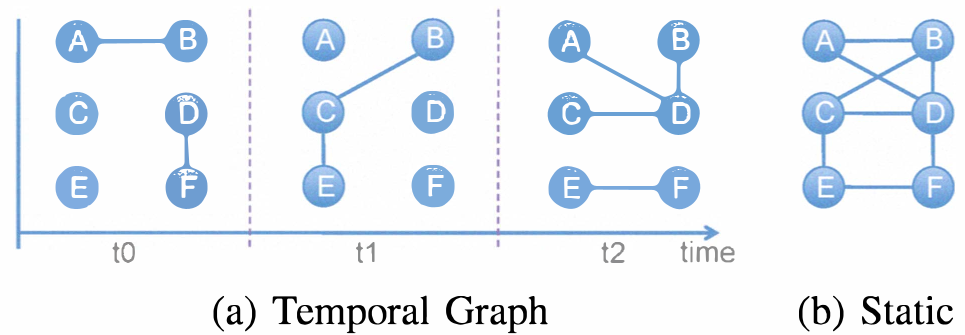
As shown in the figure above, static analysis underestimates the actual path length and ignores time-ordering. STOP uses Temporal Closeness Centrality, which measures how fast a node can reach others given the chronologically ordered contact sequence.
2. Predictability of "Central" People
One of the paper's key insights is that human mobility is periodic. A person who is "central" (meets many people) on a Monday is statistically likely to be central on Tuesday. The authors tested this using the Jaccard Index across several datasets, finding high correlation in top-ranking nodes over time.
3. Prediction Functions
To handle the "lag" between data collection and patch deployment, they proposed multiple weighting functions:
- Uniform: All past data is weighted equally.
- W-log / W-exp: Recent contacts are weighted more heavily, reflecting the most recent social dynamics.
Experiments & Results: Efficiency at Scale
The authors utilized three real-world datasets: CAMBRIDGE (Office), INFOCOM (Conference), and MIT (Campus).
SOTA Comparison: Temporal vs. Random
The difference in containment efficiency is night and day. In the MIT dataset simulations, a patch started from a node selected via Temporal Centrality contained the malware nearly 3x faster than a random selection.
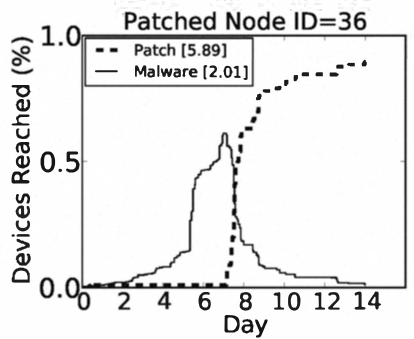 Figure: The "Area Under the Curve" (AUC) is vastly reduced when using Temporal Closeness (Left) compared to Random Selection (Right).
The "Top-k" Advantage
A critical finding was that temporal metrics require a smaller . To stop a 10% initial infection, STOP only needs to patch 5% of the most central nodes to achieve total containment within 10 hours. Static methods, by contrast, took over 75 hours to achieve the same result because they failed to identify the most "temporally" well-connected spreaders.
Critical Insight & Future Outlook
Takeaway: The researchers proved that we don't need "global future knowledge" to stop a worm. By looking at the recent temporal past, we can predict the near temporal future.
Limitations & Privacy: While powerful, the system requires devices to report their "sighting logs" to a central server. This raises privacy concerns, though the authors argue that mobile operators already track cell-tower locations. A future privacy-preserving version (e.g., using Federated Learning or Differential Privacy) could make this system highly deployable for national cybersecurity.
Conclusion: STOP demonstrates that temporal graph theory isn't just an academic exercise—it is a robust tool for securing the increasingly decentralized and "social" mobile topology of the modern world.