
SEES Framework: Bridging the Gap Between Body, Society, and Classroom Technology
A framework for socio-enactive educational systems: linking learning, design, and technology
This paper introduces the Socio-Enactive Educational System (SEES) Framework, a design methodology for collaborative learning tools that utilize body-based interactions and sensory coupling. Applied via the SEES Framework, the study demonstrates "System 1" (narrative exploration for adults) and "System 2" (Little Red Riding Hood for children), achieving high user satisfaction (4.88/5 on Emoti-SAM).
TL;DR
The SEES (Socio-Enactive Educational System) Framework is a revolutionary design methodology that shifts educational technology from "viewing a screen" to "interact with the world." By combining enactive cognition (learning through action) with socio-cultural values, the framework helps designers build systems where technology becomes a physical extension of the learner’s body.
Background Positioning: This work represents a significant theoretical and practical evolution in Human-Computer Interaction (HCI) for education, moving from Computer-Supported Collaborative Learning (CSCL) toward fully embodied, physical-virtual ecosystems.
Problem & Motivation: The "Screen-Only" Bottleneck
Modern classrooms are often flooded with digital tools that treat students as passive observers or simple "clickers." The authors argue that current educational software ignores:
- Embodied Cognition: We learn by moving and doing, not just by seeing icons.
- Socio-Cultural Context: Learning isn't a vacuum; it is filtered through cultural beliefs and individual histories.
- The Complexity of the "Enactive" Coupling: Designing systems that feel like an extension of the self—rather than just a tool—is technically and theoretically difficult.
Methodology: The SEES Framework
The heart of the paper is the SEES Framework, which utilizes Peirce’s Theory of Signs to structure the design into three cycles:
- The Informal System (Interpretant): Focuses on "Why" and "Who" (Learning Objectives, Pedagogical Culture, Target Audience).
- The Formal System (Object): Focuses on the "Mechanics" (Collective Behavior, Enactive Environment, Physical-Virtual Setting).
- The Technical System (Representamen): Focuses on "How" (Interactions, Multimedia Content, Physical-Virtual Environment).
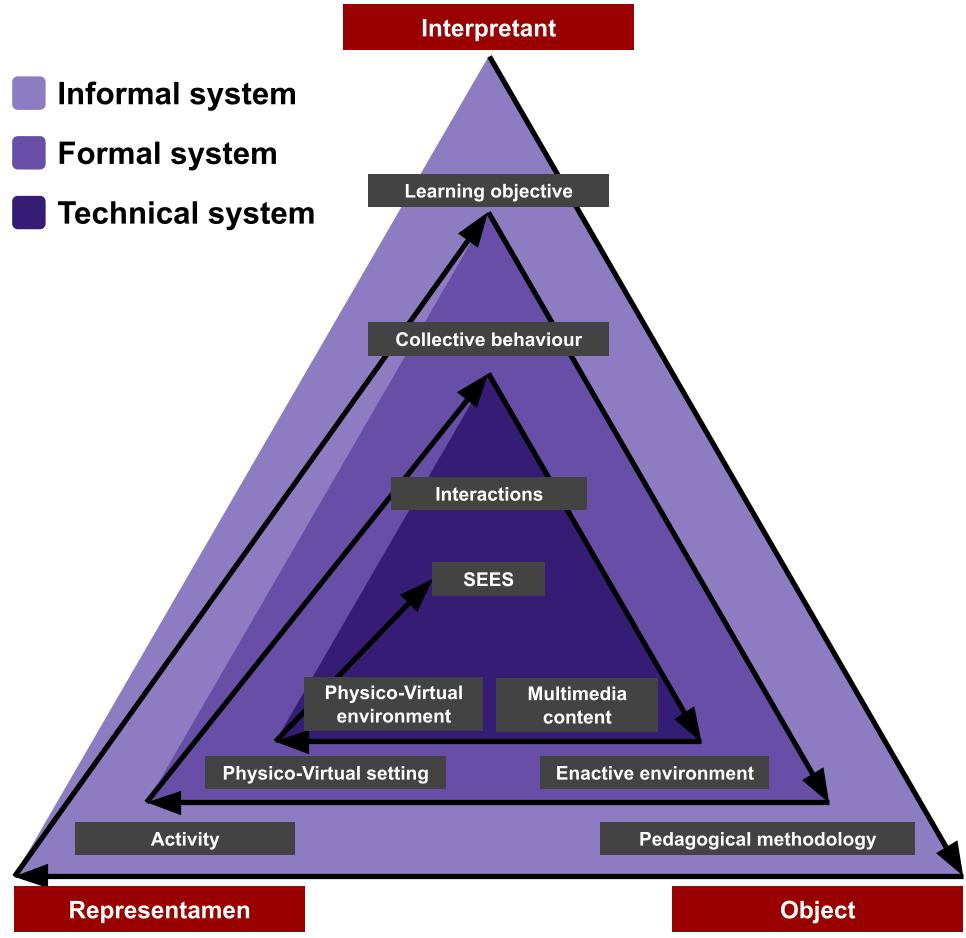
This 9-step process ensures that the technical choice (e.g., using a QR code) is always rooted in a pedagogical objective (e.g., critical thinking).
Experiments & Results: Putting the Body to Work
The authors tested the framework with two specific implementations:
System 1: Immersive Detective Story (Adults)
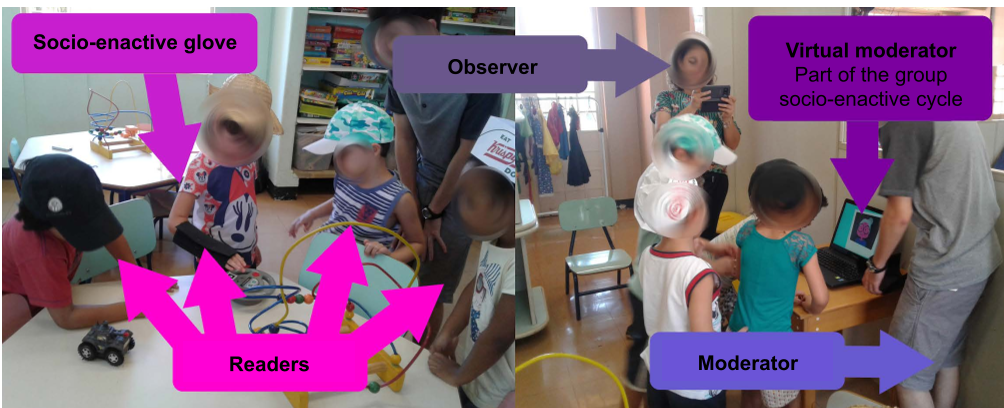
Using "enactive gloves" and a "virtual mediator" (a voice-reactive screen), adults explored a physical room.
- The "Radar" Insight: The glove vibrated at different frequencies based on the student's distance from objects.
- Result: Even though the system was "unpredictable," it was rated as highly "integrating" and "captivating."
System 2: Little Red Riding Hood (Children 4-5)
Targeting young learners, this system adapted the hardware for a fairy tale setting.
- The "Invisible" Tech: Analysis of children's drawings showed they drew the grandmother and the toys, but almost never the smartphone or the glove.
- Physical Intuition: Children developed unique "spiral" arm movements to calibrate the tech, demonstrating how they incorporated the machine into their own physical repertoire.
Key Performance Comparison
| Metric | System 1 (Adults) | System 2 (Children) |
|---|---|---|
| Satisfaction | High (Captivating) | 4.88 / 5.0 (Emoti-SAM) |
| Learning Outcome | Divergent Thinking | Collaboration & Curiosity |
| Key Behavioral Change | Shared unique perspectives | Overcame communication barriers |
Critical Analysis & Conclusion
The Collective Breakthrough: The most significant take-away is "Mutual Incorporation." In socio-enactive systems, students don't just interact with a computer; they interact through the computer with each other.
Limitations:
- Teacher Control: The authors admit these systems can be "too enactive"—the unpredictability that makes them great for learning can make them difficult for a teacher to manage in a traditional 40-minute period.
- Learning Analytics: The current framework lacks a "dashboard" for data-driven assessment.
Future Outlook: The SEES Framework paves the way for a future where "Phygital" (Physical-Digital) environments are the norm. By rooting design in semiotics and enactivism, we can create educational tools that feel as natural as a pencil but are as powerful as a supercomputer.