
Decoding the Language of Truth: A Sociolinguistic Route to Twitter Credibility
3329_A Sociolinguistic Route to the Characterization and Detection of the Credibility of Events on Twitter.
This paper introduces a sociolinguistic approach to detect the credibility of Twitter events using a novel Hierarchical Attention Network augmented with linguistic features (HAN-SL). Evaluated on the massive CREDBANK dataset, the model achieves a state-of-the-art accuracy of 0.54, outperforming previous baselines by approximately 26% across four credibility classes.
TL;DR
Researchers from IIT Kharagpur have developed a new deep learning framework, HAN-SL, that identifies whether Twitter events are "fake news" or "legitimate" by analyzing their linguistic DNA. By blending Hierarchical Attention Networks with sociolinguistic markers (like swear words and cognitive bias terms), they improved prediction accuracy by 26% over previous methods and proved that we can judge an event's credibility using only its first 1,000 tweets.
The Problem: The High Cost of the "Gatekeeper-less" Web
On Twitter, everyone is a sensor but no one is an editor. This "gatekeeper-less" environment allows rumors regarding earthquakes, elections, or public health to spark panic before official statements can intervene. Existing research often analyzed these rumors after the fact and for specific niche incidents. The challenge addressed here is: Can we build a generalized, automatic system that measures the "perceived trustworthiness" of any social media event as it unfolds?
Methodology: Looking for the "Shadow" of a Lie
The authors' core insight is that deception leaves a linguistic footprint. Using the LIWC (Linguistic Inquiry and Word Count) and Empath tools, they analyzed 66 million tweets from the CREDBANK dataset.
1. Sociolinguistic Discoveries
The study found a strong negative correlation between credibility and specific categories of language:
- Low Credibility Markers: High usage of 'negate' (no, never), 'swear' (profanity), 'hate', and 'cogmech' (cognitive mechanics like "should," "would," "could"—indicating uncertainty).
- High Credibility Markers: Terms related to 'health', 'achievement', and 'sports'. Highly credible events show a general agreement among users (e.g., "I agree", "convincing").
2. The HAN-SL Architecture
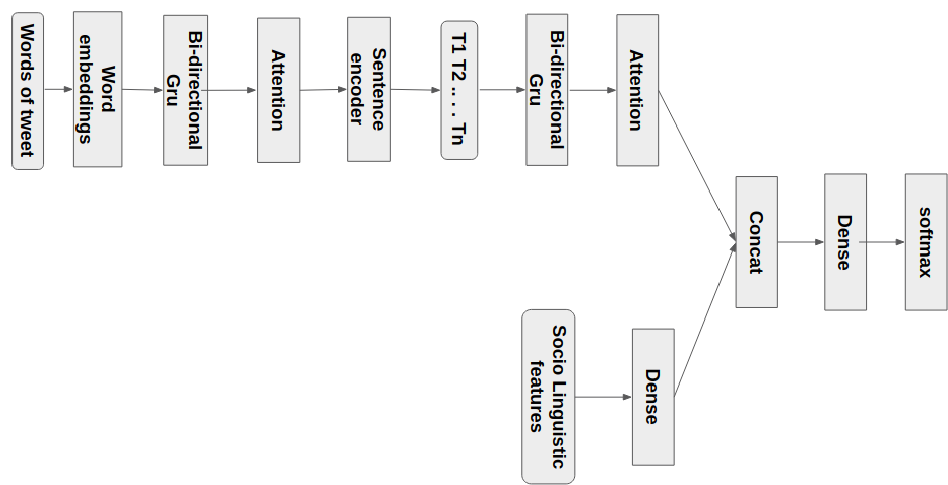
Standard Deep Learning models often treat a collection of tweets as a single flat "bag of words." The authors argue this is wrong. An event is a hierarchy: Words form Tweets, and Tweets form an Event.
The Hierarchical Attention Network (HAN) uses:
- Word Encoder/Attention: Identifies which specific words in a tweet are crucial.
- Tweet Encoder/Attention: Identifies which specific tweets in a thread carry the most weight for the event's overall credibility.
- SL-Augmentation: The model then "fuses" these neural features with the sociolinguistic vectors (SL) mentioned above to make a final 4-class classification.
Experiments & Results: Efficiency is Key
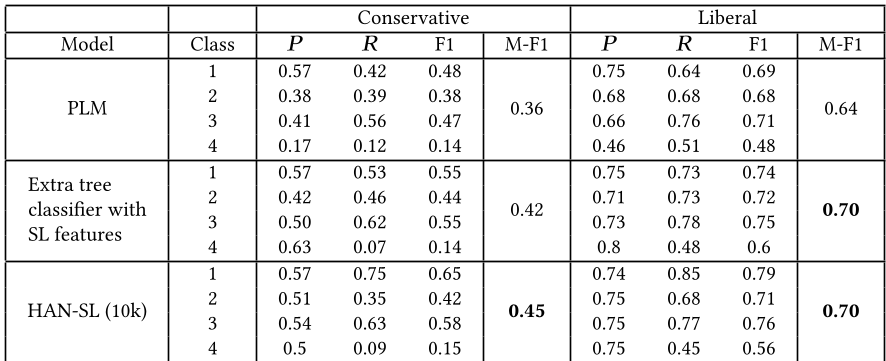
The researchers tested their model against the Parsimonious Language Model (PLM), the prior SOTA.
| Model | Conservative Accuracy | Liberal Accuracy |
|---|---|---|
| Previous SOTA (PLM) | 0.43 | 0.67 |
| HAN-SL (Proposed) | 0.54 | 0.74 |
The "Early Bird" Insight
Perhaps the most fascinating result is the temporal analysis. The researchers limited the model to only the first 1,000 tweets of an event. Surprisingly, the accuracy barely dropped compared to analyzing the full 10,000+ tweets. This suggests that the "vibe" of an event is established almost immediately, allowing for real-time flagging of misinformation before it goes viral.
Critical Insight: Why Does Profanity Matter?
The paper draws an interesting parallel to "offline" sociolinguistics. Just as profanity decreases the perceived credibility of police officers in the real world, it acts as a signal of low reliability in the digital world. The presence of 'hate' and 'confusion' words acts as a "smoke signal" for a lack of evidence.
Conclusion & Future Outlook
This work provides a scalable blueprint for computational fact-checking.
- Takeaway: We don't need to wait for a rumor to finish spreading to identify it; the linguistic structure of the first few hundred responses often tells the whole story.
- Limitations: The overall accuracy of 54% (on a 4-class problem) shows that credibility is still a deeply complex human judgment that AI hasn't fully mastered.
- Future Work: Integrating modern Transformers (like GPT-4 or Llama-3 style embeddings) with these sociolinguistic insights could likely push accuracy toward the 70-80% range, making automated "credibility tags" a reality for social newsfeeds.