
Decoding the Gender Signal: Can Machine Learning Reveal Who Wrote the Code?
Sociolinguistics and programming
This paper explores the intersection of sociolinguistics and computer science, proposing a machine learning approach to identify the gender of C++ programmers. By treating code as a linguistic artifact and applying the K* algorithm, the authors achieved an F-measure of 71.9% in gender classification.
Executive Summary
TL;DR: Researchers from the University of Lethbridge have successfully demonstrated that the way we write code is not just dictated by logic, but by our social identity. Using machine learning classifiers on C++ source code, the study achieved a ~72% success rate in predicting the author's gender, proving that "Software Linguistics" is a viable field for social discovery.
Positioning: This work acts as a bridge between traditional sociolinguistics and modern static code analysis. Rather than focusing on bug detection or performance, it treats source code as a "stylistic signature" akin to creative writing or formal literature.
Problem & Motivation: The "Stylistic Freedom" within Syntax
Programming languages are often viewed as rigid systems of logic where the compiler dictates the rules. However, the authors argue that within those rules exists significant stylistic freedom. Decisions regarding:
- The choice of loop types (e.g.,
whilevsfor). - The density and tone of comments.
- Variable naming conventions and operator placement.
Existing work in natural language has shown that women tend to use more personal pronouns while men use more determiners. This paper asks: Does this sociolinguistic variation translate to C++?
Methodology: Feature Engineering for Code
The researchers treated C++ programs as text documents. The core challenge was transforming raw code into a format machines can "understand."
- Document Representation: They selected 50 key attributes divided into Keywords, Operators, Comments, Brackets, and Loops.
- TF-IDF Weighting: To prevent common terms (like
int) from drowning out unique stylistic choices, they used Term Frequency-Inverse Document Frequency (TF-IDF) to weigh the importance of features. - Model Selection: Three distinct algorithms from the WEKA suite were tested:
- K*: An instance-based learner using entropic distance.
- J48: A C4.5-based decision tree.
- Naïve Bayes: A probabilistic classifier based on attribute independence.
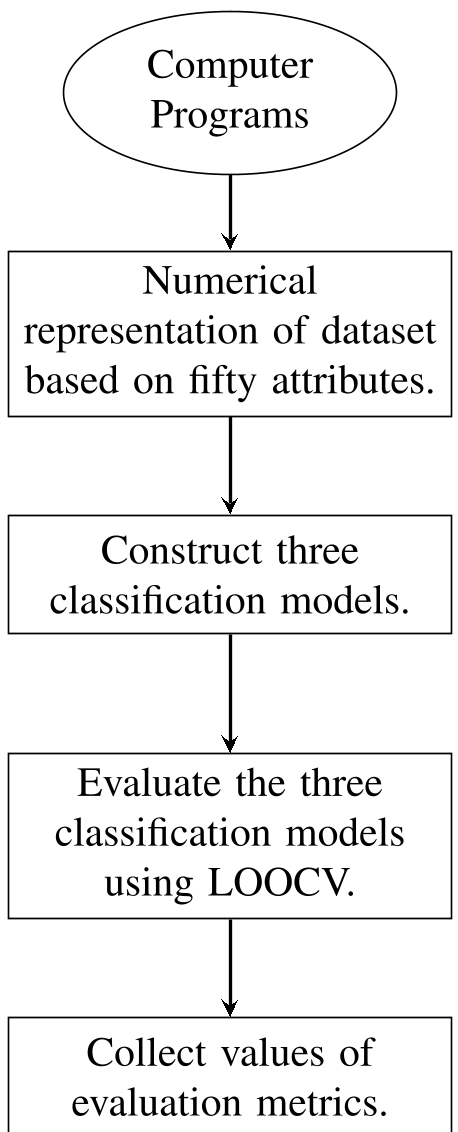 Figure 1: The overarching workflow from data collection to classification.
Experiments & Results
The study utilized a balanced dataset of 100 C++ programs. Given the small sample size, the authors employed Leave-One-Out Cross-Validation (LOOCV) to ensure the models didn't simply "memorize" the data (overfitting).
Performance Comparison
The results revealed a clear winner in the K* algorithm:
| Model | Precision (%) | Recall (%) | F-Measure (%) |
|---|---|---|---|
| K* | 72.3 | 72.0 | 71.9 |
| J48 | 63.0 | 63.0 | 63.0 |
| NB | 66.0 | 66.0 | 66.0 |
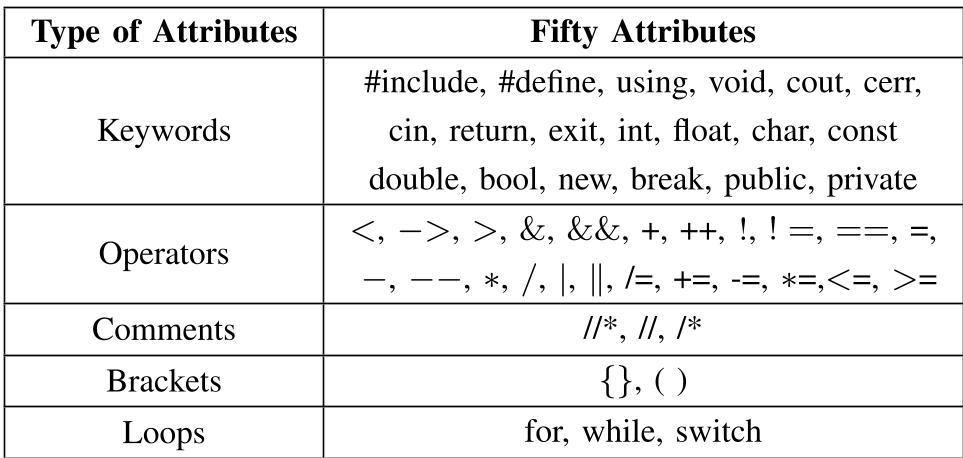 Table 1: The 50 attributes used to define the "linguistic fingerprint" of the programmers.
The K algorithm’s* superiority suggests that programming style is best captured by looking at "clusters" of similar hackers rather than broad, tree-based rules. The 72% accuracy is a strong baseline, confirming that code is indeed a medium for sociolinguistic expression.
Critical Analysis & Conclusion
Limitations
- Data Skew: The original dataset was heavily male-biased, requiring oversampling of female code samples. This might mean the model learned the specific habits of a few individuals rather than "female programming style" as a whole.
- Experience Level: The subjects were students. Professional developers might follow stricter industry style guides (e.g., Google's C++ Guide), which could mask their personal sociolinguistic traits.
Final Takeaway
This paper opens the door to Socially-Aware IDEs. Imagine a development environment that recognizes miscommunication patterns between different demographic groups or an automated system that can detect plagiarism even when a student tries to "disguise" their code. By proving that gender is reflected in C++, the authors have shown that the "who" behind the code is just as visible as the "what."
Future Work: The authors plan to expand the feature set to include variables like a programmer’s native spoken language and years of experience, further mapping the complex human identity behind the digital screen.