
Leveraging Sociological Models for Prediction: Inferring Adversarial Relationships
Leveraging sociological models for prediction I: Inferring adversarial relationships
This paper introduces a novel machine learning (ML) framework that integrates Structural Balance Theory (SBT) to predict adversarial relationships in social networks. By leveraging sociological insights, the proposed Edge-Sign Prediction (ESP) algorithm achieves state-of-the-art results in inferring whether social ties are friendly or antagonistic, particularly in Wikipedia voting and interaction datasets.
TL;DR
Predicting human behavior is notoriously difficult because social data is often sparse, "hidden," or adversarial. This paper demonstrates that we don't need more data to solve this; we need smarter priors. By embedding Structural Balance Theory (SBT) into a machine learning framework, the authors can predict whether two people are friends or enemies with startling accuracy, even when training data is nearly non-existent.
Problem & Motivation: The "Data Hunger" of Modern ML
Standard Machine Learning (ML) models are essentially sophisticated pattern matchers. To predict a relationship's "sign" (positive for friend, negative for foe), they typically require thousands of labeled examples. However, in sensitive domains like national security or emerging social conflicts, we rarely have the luxury of "Big Data."
The authors identify two fatal flaws in prior work:
- Insufficient Accuracy: High-consequence decisions cannot rely on models that guess.
- Data Labeling Costs: Manually labeling adversarial relationships is time-consuming and often impossible in real-time.
Their Insight: Why treat social networks as random data points when centuries of sociology tell us how they work? Humans tend to follow specific patterns—like "the enemy of my enemy is my friend"—to maintain cognitive and structural balance.
Methodology: Fusing Sociology with Graph Theory
The authors propose Algorithm ESP (Edge-Sign Prediction). Instead of a simple black-box classifier, ESP uses a bipartite graph model represented by a Laplacian-based optimization problem.
1. The SBT Features
The model uses 21 features. Sixteen of these are based on triads (triangles of three people). According to SBT, a triad is "balanced" if it has an odd number of positive signs.
- Balanced: Three friends (+) OR one friend and two enemies (+, -, -).
- Unbalanced: Two friends and one enemy (+, +, -) — this creates social tension.
2. The Bipartite Graph Model
The authors construct a graph where one set of nodes represents the edges we want to predict and the other set represents the features.
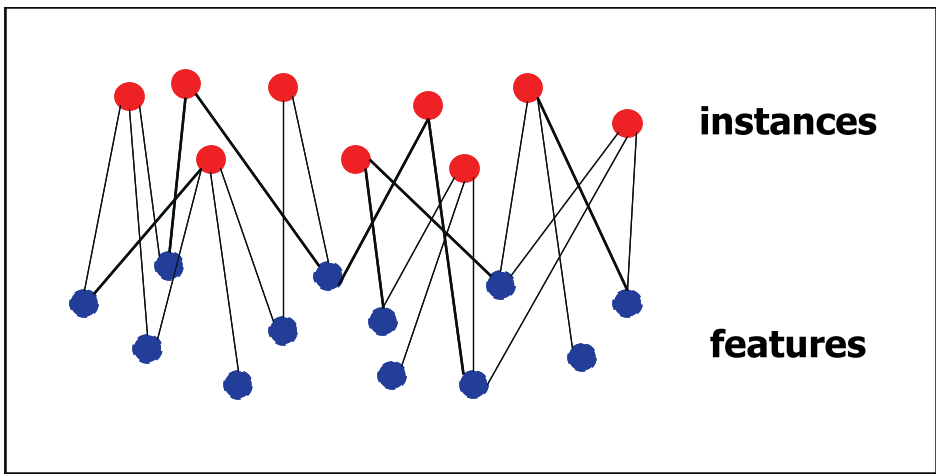
The learning process involves minimizing a cost function that reconciles three things:
- Known labels from the training data.
- Sociological Priors: Pre-assigning "polarity" to features that should be positive or negative according to SBT.
- Graph Smoothness: Ensuring that similar edge-instances have similar predicted signs.
Experiments & Results: Winning with Less
The authors tested ESP on two large Wikipedia datasets: one for "admin" voting and one for editor interactions.
The "Small Data" Advantage
The most impressive result is shown in the performance curves. Most ML models "die" when the number of labeled instances () is low.
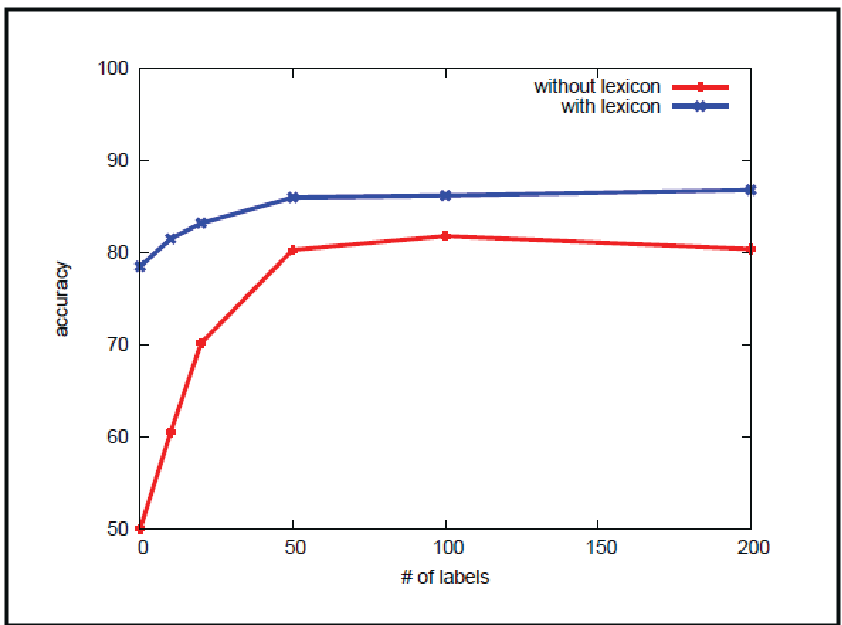
As shown above, when the number of labeled examples is near zero, the ESP algorithm (blue line) significantly outperforms the gold-standard logistic regression (red line). By using SBT as a guide, the model "knows" the general rules of social interaction before it even sees the data.
Predicting Historical Fractures
The paper extends this to "Network Fracture." Using a matrix differential equation: They show that if you know only a tiny fraction of relationships (e.g., 15%), you can predict how a whole network will split. They successfully applied this to the Allied vs. Axis split in WWII, proving that sociology can indeed "predict the present" and the near future.
Critical Analysis & Conclusion
Takeaway
The core value of this work is the shift from Purely Data-Driven to Theory-Informed ML. By using the graph Laplacian to bridge the gap between sociological theory (SBT) and raw statistics, the authors provide a template for building more efficient models.
Limitations
- Dynamic Adaptation: The model assumes a somewhat static relationship structure. In rapidly evolving adversarial settings, "balance" might shift faster than the algorithm can compute.
- Complexity of Sentiment: The binary (+1/-1) model simplifies human emotion, which often exists in shades of grey.
Future Outlook
This approach is a goldmine for Small-Data AI. In fields like rare disease research or niche social dynamics where data is scarce, "leveraging the model" of the domain is the only viable path forward.