
Predicting Virality: Why Sociological Models are the Secret Sauce for ML
Leveraging sociological models for prediction II: Early warning for complex contagions
The paper introduces Algorithm EW, a machine-learning-based early warning system that integrates sociological models to predict whether social diffusion events, such as online memes or cyber threats, will achieve "viral" reach. By leveraging structural features like community dispersion and k-shell decomposition, the method achieves superior predictive accuracy (reaching SOTA performance) even with very limited time-series data.
TL;DR
Predicting human behavior is notoriously difficult, especially when you need to know the outcome before it happens. This paper demonstrates that by embedding sociological theories—specifically complex contagion and network topology—into machine learning models, we can predict whether a meme or a cyber-attack will go viral with startling accuracy, even when we have almost no data.
The Problem: The "Data Hunger" of Blind ML
Most predictive models treat social media data as a simple time series: "If X people mention it now, Y people will mention it later." This approach fails for two reasons:
- Data Scarcity: By the time you have enough data for a standard ML model to be sure of a trend, the "viral" event is already over.
- Ignoring Mechanics: It treats information like a virus (simple contagion). But human behavior is "complex"—we often need to see multiple friends doing something before we join in.
The authors argue that the structure of the network where the spark begins matters more than the spark itself.
Methodology: The Sociology-AI Fusion
The core of the paper lies in Predictability Assessment. Instead of just throwing features at a neural network, the authors use Stochastic Hybrid Dynamical Systems (S-HDS) to model how information jumps between communities.
The Two Golden Features
Based on their sociological modeling, they identified two "Network Dynamics" features that outperform everything else:
- Community Dispersion: Does the meme jump across different "clusters" of people, or is it stuck in one echo chamber?
- K-Shell Activity: Is the activity reaching the "core" of the network—the highly connected influencers who act as the structural backbone?
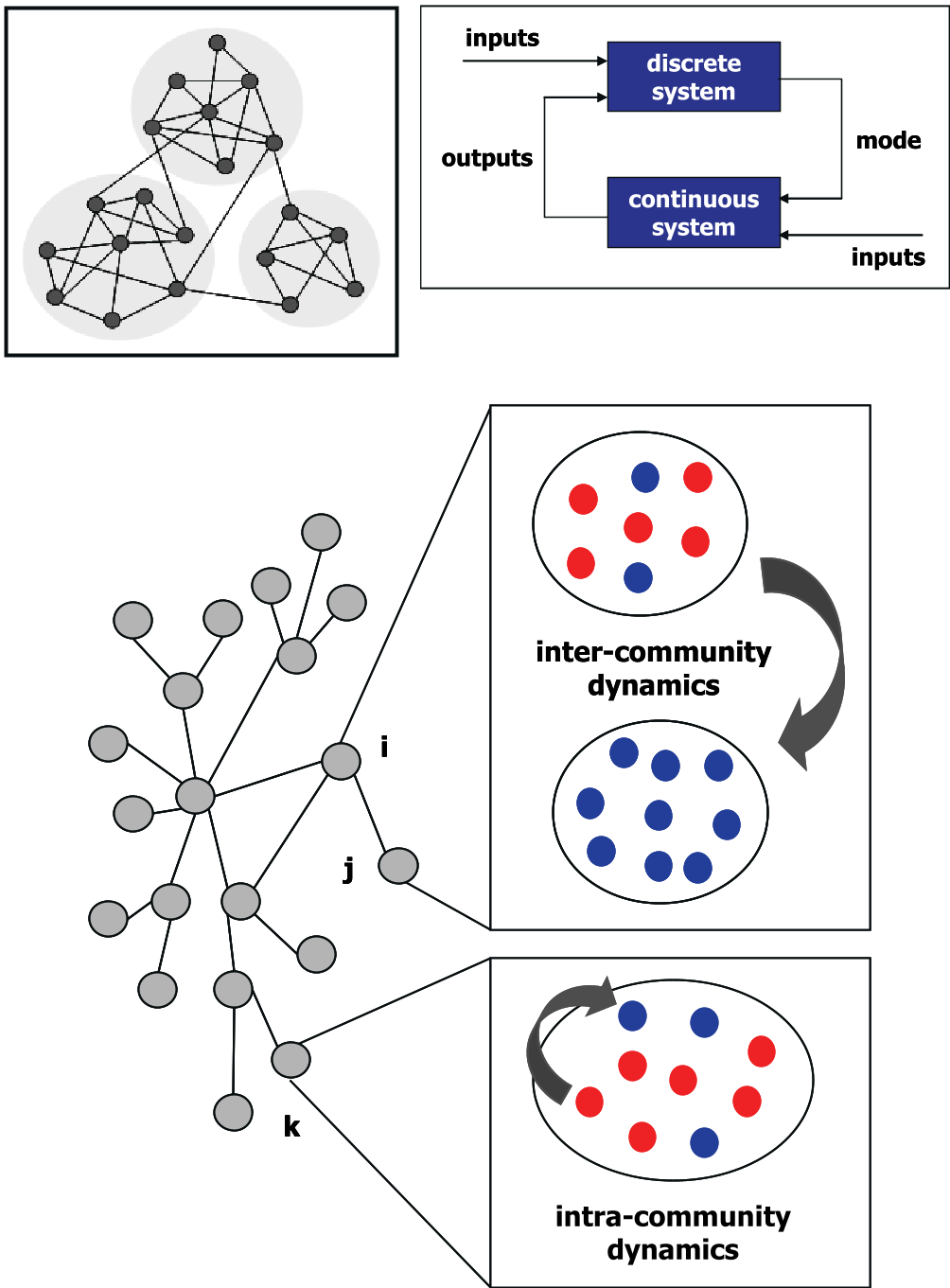 Figure 1: The S-HDS framework capturing intra-community and inter-community diffusion dynamics.
Experiments: Memes and Cyber-Warfare
The researchers tested their Algorithm EW (Early Warning) against a "Gold Standard" ML method in two high-stakes scenarios:
1. Meme Tracking
Using a dataset of 70,000 memes, the algorithm tried to predict "success" (virality).
- Intrinsic Features (Sentiment/Happiness of the text) only achieved 66.5% accuracy.
- Algorithm EW reached high accuracy within 12 hours of a meme’s birth.
2. DDoS Attack Early Warning
Can social media chatter predict a cyber-attack? The authors analyzed events like the 2007 Estonia attack and the WikiLeaks incidents. By looking at "community dispersion" in social media chatter before the attacks, the algorithm achieved 95-100% accuracy in distinguishing real threats from natural internet outages (like earthquakes).
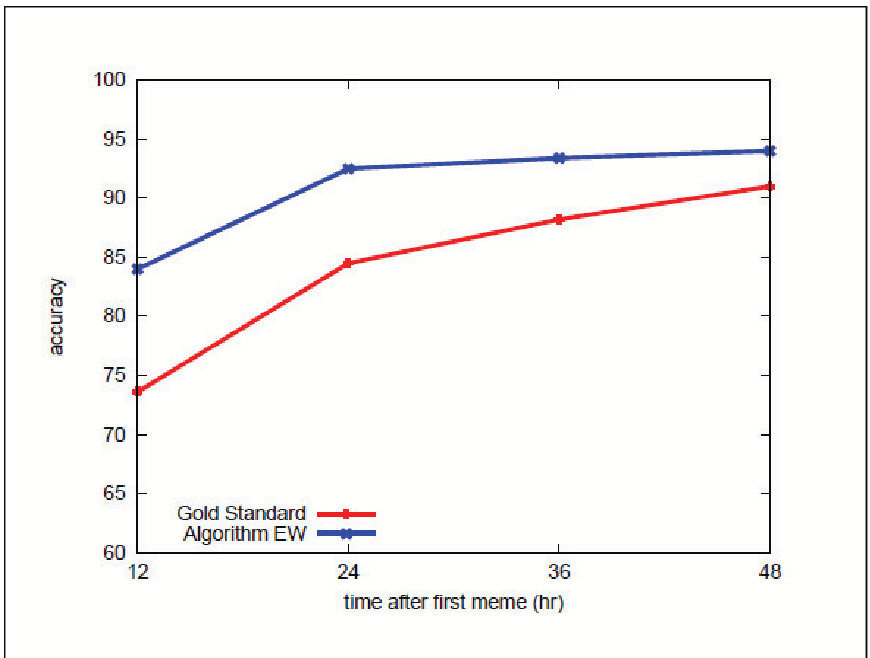 Figure 2: Accuracy Comparison. Note how the blue line (Algorithm EW) stays high even at the very beginning of the timeline, while the red line (Gold Standard) relies on more time passing.
Deep Insight: Structure Over Content
The most striking takeaway is the hierarchy of predictive power. The authors found that:
- Community Dispersion was the #1 predictor.
- K-Core Activity was #2.
- Content/Sentiment was actually the least useful.
In the world of complex contagions, who is talking and where they are in the social graph is infinitely more important than what they are saying.
Conclusion & Future Outlook
This paper proves that the "Black Box" approach to ML is suboptimal for social science. By using sociological models to guide feature engineering, we can create "Early Warning" systems that are faster and require less data than brute-force deep learning.
Limitations: The study relies on high-quality network graph data, which isn't always available in real-time due to API restrictions (e.g., modern Twitter/X or Facebook). Future work focusing on "graph-less" proxies for these sociological structures would be a major breakthrough.