
SocioNet: Bridging Social Intuition and P2P Efficiency via Small-World Overlays
SocioNet: A Social-Based Multimedia Access System for Unstructured P2P Networks
SocioNet is a social-based multimedia access system for unstructured P2P networks that clusters peers into a small-world topology based on content preferences. By combining interest-based clustering with random shortcuts, it achieves high success ratios in partial-match (keyword) searches with significantly reduced message overhead compared to traditional non-semantic overlays.
TL;DR
SocioNet transforms unstructured P2P networks by mimicking human social structures. It clusters peers with similar multimedia interests into "communities" while maintaining random shortcuts to ensure the entire network remains reachable within a few hops. By utilizing a mathematical TTL-setting model and distributed buddy selection, it solves the efficiency bottleneck of keyword-based searches in decentralized systems.
Background: The Keyword Search Dilemma
In the landscape of Peer-to-Peer (P2P) systems, there has always been a tension between Structure and Flexibility. Distributed Hash Tables (DHTs) are efficient but rigid—they excel at finding a file if you have its exact ID, but fail miserably at "flexible" queries like searching for any song by The Beatles.
Unstructured networks like Gnutella allow for keyword searches through flooding, but this often leads to a "broadcast storm," clogging the network with redundant messages. SocioNet's core insight is that P2P users aren't random; they behave like social actors. If we can organize the network topology to reflect user interests, we can make "blind" flooding significantly more "sighted."
Methodology: The Small-World Blueprint
SocioNet is built on the -model of social networks (Watts and Strogatz). It characterizes a dual-link strategy:
- Similarity Links (Friends): Each peer finds "buddies" who share similar content libraries. This creates dense clusters where common requests are satisfied within 1-2 hops.
- Random Shortcuts (Acquaintances): A fraction () of links are rewired to random peers. These act as "bridges" that connect different interest communities, ensuring the "six degrees of separation" property.
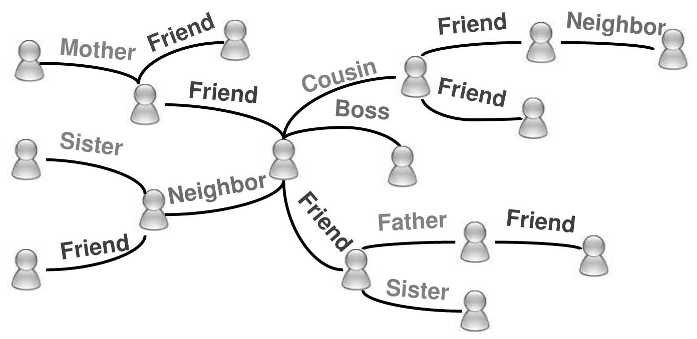 Fig 1: The similarity-based sociogram where colors represent different interest clusters.
The Similarity Engine
The heart of the system is the Cosine Similarity Measure. SocioNet defines a peer's profile as a weighted vector of keywords (e.g., Genres like Rock, Jazz, Pop). Crucially, the authors adjust the standard cosine measure to account for the quantity of objects, rewarding peers who are "libraries" of certain genres rather than just "fans."
Intelligent Search: The TTL Model
One of SocioNet's most academic contributions is the TTL-setting model. Instead of choosing a static Time-to-Live (TTL) for query packets, SocioNet uses Zipf-like distribution statistics and the network's clustering coefficient to calculate the minimum TTL needed to reach a desired Success Ratio. This prevents the "over-flooding" that plagues most P2P protocols.
Experimental Validation
Using real-world data from AudioScrobbler (tracking 1,355 users and 31,005 distinct songs), the authors proved that SocioNet isn't just a theoretical toy.
Performance in Static and Dynamic Environments
SocioNet significantly outperforms Semantic Overlay Networks (SON) and random networks. In static tests, it achieves higher precision and recall rates because queries are directed toward clusters that actually possess the data.
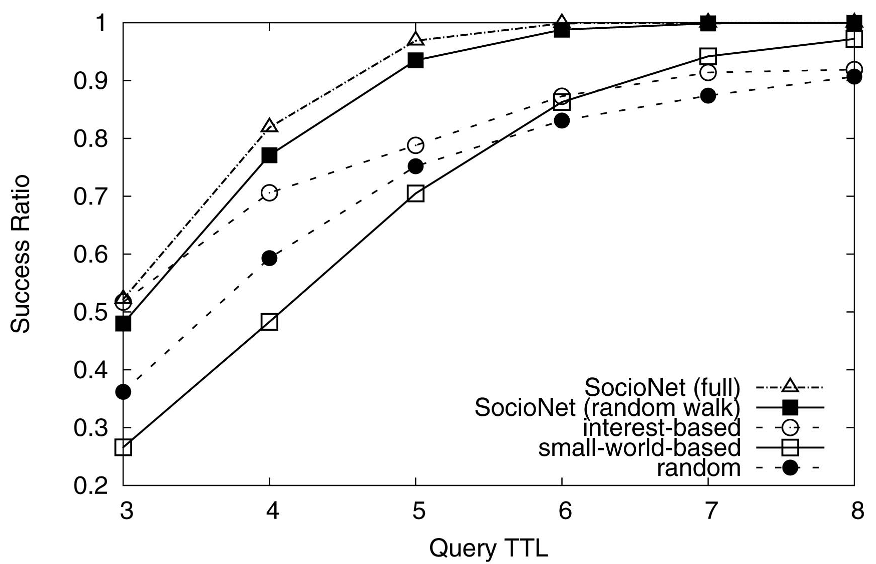 Fig 2: SocioNet (Full and Random Walk) consistently outperforms benchmarks across Success Ratio, Precision, and Recall.
In Churn scenarios (where nodes constantly join and leave), SocioNet's distributed adaptation—using random walks to find new "buddies"—maintains a 40% higher cumulative success match rate than standard small-world models.
Deep Insight: Why It Works
The genius of SocioNet lies in its Inductive Bias. It assumes that if I like Jazz, my neighbors in the P2P network should also like Jazz. By baking this preference into the topology (the hardware-level connections), the algorithm (searching) becomes trivial.
However, the "random" links are the unsung heroes. Without them, the network would fragment into "echo chambers" (islands of interest). The random links provide the "long-range" reach required to find that one obscure track that doesn't fit your primary profile.
Conclusion and Future Outlook
SocioNet demonstrates that the most efficient way to manage decentralized data is to look at how humans manage information in the real world. While the P2P craze of the 2000s has evolved into modern CDN and Blockchain technologies, the Small-World Similarity principles explored here remain highly relevant for decentralized AI and edge computing, where finding "the right node" quickly is a matter of latency and survival.
Takeaway: By combining Interest-based Clustering with Small-World Shortcuts, we can create a P2P system that is both flexible enough for keywords and efficient enough for scale.