
Reconciling the Clock and the Crisis: A New Framework for Distributed Coordination
'Is the Time Right Now?': Reconciling Sociotemporal Disorder in Distributed Team Work
This paper introduces a pluritemporal analytical framework to understand how globally distributed teams coordinate under extreme time pressure. Focusing on The Standby Task Force (SBTF) during the 2017 Hurricane Maria crisis, it identifies how volunteers reconcile "sociotemporal disorder" across conflicting technical, natural, and social time scales to achieve SOTA-level humanitarian coordination.
TL;DR
In the wake of Hurricane Maria, a global network of digital volunteers fought a hidden battle: not just against the disaster, but against time itself. This paper uncovers how distributed teams overcome sociotemporal disorder—the confusion caused by clashing time zones, misleading social media timestamps, and the urgent pace of a crisis. By introducing a pluritemporal framework, the authors provide a roadmap for designing collaborative tools that understand time as a social construct, not just a number on a clock.
The "Invisible Substrate" of Work: Why Clock Time Isn't Enough
Most collaborative tools (Slack, Google Sheets, Trello) treat time as a linear, objective constant. But for a volunteer in London trying to verify a hospital's power status in Puerto Rico based on a tweet from a user in New York, time is anything but simple.
The authors argue that existing systems fail because they ignore the qualitative dimensions of time—urgency, rhythm, and presence. When these dimensions clash, it creates sociotemporal disorder, where the team's ability to "get on the same page" breaks down, leading to duplicated efforts or, in crisis scenarios, dangerous misinformation.
Methodology: The Pluritemporal Framework
The core contribution is an analytical lens that breaks time into six distinct discursive modes. This allows us to see how "temporal coordination" is actually performed through language:
- Standard: Clock time and ISO formats.
- Interval: Subjective durations (e.g., "give me a sec," "for a while").
- Chronology: Constructing the linear past/present/future.
- Tempo: The "speed" or urgency of the mission.
- Presence: Time as movement (e.g., "catch up," "long time").
- Ephemerality: Recognizing the fleeting nature of fluid information.
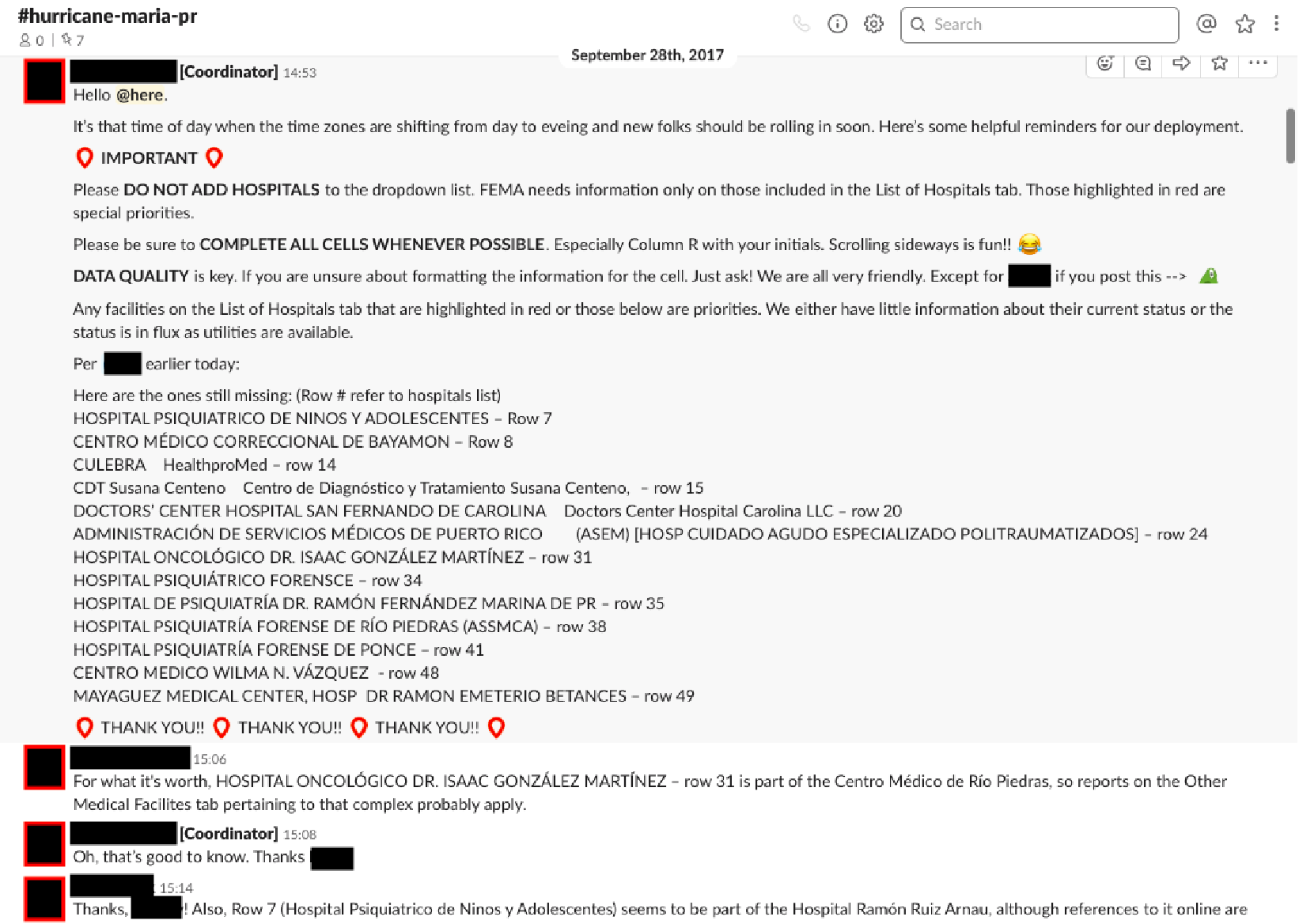 Figure 1: The Slack environment where volunteers negotiate these temporalities.
The Clash of Three Orders
The paper posits that digital humanitarian work happens at the intersection of three often-conflicting temporal orders:
- The Temporal Order of the Crisis: The physical disaster (landfall, recovery phases, local AST time).
- The Temporal Order of Technologies: Algorithmic feeds, timezone-shifted metadata, and rigid database schemas.
- The Sociotemporal Order of the Distributed Work: The messy reality of volunteers' lives, shifts, and "time-wasting" anxieties.
Case Study: The Ponce Hospital Discrepancy
A fascinating finding in the results describes a conflict between a "more recent" social media timestamp and a "more credible" source. Volunteers had to ignore the technology's primary temporal signal (the timestamp) to prioritize the human context. This proves that context, not just recency, dictates temporal truth.
 Figure 2: The Google Sheet used by SBTF, showing the manual entry of "Time" and "Date" which often lead to formatting "jumbles."
Design Implications: Moving Toward Temporal Awareness
The authors don't just critique; they offer a suite of design directions for the next generation of CSCW tools:
- Automated Timestamp Management: Collaborative platforms should allow "locking" a primary mission timezone while providing automatic local-to-crisis conversions.
- Provenance Awareness: Tools should visually link data points to their temporal origin (e.g., showing a tweet's "true" time regardless of the reader's settings).
- Ambient Tempo Cues: Interfaces like "Time Aura" could provide peripheral cues about the mission pulse to prevent burnout and ensure task alignment.
Critical Insight: The Future of Distributed Work
This paper is a masterclass in Crisis Informatics. It reveals that the most critical "work" in a distributed team is often the "articulation work"—the invisible talk required to make sure everyone is operating in the same version of "now."
Takeaway for Designers: Stop treating time as a metadata field. Start treating it as a shared social experience that needs its own dedicated awareness tools. If our tools can't reconcile "sociotemporal disorder," our global teams will always be fighting the clock as much as the problem they are trying to solve.