
SOCKER: Bridging the Gap Between Virtual Socializing and Face-to-Face Interaction
SOCKER: Enhancing Face-to-Face Social Interaction Based on Community Creation in Opportunistic Mobile Social Networks
This paper introduces SOCKER, a unified socially-aware community creation mechanism for Opportunistic Mobile Social Networks (OMSNs). It aims to facilitate face-to-face social interactions by leveraging mobile phone sensing and opportunistic encounters using a broker-based, single-copy information dissemination approach.
TL;DR
While our digital lives are more connected than ever, our physical, face-to-face social interactions often lag behind. SOCKER is a novel framework designed for Opportunistic Mobile Social Networks (OMSNs) that uses the mobile phones in our pockets to help us form real-world communities (like a pickup football game) by smartly selecting "brokers" based on their popularity, social closeness, and effectiveness.
Problem & Motivation: The Digital-Physical Divide
Existing social networks like Facebook or LinkedIn excel at building virtual communities. However, they aren't optimized for spontaneous, real-world interactions. Imagine wanting to organize a local soccer match with exactly 21 other people. If you post it online, you might get 100 replies, leading to disappointment for many, or 0 replies if your local network is small.
Current mobile social network research focuses heavily on how data moves (routing) rather than why it moves (forming social groups). Traditional "flooding" or multi-copy protocols create massive network overhead and make it nearly impossible to manage fixed-size groups without central servers.
Methodology: How SOCKER Smarter
The researchers propose a single-copy, broker-based approach. One person (the initiator) starts with the "task." As they move and encounter others, they can pass this task to a "broker"—someone more likely to find the right participants.
1. The Three Whys of Broker Selection
To choose the best broker, SOCKER uses three sophisticated metrics:
- User Popularity: How many people a user typically meets. High-popularity users act as catalysts to speed up the process.
- Inter-User Closeness (IUC): Measures the strength of a relationship based on "valid encounters" (long-duration meetings during non-working hours). This allows the system to distinguish between a "close-activity" (gathering old friends) and an "open-activity" (making new friends).
- User Effectiveness (UE): A "smart" metric that tracks which users have already been seen. It prevents the task from being passed to someone who only hangs out with people the previous broker already checked.
2. Privacy-Preserving Match-making
Instead of the broker scanning everyone's private data, SOCKER uses a broker-to-user scheme. The broker pushes the task to a user's device; the user's phone then checks for a match locally and only notifies the broker if they want to join.
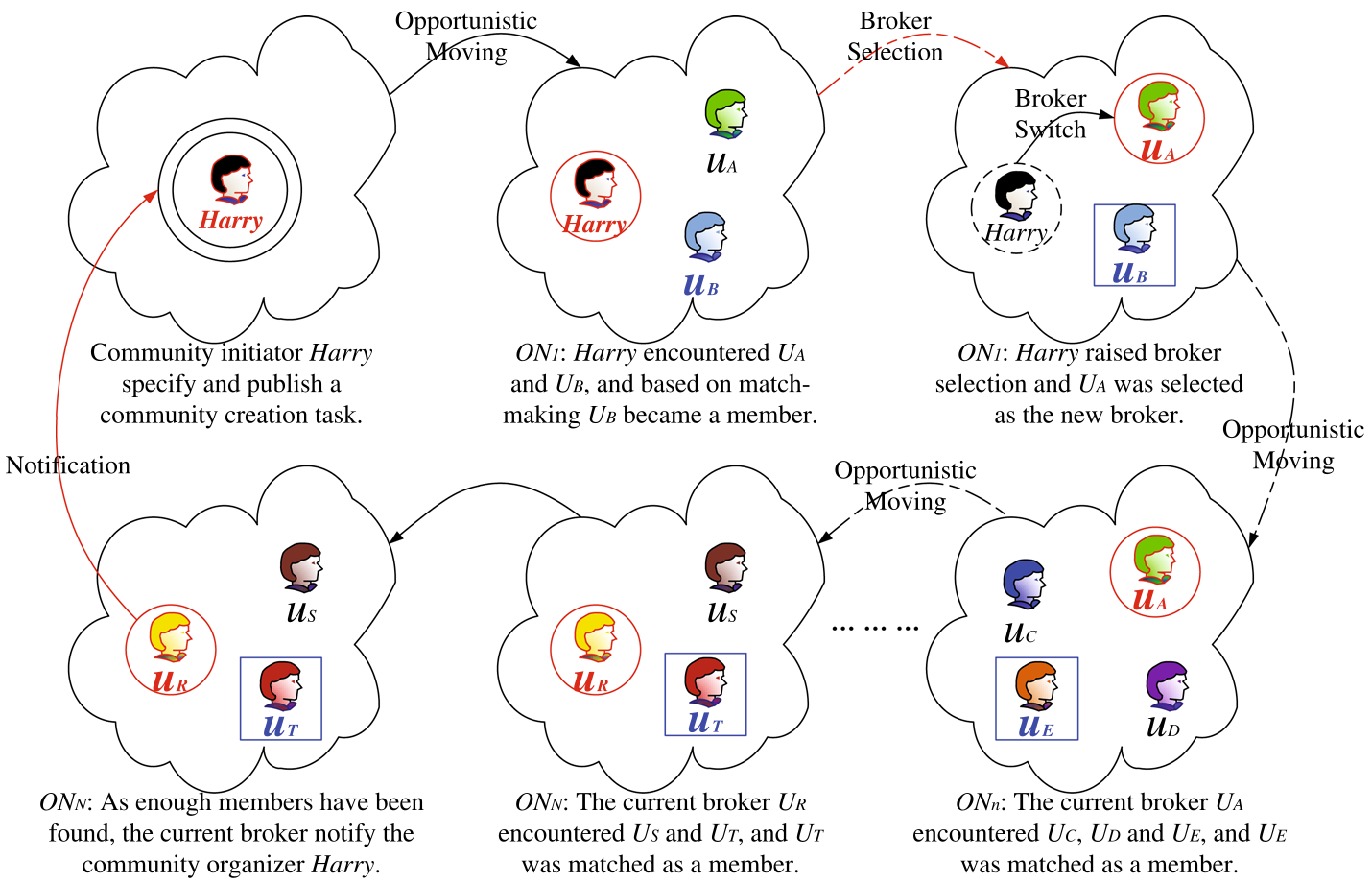 Figure 1: The lifecycle of a community creation task in SOCKER, showing the transition of "brokers" as they encounter more "effective" candidates.
Experiments & Results
The team tested SOCKER against the MIT Reality Mining dataset, which contains real-world Bluetooth encounter data from 106 subjects over a year.
- Higher Completion: SOCKER consistently achieved a higher Community Completion Ratio (CCR) than traditional non-broker methods.
- Efficiency: By using the Expected Broker Popularity (EBP) and User Effectiveness (UE), the system reduced "unnecessary" handovers (Task Transfer Cost), making the process much lighter on battery and bandwidth.
- Satisfaction: For "close-activities," the system successfully prioritized participants with high IUC values, ensuring the group consisted of people the initiator actually knew and liked.
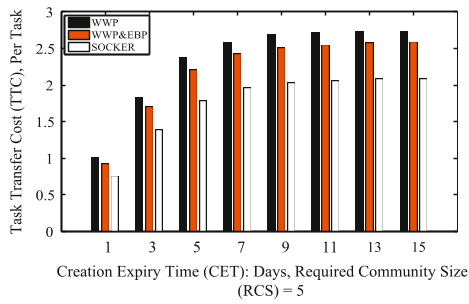 Figure 2: Performance metrics showing SOCKER's superiority in CCR and lower overhead across different activity types.
Critical Analysis & Conclusion
The standout feature of SOCKER is its ability to translate social intentions into mathematical metrics. It proves that by understanding human mobility and social patterns, we can create decentralized systems that bring people together in the physical world.
Limitations: The study relies on historical data (8 weeks of training) to predict future behavior. In highly unpredictable environments, the accuracy of "Popularity" or "IUC" might waver. Furthermore, while it protects some privacy, the "broker" still knows who eventually joins the group.
Future Outlook: SOCKER paves the way for "socially-aware" IoT. Imagine a world where your wearable device helps you find a study group in a library or a hiking partner in a park, all without a central "Big Brother" server managing your every move.
Key Takeaway
SOCKER demonstrates that the best way to build a community isn't just about finding anyone, it's about finding the right people through the most effective messengers, all while respecting the "rhythm" of human life.