
Unmasking the Puppeteers: Detecting Sockpuppets via Propagation Trees
Sockpuppet Detection in Social Network via Propagation Tree
The paper introduces a propagation-structure based method for sockpuppet detection in social networks. By constructing and analyzing "Propagation Trees," the authors identify unique structural artifacts—such as increased depth and width—that distinguish malicious multi-account operations from ordinary users on platforms like Sina Weibo.
TL;DR
Sockpuppets—multiple accounts controlled by a single "puppetmaster"—are the backbone of modern disinformation and cyberbullying. While these actors can change their names and writing styles, they cannot easily hide the way their messages spread. This paper demonstrates that sockpuppet propagation trees are significantly deeper, wider, and more redundant than those of ordinary users, providing a high-accuracy "fingerprint" for detection.
Problem & Motivation: The Limit of Linguistic Cues
The cat-and-mouse game of sockpuppet detection has traditionally focused on Verbal Features (stylometry) and Non-verbal Features (login times, IP addresses). However, "smart" puppetmasters possess a high degree of adaptability:
- Linguistic Disguise: Authors can intentionally vary their vocabulary or use automated tools to alter writing styles.
- Profile Camouflage: Fake bios and diverse login devices can circumvent simple behavioral filters.
- The Hidden Intent: Previous works often treated accounts as isolated nodes, ignoring the holistic "propagation structure" that reveals the coordinated intent to amplify specific viewpoints.
The researchers observed that sockpuppets have a specific goal: Information Amplification. This goal forces them into observable structural patterns that are far more difficult to mask than a profile picture or a sentence structure.
Methodology: The Anatomy of a Propagation Tree
The core innovation lies in the Propagation Tree Construction. By parsing reposting logs (e.g., "A retweets B who retweeted C"), the authors build a hierarchical tree representing the life cycle of a message.
Core Insight: The "Wider and Deeper" Rule
The authors observed three key behavioral anomalies:
- Redundancy: Sockpuppets often participate in the same discussion multiple times within the same tree to maximize reach.
- Structural Aggression: Sockpuppet trees are deeper (avg. 1.86 vs 1.75) and wider (avg. 4.15 vs 3.51) than ordinary ones.
- Behavioral Mimicry: Pairs of sockpuppets within the same group exhibit highly similar tree dimensions (Size, Depth, Width), reflecting a shared tactical playbook.
 Figure 3: Conceptual construction of propagation trees from reposting logs.
Feature Engineering
The model extracts 10 specific features, categorized into:
- Activity Metrics: Number of posts (), Average interval between interactions ().
- Complexity Metrics: Average depth (), Average size (), and Average number of children ().
- Identity Metrics: Average number of identical accounts in a tree (), which flags recursive self-amplification.
Experiments & Results: Outperforming the Baselines
The researchers validated their approach on two datasets from Sina Weibo. They compared their method against Profile, Verbal, and Non-verbal baselines using algorithms like SVM, Random Forest (RF), and Logistic Regression (LR).
| Method | Algorithm | Precision | Recall | F1-Score |
|---|---|---|---|---|
| Verbal | LR | 0.804 | 0.537 | 0.635 |
| Non-verbal | LR | 0.781 | 0.597 | 0.674 |
| Propagation Tree | LR | 0.840 | 0.633 | 0.719 |
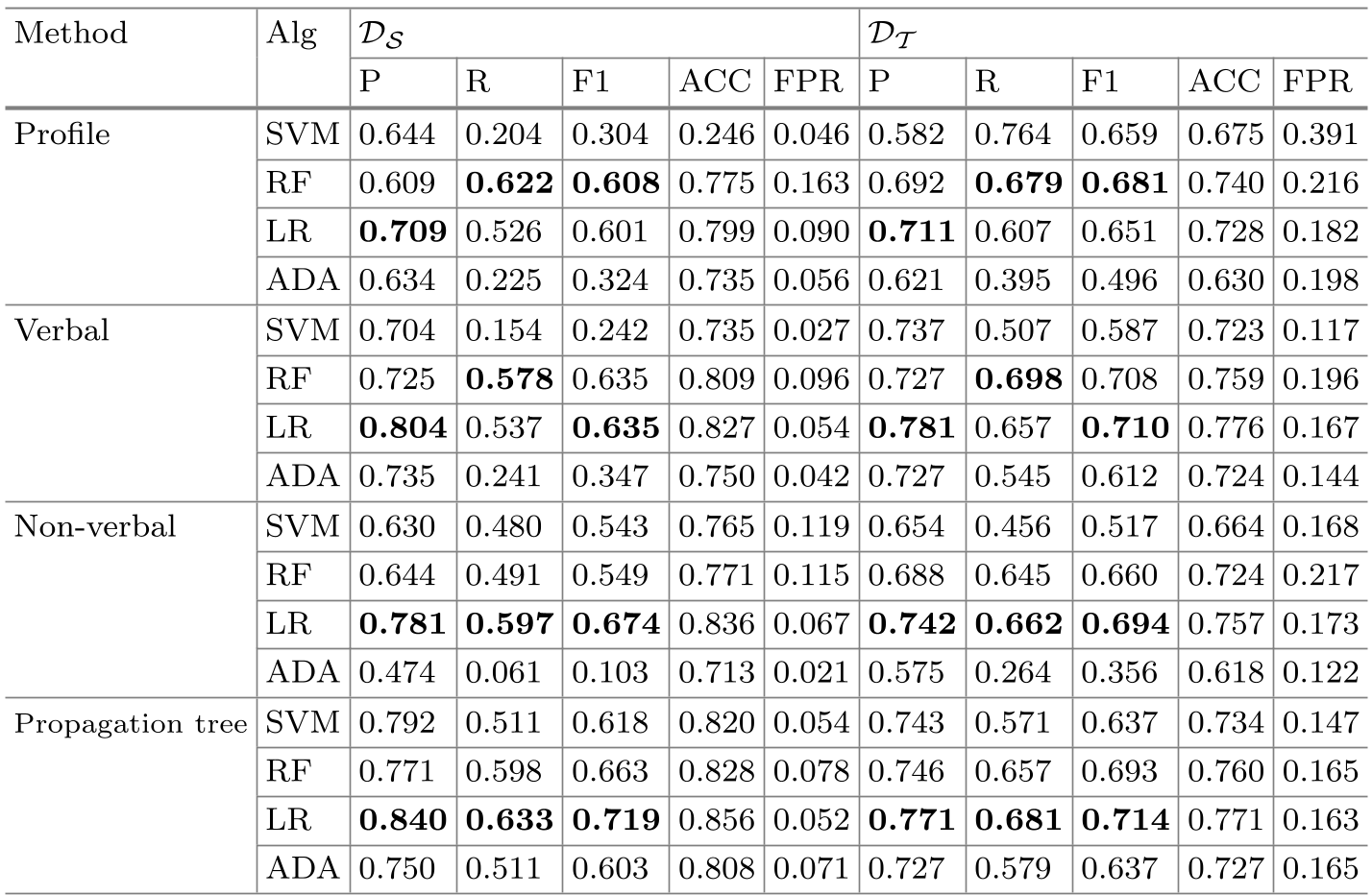 Historical Comparison: The Propagation Tree method consistently yields higher F1-scores and lower False Positive Rates (FPR).
Why it Works
The experiment confirms that while Verbal features are somewhat effective, they suffer from high variability. Propagation features are more robust because they capture the structural signature of coordination. Even if a puppetmaster changes the content of the message, the way they deploy their "army of me" to boost that message remains structurally consistent.
Critical Analysis & Conclusion
Takeaway
This work shifts the focus from "what is being said" to "how it is being spread." The Propagation Tree method provides a robust, platform-independent framework for identifying malicious coordination.
Limitations
- Latency: Tree construction requires a message to have already propagated, meaning this is a detective rather than preventative measure.
- Platform Specificity: The method relies on the "//@username" convention or explicit repost chains, which may vary across different social APIs.
Future Outlook
As adversarial AI continues to generate realistic text (GPT-4), verbal detection will become obsolete. The future of social platform integrity lies in Structural Behavioral Analysis—detecting the invisible threads connecting accounts through their collective impact on the information landscape.