
SoCo: Synergizing Social Circles and Contextual Intelligence for Precision Recommendation
SoCo : A Social Network Aided Context-Aware Recommender System
The paper introduces SoCo, a novel recommendation framework that integrates Social network information and Context-aware data using a hybrid approach of Random Decision Trees and Matrix Factorization. By systematically combining diverse context types (time, location, etc.) with social regularization, it achieves a significant SOTA advancement, reducing Root Mean Square Error (RMSE) by up to 15.7%.
TL;DR
Recommender systems have long evolved past simple user-item grids. However, most contemporary models treat Context (Time, Location) and Social Influence (Friends' Tastes) as separate silos. SoCo breaks this barrier by using Random Decision Trees to partition data into "contextual buckets" and then applying Matrix Factorization refined by a unique context-aware social similarity metric. The result? A staggering 15.7% improvement over prior SOTA context-aware models.
The "Context vs. Social" Dilemma
Why do we need a new model? Consider a user, Bill. Bill likes action movies with his brothers but romance movies with his girlfriend.
- Context-Aware Systems see the "who" (girlfriend vs. brothers) but might ignore that Bill's best friend—who has identical movie tastes—just rated a new film.
- Social Models see the friend's rating but fail to realize the friend watched it in a completely different context (e.g., alone vs. at a party).
Previous attempts at merging these often suffered from scalability issues (dealing with N-dimensional tensors) or data rigidity (only handling categorical "tags" rather than continuous data like timestamps).
Methodology: The SoCo Architecture
SoCo operates through a clever two-stage pipeline: Partitioning and Regularized Factorization.
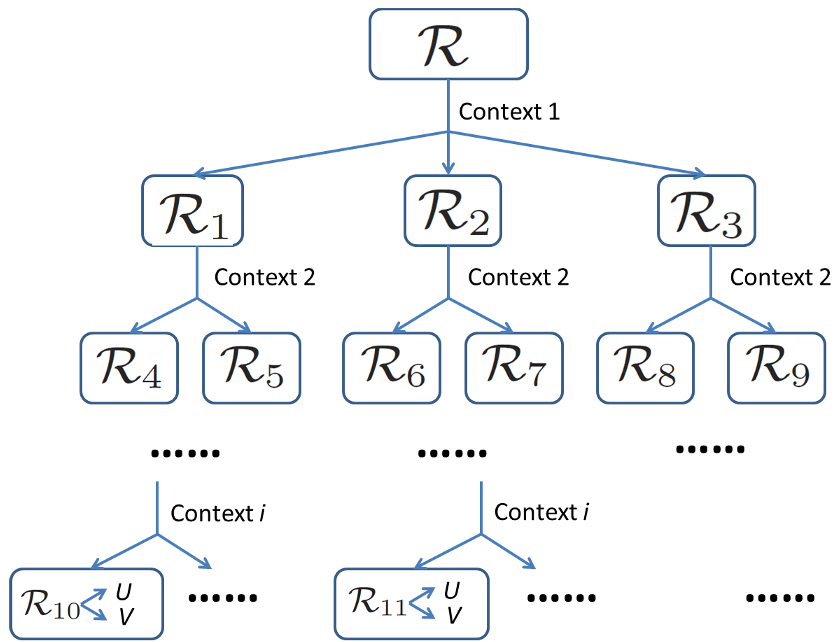
1. Contextual Partitioning via Random Decision Trees
Instead of factorizing one massive, sparse matrix, SoCo uses Decision Trees to split the matrix. Each branch of the tree represents a contextual dimension (e.g., Is it the weekend? Was the user at home?).
- The Insight: Ratings within the same leaf node are "contextually pure." Small, dense sub-matrices are easier to factorize and provide more localized, accurate predictions.
- Scalability: By working on leaves, the computational load is significantly lighter than global tensor decomposition.
2. Social Regularization with a Twist
Once the matrix is partitioned, SoCo doesn't just look at a user's ratings. It looks at their friends. However, not all friends are equal. SoCo introduces a Context-Aware Pearson Correlation Coefficient (PCC). This formula weights a friend's influence higher if they have historically rated items under similar contextual conditions as the current target prediction.
The final objective function balances the error of the rating prediction with a "Social Penalty" that ensures a user's latent factors stay close to their most relevant (contextually similar) friends.
Experimental Results: Proving the Synergy
The authors tested SoCo on the Douban dataset (rich in social links) and MovieLens-1M.
Key Performance Indicators:
- Superiority over SOTA: SoCo consistently maintained the lowest MAE and RMSE across Books, Movies, and Music.
- The Alpha () Factor: The study found that an value of approximately 0.01 provides the perfect balance between individual preference and social influence.
- Tree Efficiency: Only 2-3 random trees are required to reach peak performance, making the system viable for production environments.
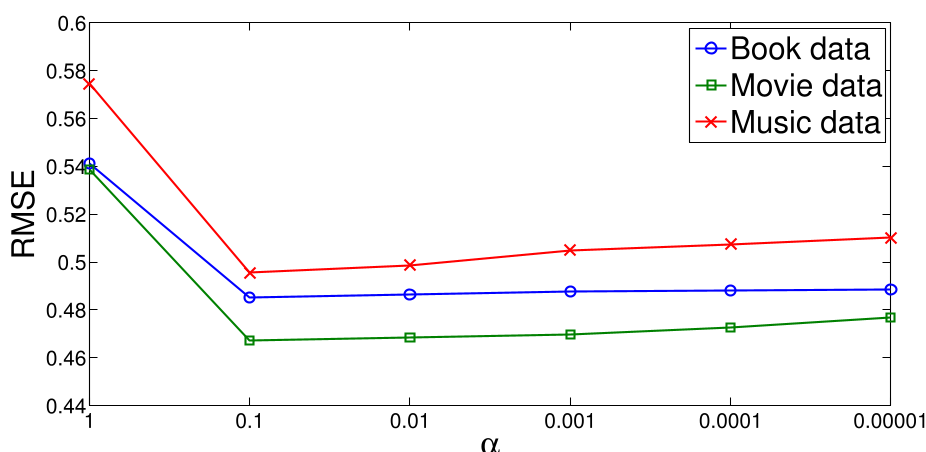 Figure: Performance improvement as social information () is integrated.
Comparison Table (Douban All)
| Model | MAE | RMSE |
|---|---|---|
| SoCo (Ours) | 0.3675 | 0.4788 |
| RPMF (Context only) | 0.4594 | 0.5681 |
| SoReg (Social only) | 0.4374 | 0.5451 |
| BMF (Basic MF) | 0.5029 | 0.6416 |
Critical Insight & Conclusion
The genius of SoCo lies in its explicit handling of context. While many models try to "learn" context implicitly as latent factors (like RPMF), SoCo uses it as a structural guide to reorganize the data.
Limitations: The model may exacerbate cold-start issues if a leaf node becomes too small. The authors mitigate this by backfilling sub-matrices with contextually similar ratings from the original matrix—a "fuzzy" partitioning approach that balances local accuracy with global data density.
Future Outlook: As we move toward 2026, the integration of real-time sensor data (IoT) into the SoCo framework could allow for "Hyper-Social" recommendations that react to a user's physical environment and social circle simultaneously.