
Intelligent Cardiac Monitoring: Enhancing ECG Abnormality Detection with DENLMS and SVM
SPECIAL SECTION ON SOFT COMPUTING TECHNIQUES FOR IMAGE ANALYSIS IN THE MEDICAL INDUSTRY CURRENT TRENDS, CHALLENGES AND SOLUTIONS
This paper presents a remote healthcare framework for ECG abnormality detection, integrating a Delayed Error Normalized LMS (DENLMS) adaptive filter for denoising and an SVM classifier for arrhythmic beat categorization. The system leverages Discrete Wavelet Transform (DWT) with Coiflet wavelets for Heart Rate Variability (HRV) feature extraction, achieving a State-of-the-Art (SOTA) classification accuracy of 96%.
TL;DR
This research introduces an end-to-end pipeline for remote cardiac health monitoring that bridges the gap between signal denoising and automated diagnosis. By utilizing a specialized Delayed Error Normalized LMS (DENLMS) adaptive filter and a Support Vector Machine (SVM), the system achieves a remarkable 96% accuracy in detecting arrhythmias while maintaining the low computational overhead required for portable healthcare devices.
Background: The Challenge of Remote ECG
In the era of telemedicine, transmitting high-fidelity Electrocardiogram (ECG) data over wireless channels is fraught with technical hurdles. Signals are often corrupted by White Gaussian Noise (WGN) and motion artifacts. While standard filtering exists, the "Remote Healthcare" constraint demands algorithms that are not only accurate but also computationally lean for hardware implementation (VLSI) and fast enough for real-time monitoring.
Motivation: Why the Current Methods Fall Short
The authors identify two primary bottlenecks in existing work:
- Computational Complexity: High-performance filters like Recursive Least Squares (RLS) are too resource-heavy for battery-powered portables.
- Filter Stability: Traditional LMS (Least Mean Squares) filters often struggle with a fixed step size—too large, and the system becomes unstable; too small, and it converges too slowly to catch transient abnormalities.
The Core Methodology: DENLMS + Coiflet DWT
The paper's technical innovation resides in a three-stage pipeline:
1. Preprocessing with DENLMS
To solve the latency issue, the authors use a Delayed LMS approach, which allows for pipelining in hardware. By "Normalizing" the step size (NLMS), they ensure the filter adapts its learning rate based on the input power, leading to faster convergence without sacrificing stability.
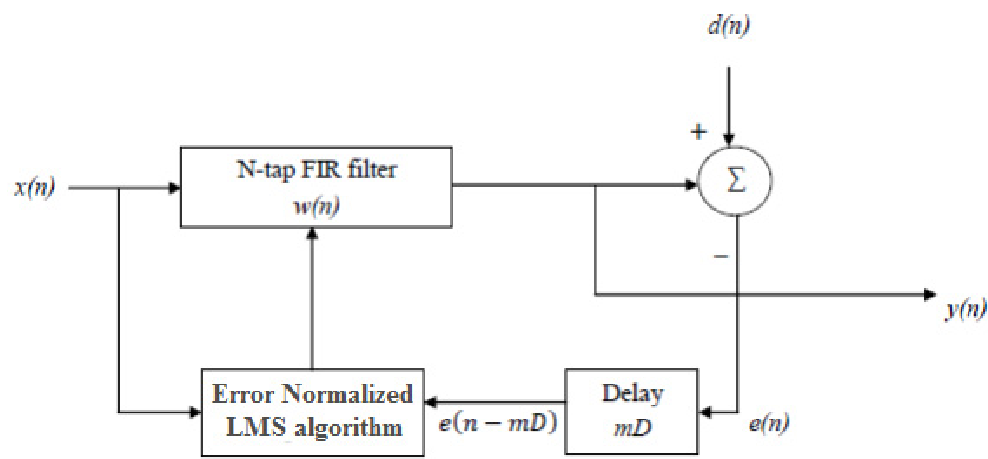 Figure 1: The proposed DENLMS architecture highlighting the feedback loop and weight update mechanism.
2. Feature Extraction via Coiflet Wavelets
Instead of simple thresholding, the study employs Discrete Wavelet Transform (DWT). They specifically select the Coiflet mother wavelet because its near-linear phase and symmetry make it superior to Daubechies wavelets for identifying the QRS complex (R-peaks) in noisy signals. This allows for the calculation of Heart Rate Variability (HRV) features across Very Low, Low, and High frequencies.
Experimental Results & SOTA Comparison
The system was validated using the gold-standard MIT-BIH Arrhythmia Database.
- Filtering Excellence: The DENLMS achieved an MSE of 19.5 dB much faster than TDLMS or standard DNLMS, proving its efficiency for real-time applications.
- Classification Superiority: When compared to other paradigms like Principal Component Analysis (PCA) combined with Neural Networks or Fuzzy KNN, the SVM approach stood out.
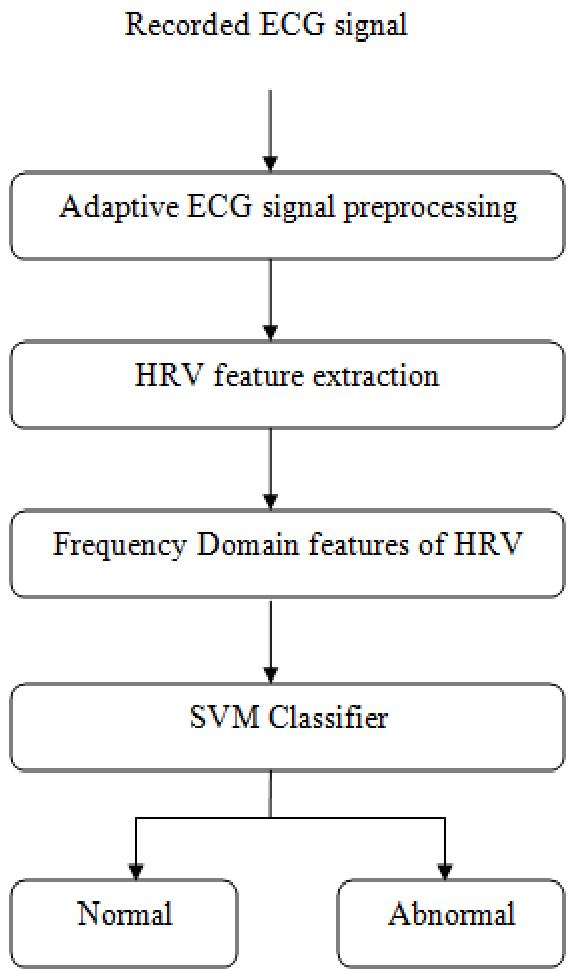 Table: Comparison of classification accuracy across different machine learning methodologies.
The SVM reached 96% accuracy, significantly higher than the 90.4% achieved by standard KNN or the 94.2% of Neuro-Fuzzy systems.
Critical Insight: Efficiency Meets Accuracy
The true value of this work is not just the 96% accuracy—it is the hardware-centric design. By focusing on the DENLMS algorithm, the authors provide a blueprint for filters that can be implemented in VLSI with minimal area and power consumption. This makes the leap from a laboratory MATLAB simulation to a real-world wearable medical device feasible.
Conclusion and Future Outlook
The combination of adaptive filtering and SVM-based classification provides a robust framework for heart disease detection. While the accuracy is impressive, future work could explore the integration of Deep Learning models that are specifically pruned for edge devices, or the application of this denoising technique to other bio-signals like EEG or EMG.
Takeaway: Effective remote healthcare isn't just about the "smartest" AI—it's about the synergy between efficient signal processing and robust pattern recognition.