
Soft Computing in EDM and LA: Bridging the Gap Between Data and Pedagogy
On the Use of Soft Computing Methods in Educational Data Mining and Learning Analytics Research: a Review of Years 2010–2018
This paper presents a systematic literature review (SLR) of 300 journal articles published between 2010 and 2018, analyzing the application of Soft Computing (SC) methods within Educational Data Mining (EDM) and Learning Analytics (LA). The study highlights how SC tools like Bayesian reasoning, Decision Trees, and Neural Networks are leveraged to solve complex educational problems such as performance prediction and student assessment.
TL;DR
This comprehensive review analyzes how Soft Computing (SC)—including Fuzzy Logic, Neural Networks, and Evolutionary Algorithms—has transformed Educational Data Mining (EDM) and Learning Analytics (LA) from 2010 to 2018. The core insight is that while EDM has enthusiastically adopted automated SC tools for prediction, the LA field remains more conservative, relying on "classic" statistics to support human judgment.
The "Hard" Problem of Educational Data
Why is education a "Soft Computing" problem? Unlike physical systems governed by rigid laws, education involves human cognition, social dynamics, and qualitative feedback. Traditional mathematical models often break down when faced with:
- Imprecision: Subjective grading and student engagement metrics.
- Uncertainty: The stochastic nature of student motivation and dropout risks.
- Complexity: Large-scale data generated by Learning Management Systems (LMS) that require iterative optimization rather than exhaustive search.
Methodology: The Four-Axis Analysis
The authors provide a rigorous systematic review, filtering 775 initial papers down to 300 high-quality journal articles. They examine:
- Objectives: Assessment, Prediction, and Recommendation.
- Contexts: E-learning, Blended Learning, and Traditional Classrooms.
- Classic Methods: Regression, Clustering, and Correlation.
- Soft Computing Tools: ANN, SVM, Fuzzy Logic, and Hybrid Systems.
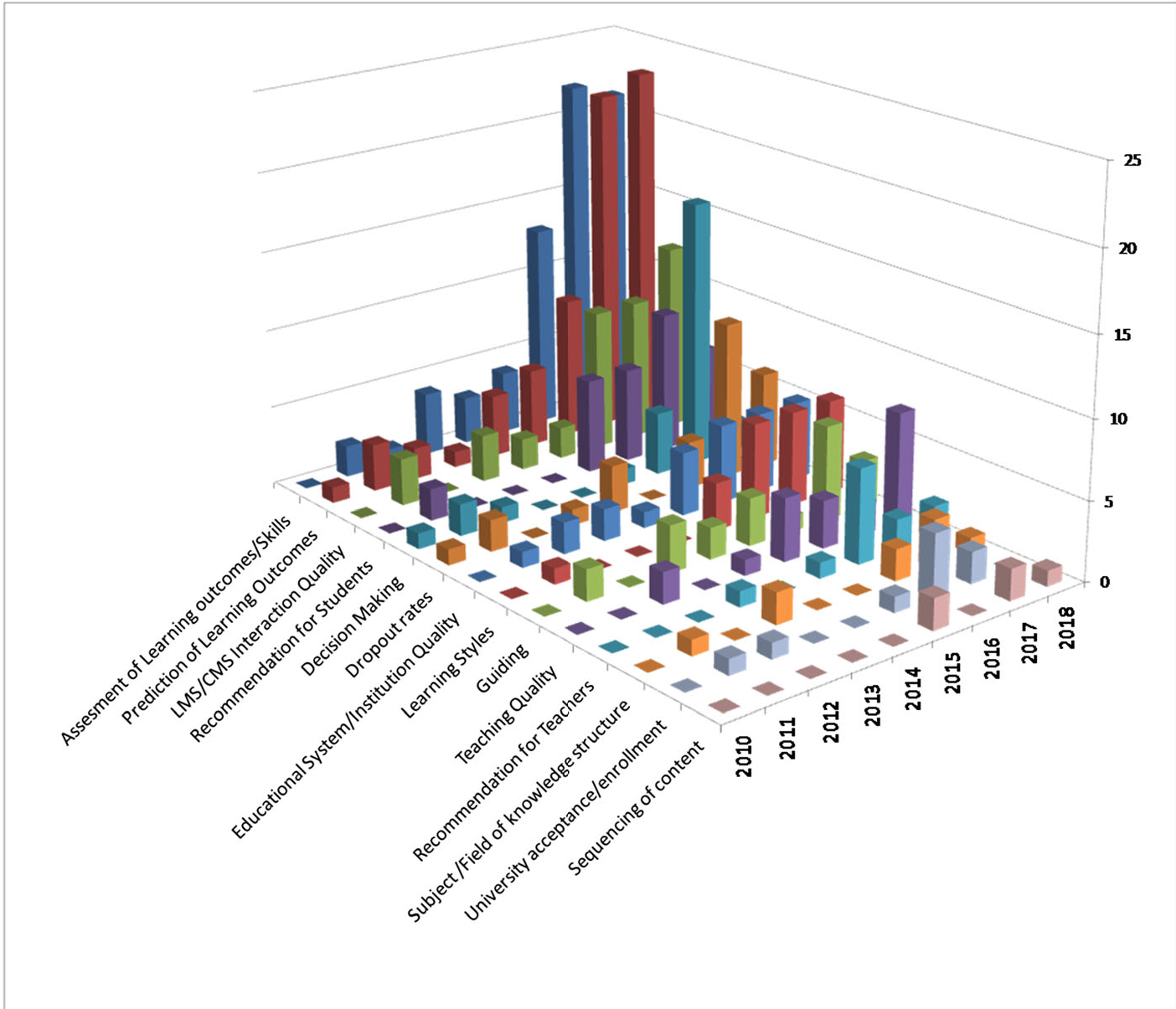 Figure 1: The rising trajectory of various educational problems addressed by EDM research, showing a dominant focus on Assessment and Prediction.
Key Insights: EDM vs. LA
The paper unearths a fascinating divergence in how these two sibling fields handle AI:
1. The Automation Divide
EDM is largely an automated endeavor. Over 70% of the reviewed papers use SC to detect patterns without human intervention. Conversely, LA prioritizes the human-in-the-loop, with only 21% utilizing SC, preferring to present descriptive statistics to teachers and administrators.
2. The Toolset Choice
- EDM Staples: Bayesian Reasoning, Decision Trees, and Support Vector Machines (SVM).
- LA Staples: Logistic Regression and hybrid systems for specific, targeted interventions.
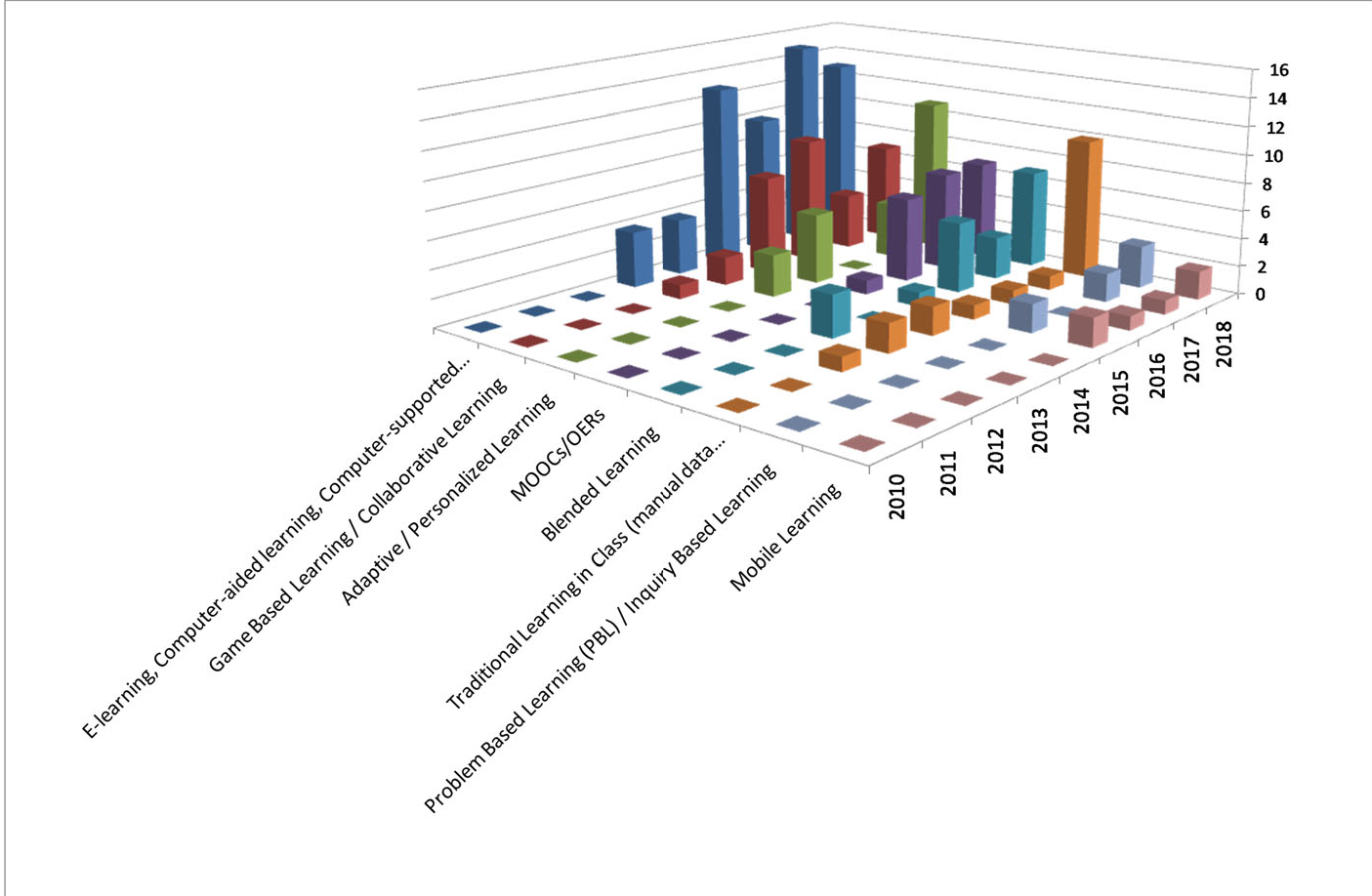 Figure 2: The distribution of Soft Computing methods across different learning environments, highlighting the saturation of E-learning and Traditional settings.
Critical Analysis: The Missing Feedback Loop
One of the paper's most salient points is the lack of "Prescriptive Analytics." While we are excellent at predicting who will fail a course (Accuracy +80% in many models), we are still in the early stages of prescribing what to do about it. The "Feedback Loop"—returning insights to students and teachers in real-time—remains the "Holy Grail" of the field.
Conclusion and Future Outlook
The next decade of research must move beyond surface-level metrics (clicks and logins) toward understanding complex constructs like metacognition and self-regulated learning. The authors argue that AI/SC is the only way to handle the multimodal, Technical complexity of 21st-century education.
Future Directions:
- Automated Visualization: Bridging the gap for non-technical stakeholders.
- Affective Computing: Incorporating student emotions into the learning model.
- Hybrid Systems: Combining the predictive power of Neural Networks with the interpretability of Fuzzy Logic.