
Decoding Software Crowdsourcing: A Game-Theoretic Evaluation Framework
An evaluation framework for software crowdsourcing
This paper proposes a formal evaluation framework for software crowdsourcing, categorizing projects based on participation-output models and submission-award schemes. It introduces a Game Theory model to analyze "Min-Max" competition rules, demonstrating how different incentive structures impact software quality and participant behavior in platforms like TopCoder and AppStori.
TL;DR
As software development shifts from traditional "factories" to decentralized "ecosystems," we lack a rigorous way to measure project success. This paper introduces an evaluation framework that uses Game Theory to balance the "Min-Max" tension between developers and testers. It explains why some platforms (like TopCoder) thrive on cutthroat competition while others (like AppStori) succeed through collaborative crowdfunding.
Background: Beyond Open Source
Unlike traditional Open Source, Software Crowdsourcing is a market-driven model. It involves an "OPEN call" for any task—design, coding, or testing—motivated by financial rewards and reputation. However, the shift raises a critical question: How do we ensure engineering discipline in a crowd of strangers?
The Problem: The Chaos of the Crowd
Software development requires rigid syntax, documentation, and liability. Existing crowdsourcing literature often treats tasks as simple "microtasks" (like image labeling). Software is different; it is interdependent and complex. The authors identify a gap: we need a guideline to prioritize goals like Quality vs. Rapid Acquisition vs. Cost Reduction.
Methodology: The Min-Max Logic
The core insight of this paper is the Min-Max relationship. In software, quality is an adversarial game:
- The Developer (Min): Tries to minimize the number of bugs in the output.
- The Tester/Reviewer (Max): Tries to maximize the identification of bugs.
The Taxonomy of Competition
The framework classifies these interactions into three intensities:
- Weak Min-Max (wmm): Collaborative; bugs aren't used for performance evaluation (e.g., peer learning).
- Min-Max (mm): Performance is tied to bugs found; used for quality assurance.
- Strong Min-Max (smm): Competitive elimination; players try to "destroy" opponents' solutions to win a sole prize.
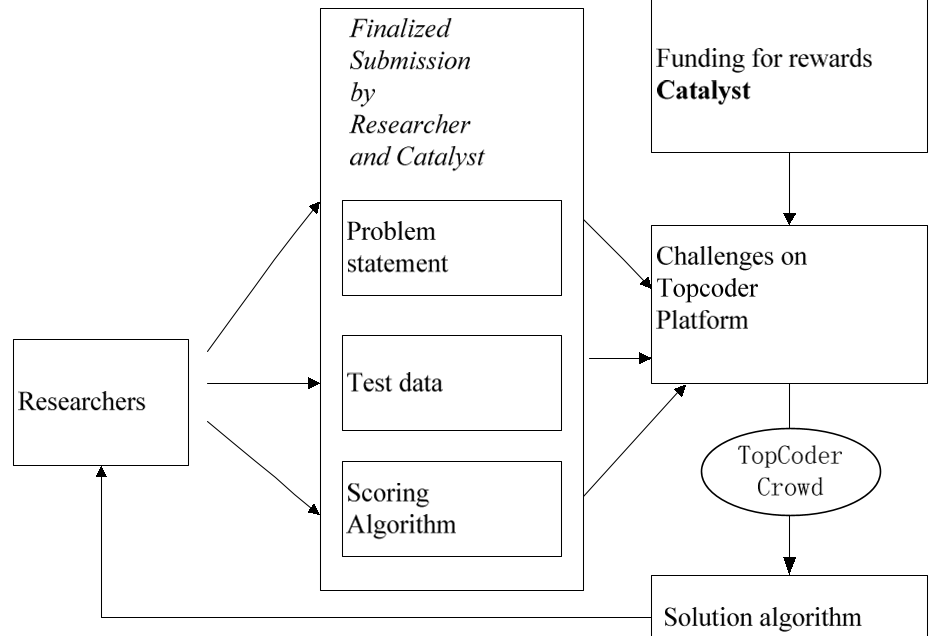 Figure 1: The architecture of a highly competitive crowdsourcing process where researchers and the crowd interact via Min-Max rules.
Mathematical Insight: The Nash Equilibrium
Using Game Theory, the authors calculate the probability () of a player choosing a "Defense" strategy (improving their own code) vs. an "Offense" strategy (finding others' bugs).
- In Non-cooperative Games (Strong Min-Max): The Nash equilibrium shows that as an opponent's skill level increases, a player is more likely to use "Offense" to sabotage the leader. This "mutual destruction" actually helps organizers identify the single most resilient talent.
- In Coordination Games (Weak Min-Max): Appropriate awards () for testing encourage superior players to help weaker players, moving the community toward "Collective Intelligence."
Case Studies: TopCoder vs. AppStori
The paper applies this framework to two real-world extremes:
1. Harvard-TopCoder (The Competitive Engine)
Here, participants produce components (). The competition is stiff, often refined to only top-two winners.
- The Reputation Factor: The authors prove that the "Intrinsic Reputation Value" () allows prestigious organizations like Harvard to attract 600+ submissions for a relatively small $200k prize. The mathematical effort involved far exceeds the monetary reward, proving that "reputation" is a quantifiable currency in crowdsourcing.
2. AppStori (The Collaborative Ecosystem)
AppStori uses Crowdfunding. There is no "sabotage." Instead, the project team has a weak min-max relationship with beta testers.
- Outcome: The team and crowd maintain 100% working momentum because the "award" is the project budget itself, fostering an agile, cohesive environment.
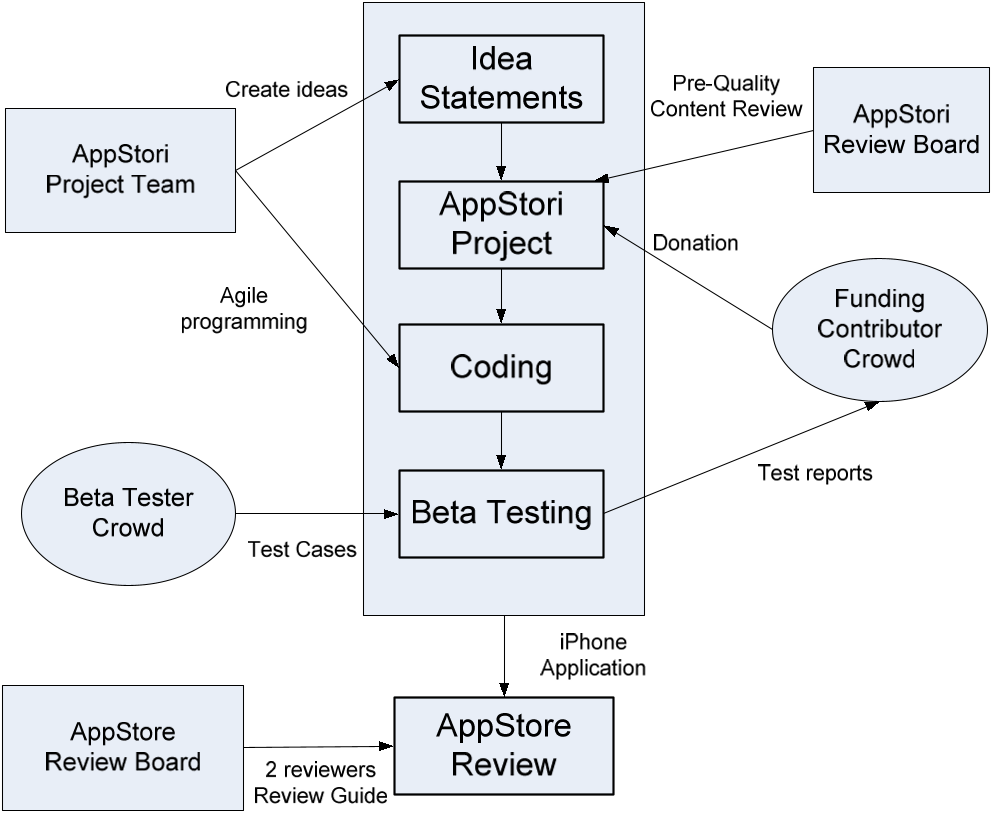 Figure 2: The collaborative AppStori process, emphasizing "Weak Min-Max" relationships between teams and funding contributors.
Critical Analysis & Conclusion
This work moves software crowdsourcing from "anecdotal success" to "mathematical design."
- Takeaway: If you want the best code, design a Strong Min-Max contest. If you want to build a community or explore new ideas, use Weak Min-Max.
- Limitations: The model assumes participants can accurately estimate their winning probability (), which may not hold true for newcomers. Future work should explore how "AI agents" in the crowd might disrupt these game-theoretic balances.
Ultimately, software crowdsourcing isn't just about "outsourcing"; it's about designing a game where the rules naturally move the crowd toward high-quality engineering.