
Software Engineering at the Speed of Light: How Twitter Became the Developer’s Global Nervous System
Software engineering at the speed of light: how developers stay current using twitter
This study investigates the pivotal role of Twitter in modern Software Engineering, characterizing it as a vital tool for staying current in a fast-paced industry. Using a Grounded Theory approach involving over 1,500 developers, the authors identify how microblogging facilitates real-time awareness, peer learning, and professional relationship building.
TL;DR
In a world where frameworks go obsolete in months, developers are turning to Twitter to maintain a competitive edge. This study reveals that Twitter isn't just "chatter"—it's a sophisticated tool for Just-in-Time Awareness, Serendipitous Learning, and Trust Building. By curating a network of "thought leaders" and "news curators," developers transform a noisy stream into a precision-engineered information filter.
Background: Beyond the Code
Historically, we viewed software engineering as a solitary activity focused on the IDE. However, the rise of open-source and social coding (GitHub) has shifted the locus of innovation to the "Social Programmer Ecosystem." The authors position this work as a critical investigation into how micro-communications solve the "information velocity" problem that email and IRC cannot.
The "Why": Motivation & The Developer Insight
The core problem is Information Overload/Velocity. Traditional methods (reading documentation, long-form blogs) are "pull" mechanisms that are too slow. The internal insight of this paper is that Twitter functions as a distributed human filter.
Developers don't follow "everyone"; they follow Curators and Thought Leaders. By doing so, they outsource the effort of finding what’s relevant. If a leader in the Node.js community retweets a library, it’s a pre-validated signal of quality.
Methodology: Decoding the Flow
The researchers utilized a three-stage Grounded Theory approach to move from raw observations to a validated model of behavior.
The Three Pillars of Value:
- Awareness: Monitoring "Technological Niches" to see what leaders are excited about before it hits the mainstream.
- Learning: Serendipitous acquisition of tacit knowledge. You don't know what you don't know until it appears in your feed.
- Relationships: Moving from "Weak Ties" (following a stranger) to "Trust and Rapport" (collaborating on a PR because you recognize their personality from tweets).
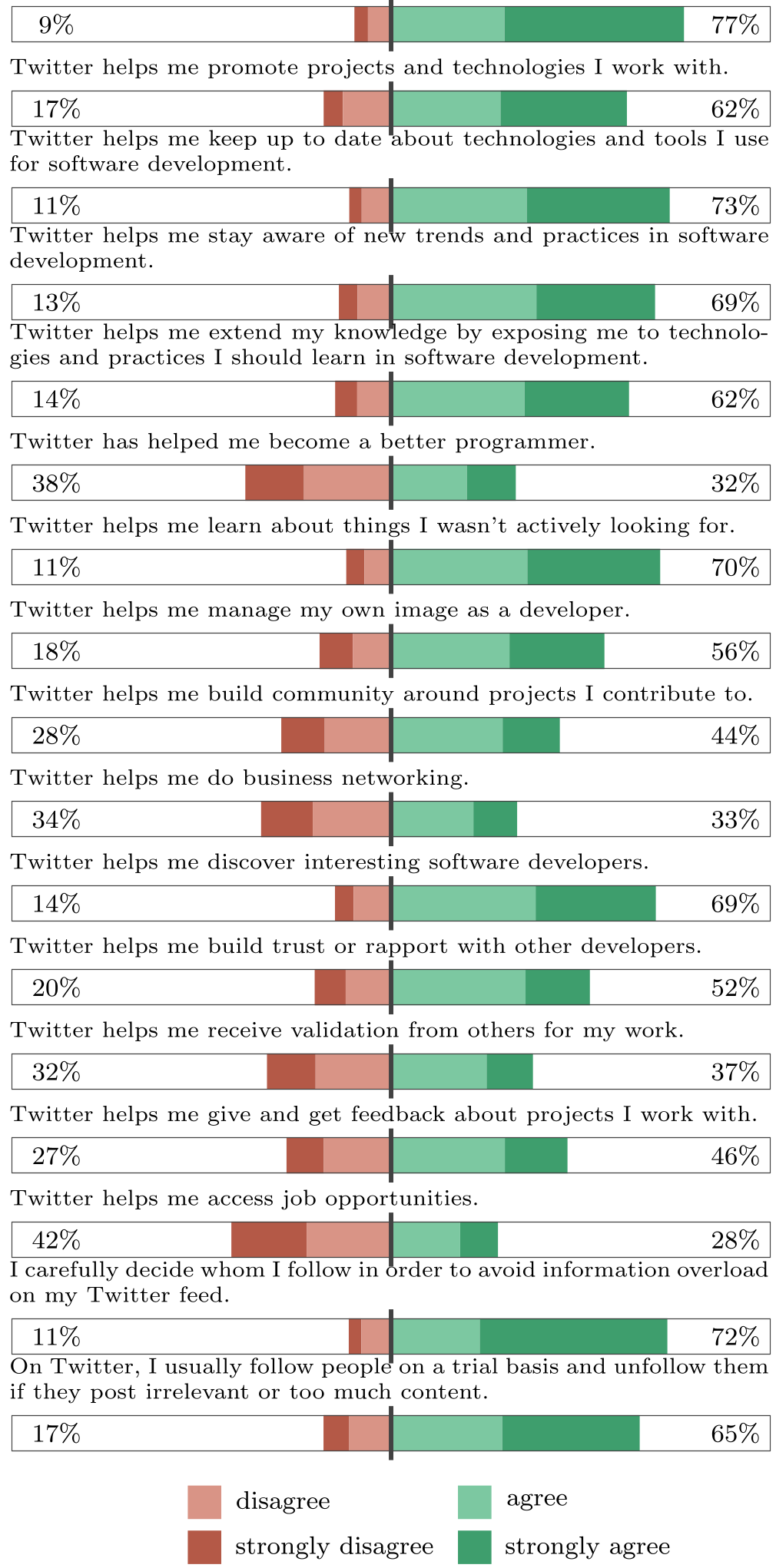 The survey results highlight high agreement on awareness (Top) vs. lower agreement on direct job hunting (Bottom).
The "How": Coping Strategies for the Firehose
One of the paper's most fascinating sections is how developers manage Noise.
- The Purge: Adopters don't see "Following" as a permanent state. They treat it as a trial; if the signal-to-noise ratio drops, they unfollow.
- Visual Skimming: Many developers admit to skimming timelines by profile pictures rather than text, using visual recognition to find posts from trusted individuals.
- Link Caching: Using tools like Pocket to "batch" the deep reading, preventing Twitter from interrupting the "Deep Work" of coding.
Critical Analysis & Future Outlook
The Power Law of Influence
The study implicitly highlights a potential danger: the Echo Chamber. If the majority of developers follow a few "Thought Leaders," the industry’s direction is controlled by a tiny elite. This "centralization of influence" impacts which technologies get adopted and which die.
Limitations
The study was conducted in 2014. Since then, the fragmentation of Twitter (now X) and the rise of platforms like Mastodon and Discord have likely changed the "Global Nervous System." However, the psychological motivations (Human Factors) identified here—the need for validation, awareness, and curated learning—remain universal.
Conclusion: Should You Tweet?
The paper’s message is clear: You don't have to be a "social" person to benefit from social media. By treating Twitter as a professional sensor network—not a social club—individual developers and organizations can detect industry shifts at the "speed of light."
Takeaway for Practitioners:
- Follow 5 niche leaders.
- Share "Micro-Learnings" (one thing you learned today).
- Prune your feed ruthlessly to maintain a high signal-to-noise ratio.