
Software Traceability with Topic Modeling: A Semantic Leap in System Evolution
Software traceability with topic modeling
This paper introduces an automated approach for software traceability by integrating prospective link capture with Latent Dirichlet Allocation (LDA) topic modeling. The methodology enables real-time semantic categorization and architectural visualization of heterogeneous software artifacts, achieving superior precision-recall performance compared to traditional LSI-based methods.
TL;DR
Managing thousands of software artifacts—from requirements to code—is a nightmare for scalability. This paper introduces a breakthrough by combining prospective link capture (recording links as developers work) with Latent Dirichlet Allocation (LDA). The result is a system that not only knows that documents are related, but why they are related semantically, visualized directly on the software architecture.
Background: The Traceability Gap
In modern software engineering, the gap between high-level requirements and low-level source code is a chasm. Traditional Retrospective Traceability tries to bridge this by looking at old documents and guessing links, which often results in a "noise" of false positives. This paper positions itself as a solution that operates in real-time, focusing on the Software Architecture as the central nexus for all relationships.
The Problem: Why Automation Fails
Existing methods (like Keyword search or Vector Space Models) are often "dumb" to context. They miss the developer's intent and fail to handle the sheer volume of heterogeneous data (PDFs, Wiki pages, Bug reports). Furthermore, manual tracing is so overhead-heavy that developers simply don't do it.
Methodology: The Symbiosis of Action and Semantics
The core innovation is the "positive symbiosis" between two techniques:
- Prospective Capture (ACTS tool): Instead of guessing links later, the system records what a developer touches while they are working on a specific architectural component.
- Topic Modeling (LDA): It uses LDA to automatically discover "topics" (clusters of words) across the documentation.
Architecture Overview
The authors implemented a suite of tools to realize this vision:
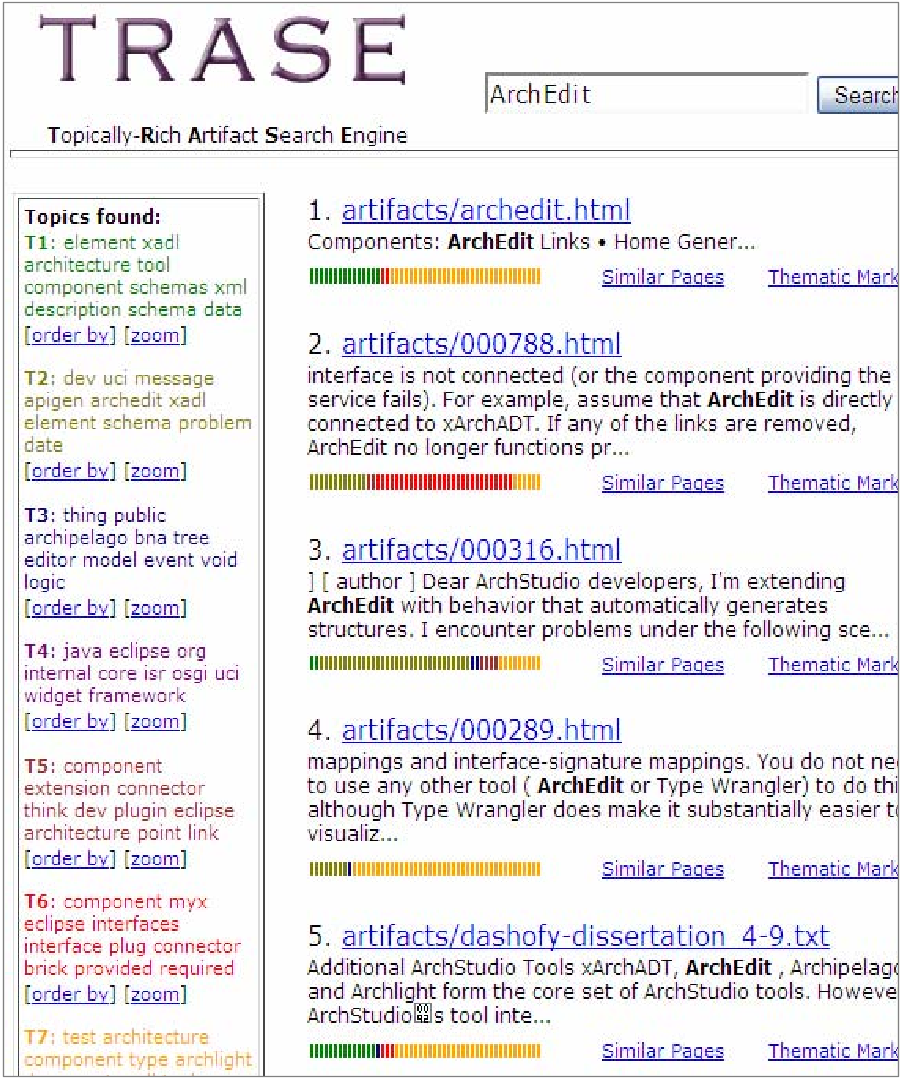
- TRASE: A search engine that reorganizes results based on latent semantic topics rather than just keywords.
- TEAM: A visualization "mashup" that colors architectural components based on the topics discussed in their associated artifacts.
The Mathematics of "Discovery"
The paper utilizes the CVB0 inference algorithm for LDA. Unlike older LSI techniques, LDA is fully probabilistic. It treats every document as a mixture of various topics, and every topic as a distribution over words. This allows the system to say, for example, that a specific bug report is "60% about XML Parsing and 40% about Java Memory Leaks."
Experiments: Real-World Performance
The authors applied this to ArchStudio, a complex system with over 85,000 lines of code.
- Scalability: The timing results (Figure 10) show that topic modeling remains efficient even as the number of artifacts increases, allowing for real-time updates.
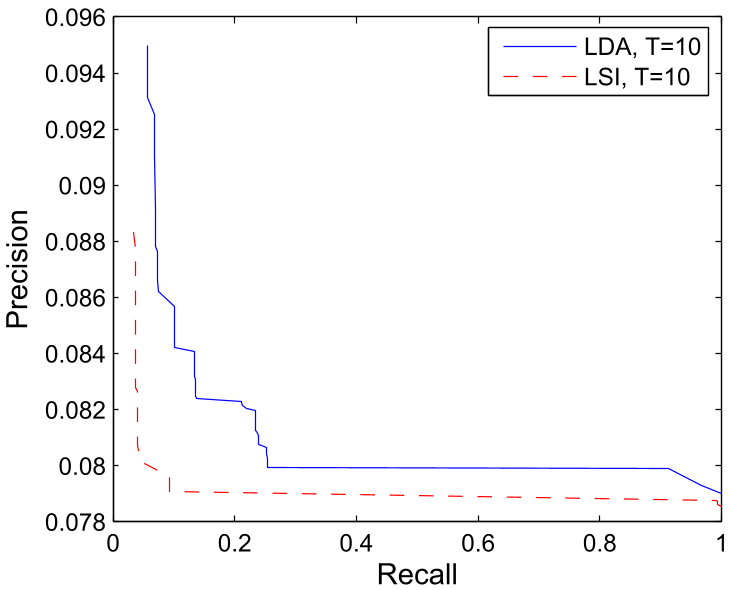
- Accuracy: In a direct face-off against Latent Semantic Indexing (LSI), LDA showed higher precision across various recall levels (Figure 11).
Deep Insight: Why Architecture Centric?
A critical takeaway is the "Boundary" principle. By linking artifacts to Architectural Components rather than individual lines of code, the researchers reduced the complexity of the link-mesh. This makes the data manageable for humans and more semantically coherent for the machine learning model.
Conclusion & Limitations
While powerful, the approach currently relies heavily on text. "Non-text" artifacts like images or video can be linked but not "understood" by the LDA model unless there is metadata. However, the study proves that when we record the process of development and layer it with semantic analysis, software maintenance becomes significantly more intuitive.
Future Outlook: The integration of automated topic labeling and temporal "Dynamic Topic Models" could allow project managers to see how a project's focus shifts over months of development.