
Beyond the Carrot: Why Solvers Actually Participate in Crowdsourcing
Solvers’ participation in crowdsourcing platforms: Examining the impacts of trust, and benefit and cost factors
This study investigates the drivers and inhibitors of "solver" participation in competition-based crowdsourcing platforms. Utilizing Social Exchange Theory (SET), the authors developed a model to evaluate how trust, perceived benefits (e.g., monetary reward, skill enhancement), and perceived costs (e.g., cognitive effort) influence actual participation behavior on the TaskCN platform.
TL;DR
Why do some crowdsourcing platforms thrive with talented contributors while others wither? This study by Ye and Kankanhalli reveals that while "carrots" like money and skill-building matter, the "sticks"—specifically cognitive effort and lack of trust—are powerful inhibitors of actual participation. By analyzing real behavioral data from TaskCN, the research proves that participation is a complex cost-benefit calculation mediated by the solver's trust in the platform's fairness.
Background: The Intention-Behavior Gap
In the academic world of Information Systems, we often ask people what they intend to do. However, in crowdsourcing, what a person says they will do and what they actually submit are two different things. This paper positions itself as a critical bridge, moving from measuring "intentions" to measuring "actual behavioral submissions" over a three-month window.
The "Why": Motivation and Cognitive Friction
The authors argue that participation isn't just about the thrill of the win. Using Social Exchange Theory (SET), they posit that humans are rational actors seeking to maximize benefits while minimizing costs.
The Drivers (The Benefits)
- Monetary Rewards: The most obvious extrinsic motivator.
- Skill Enhancement: The "learning by doing" aspect.
- Work Autonomy: The freedom to choose when and what to work on—a hallmark of the freelance economy.
- Enjoyment: The intrinsic "fun" of solving a novel puzzle.
The Inhibitors (The Costs)
- Cognitive Effort: This is the "tax" on your brain. If a task is poorly defined or requires too much mental jumping-through-hoops to link one's expertise to the problem, solvers simply walk away.
- Loss of Knowledge Power: The fear that by sharing an idea, you lose your competitive edge or proprietary "secret sauce."
Methodology: Bridging Survey and Archive
The researchers didn't just rely on a single survey. They used a multi-source approach:
- Survey Data: To capture perceptions of rewards, effort, and trust.
- Archival Data: Three months later, they pulled the actual submission counts for the same 156 users from the TaskCN database.
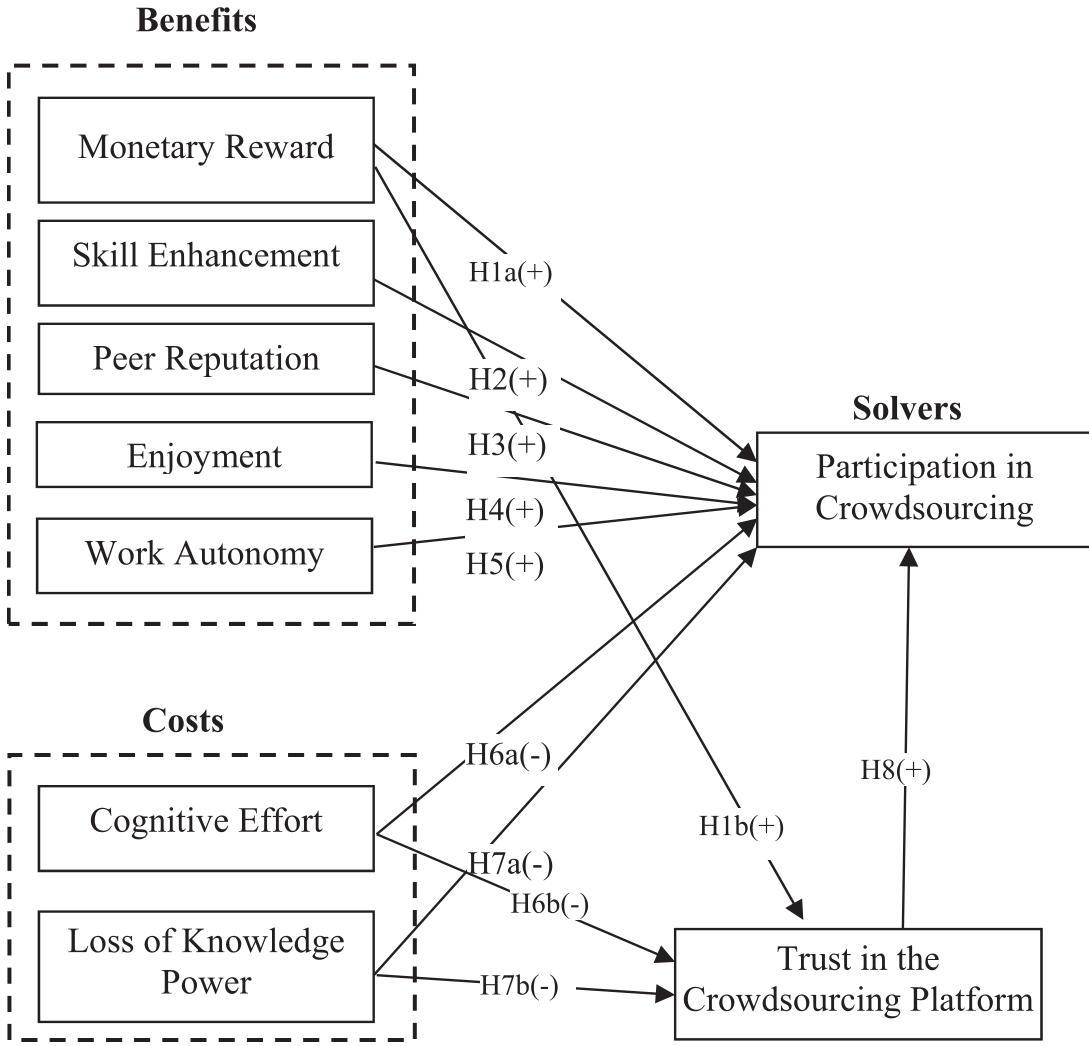 Figure 1: The Research Model illustrating the Benefit-Cost-Trust framework.
Key Insights: Trust is the Engine
The study’s most compelling finding is the role of Trust. Trust acts as a lubricant for the entire system:
- Partial Mediation: Monetary rewards don't just drive participation directly; they also build trust. If a platform is known for high, consistent payouts, solvers trust the system's fairness more, which further fuels participation.
- The Power Paradox: While the "Loss of Knowledge Power" didn't directly stop people from participating, it eroded trust, which then lowered participation.
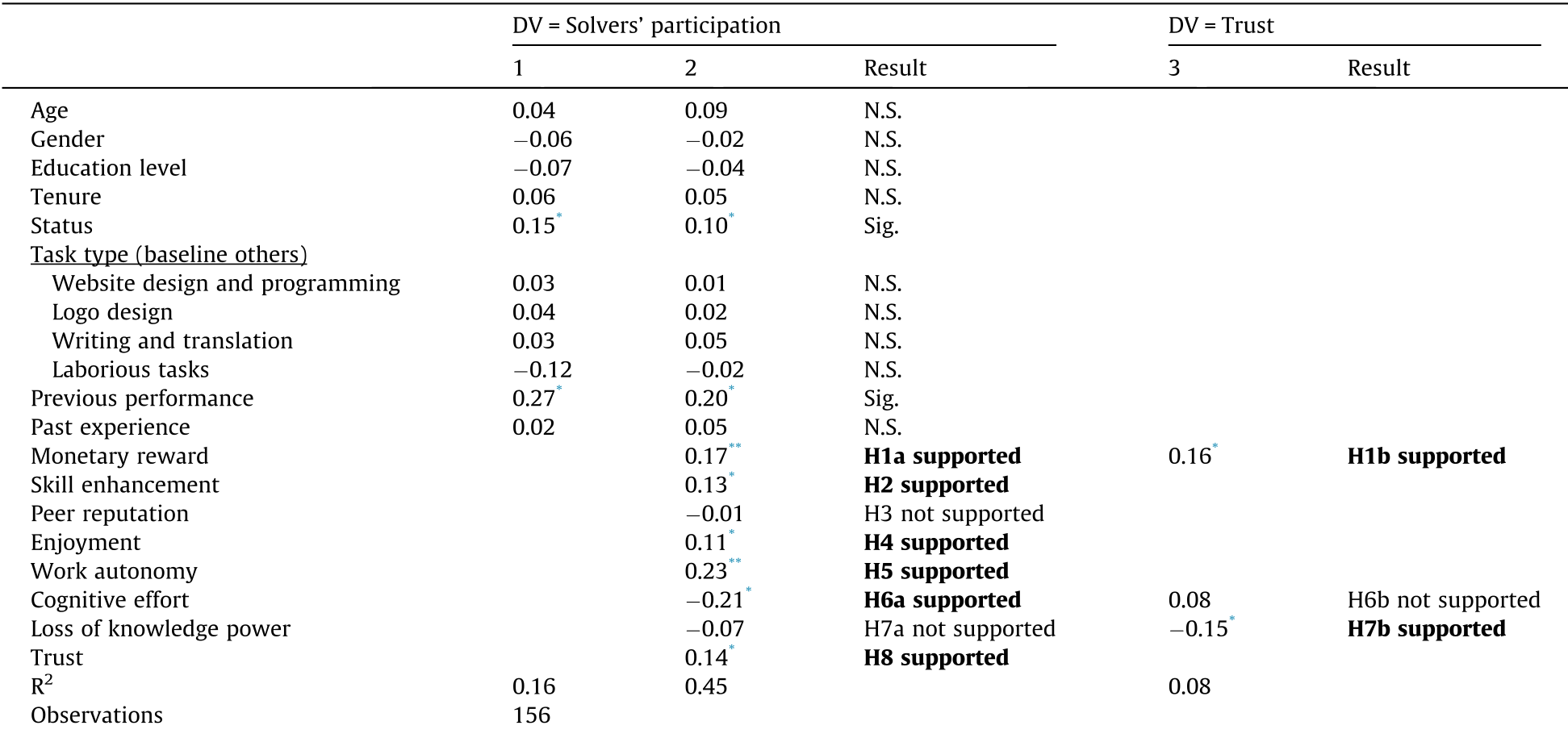 Table: Hypothesis testing results showing the significant negative impact of Cognitive Effort and positive impact of Trust.
Professional vs. Amateur Solvers
A post-hoc analysis revealed a fascinating dichotomy:
- Professionals (those who rely on crowdsourcing for income) are far more sensitive to Trust and Cognitive Effort. They view their time as a resource and won't waste it on "low-trust" or "high-friction" tasks.
- Amateurs are more driven by Work Autonomy, valuing the flexibility over the rigorous cost-benefit analysis performed by pros.
Critical Insight & Conclusion
The "takeaway" for platform designers is clear: Reduce the Friction.
If you want high-quality solvers, you cannot just throw more prize money at them. You must lower the Cognitive Effort by helping seekers define their problems more clearly. Furthermore, you must build a "Trust Infrastructure"—ensuring rewards are guaranteed and plagiarism is punished. In the social exchange of crowdsourcing, the platform's primary job is to ensure the "cost" of entry isn't higher than the "benefit" of victory.
Limitations
The study is focused on a Chinese competition-based platform (TaskCN). Future research should verify if these dynamics hold in collaborative environments like Wikipedia or purely voluntary open-source projects.