
Beyond Clusters: Transforming Self-Organizing Maps into Predictive Marketing Profiles
A new SOM-based method for profile generation: Theory and an application in direct marketing
The paper introduces a generic SOM-based profile generator that automates the creation of business-oriented customer profiles by combining Self-Organizing Maps (SOM) with salient dimensions (SD) extraction. The method was successfully validated in a direct marketing case study within the concert industry, effectively predicting potential ticket buyers for future events.
TL;DR
This paper presents a novel framework that turns the visual power of Self-Organizing Maps (SOM) into a precise "Profile Generator." By extracting "salient dimensions" from clusters, the authors create a way to target unknown prospects with specific characteristics. In a real-world concert industry trial, the method's Level Selection Technique (LST) proved to be a highly efficient way to outperform random marketing benchmarks.
The Problem: Data Rich, Insight Poor
In direct marketing, the goal isn't just to reward existing customers, but to find new ones. While supervised learning thrives on labeled historical data, it often fails to uncover the intuitive segments that managers need for broad campaigns. High-dimensional data—spanning demographics, RFM (Recency, Frequency, Monetary) scores, and interests—is often too "noisy" for humans to process manually. Prior works used SOM for visualization, but translating those colorful maps into discrete, actionable "if-then" profiles remained a manual and subjective task.
Methodology: The Five-Step Profile Engine
The core of this work is the transition from unsupervised visualization to automated rule generation.
- Index Generation: Converting raw data (age, distance, RFM) into categorical binary dimensions.
- SOM Training: Mapping high-dimensional customer data onto a 2D grid of neurons.
- Clustering & SD Extraction: Using k-means to group neurons and then identifying which dimensions (e.g., "Age 18-25" or "Distance 0-5km") statistically define that cluster against the rest of the population.
- Profile Generation (Algorithm 1): This is the paper's unique contribution. It systematically combines salient dimensions into profiles that meet specific business targets.
- Ranking (LST vs. CST): Sorting these profiles so that the most "impactful" ones are used first in a campaign.
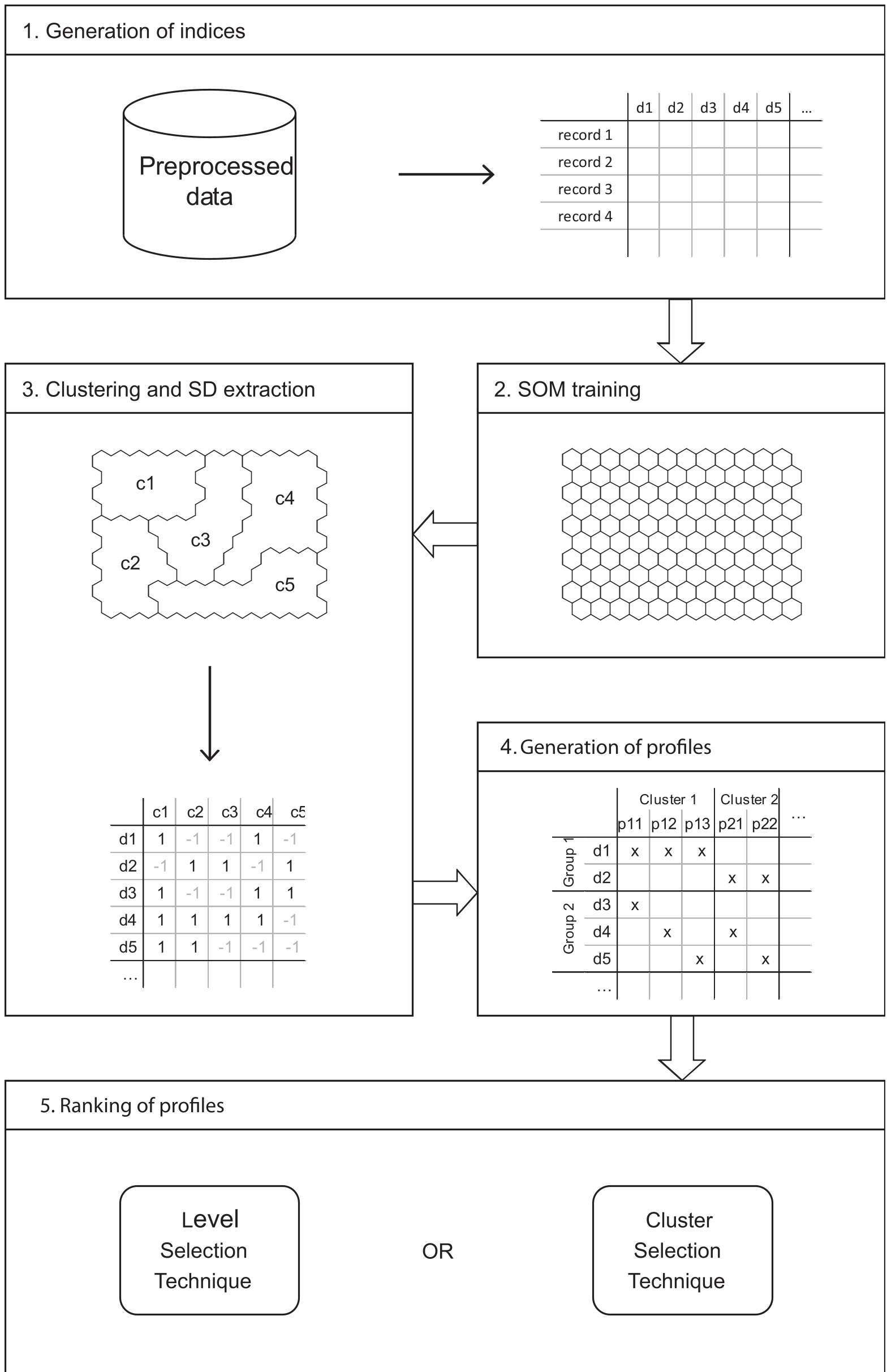 Figure: The 5-stage workflow of the SOM-based Profile Generator.
Real-World Application: The Concert Industry
Working with Ticketmatic, the authors analyzed 63,000 ticket records. They aimed to predict who would be interested in "The Concert" based on their past attendance and last.fm tags.
A 10x12 SOM was used to reduce 18 customer dimensions. The resulting map was clustered into nine distinct segments. The researchers found that some segments were highly specific—for example, Cluster 5 skewed younger and lived closer to the venue.
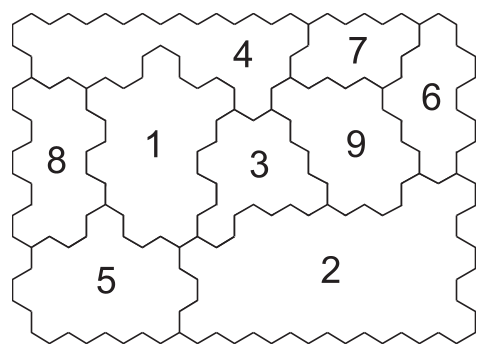 Figure: A 10x12 Self-Organizing Map clustered into 9 segments using the Davies-Bouldin index.
Key Performance Insights: Diversification Wins
One of the most valuable findings was the comparison between ranking strategies.
- Cluster Selection Technique (CST): Exhausts one cluster before moving to the next.
- Level Selection Technique (LST): Picks the "top" profile from each cluster iteratively (diversification).
The experiments (summarized from over 64,000 executions) showed that LST significantly outperforms CST. LST reaches higher "gain" faster, proving that a diversified approach into various high-potential segments is better than a deep dive into just one.
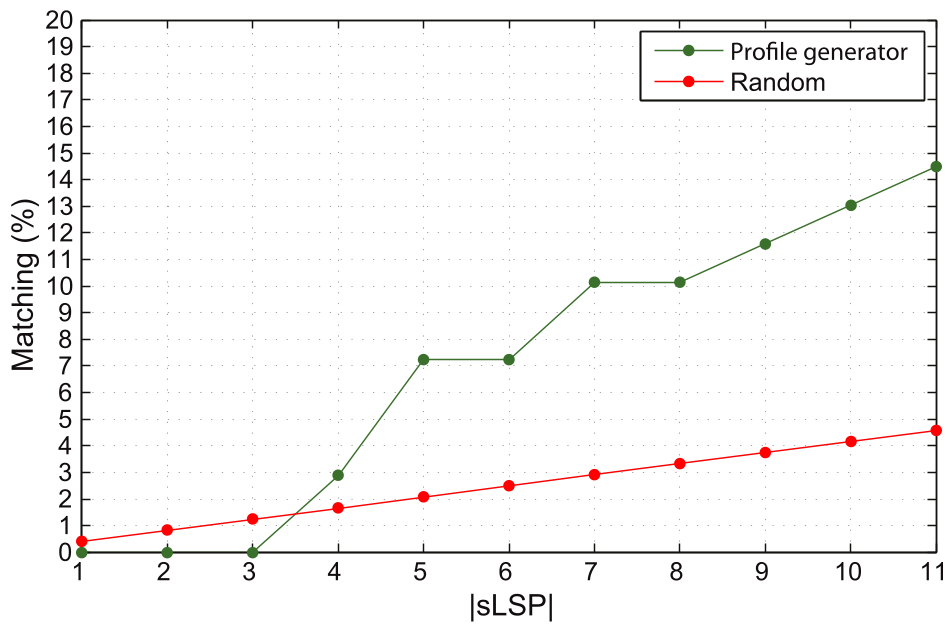 Figure: LST achieves positive gain over random benchmarks with fewer profiles compared to CST.
Critical Insight & Future Outlook
The beauty of this method lies in its robustness to data volume. The authors proved that as the dataset grows, the profiles become more stable and the gain increases. This provides an economic incentive for companies to aggregate data.
Limitations: The reliance on k-means introduces some instability (sensitivity to initial centroids), which the authors mitigated through 100-iteration averages. Future work could replace k-means with more stable hierarchical clustering or explore deep-learning-based embedding spaces to replace the initial SOM.
Conclusion
This SOM-based Profile Generator successfully bridges the gap between complex neural network training and the practical need for simple, business-oriented personas. It turns the "black box" of customer behavior into a list of targeted rules that any marketing manager can understand and deploy.