
SoNARS: Why Your Social Circle Defines Your Next Click Better Than Your History
SoNARS: A Social Networks-Based Algorithm for Social Recommender Systems
The paper introduces SoNARS (Social Networks-based Algorithm for Social Recommender Systems), a novel recommendation approach that integrates social psychology theories into item suggestion. Unlike traditional Collaborative Filtering, it weighs recommendations based on social influence and network structure, achieving an accuracy of 0.8 in Facebook-based testing.
TL;DR
Most recommender systems think you are a static island of preferences. SoNARS (Social Networks-based Algorithm for Social Recommender Systems) argues that you are a social animal easily influenced by your peers. By applying social psychology—specifically how we conform and compare ourselves to others—this algorithm predicts what you'll like by looking at the "trend" of your network and the strength of your friendships. In Facebook trials, this social-first approach hit an impressive 80% accuracy in predicting group subscriptions.
Problem & Motivation: The "Isolated User" Fallacy
The current state of Recommendation Systems (RS) is dominated by Collaborative Filtering ("people like you liked this") and Content-Based filtering ("you liked X, so here is Y"). While effective, these methods ignore a fundamental truth of human behavior: influence.
The authors argue that our interests aren't "given"—they are shaped. Prior works treat social networks merely as a way to find "similar" strangers. SoNARS challenges this by stating that the mere act of belonging to a network changes your behavior. Whether you're trying to fit in (Conformity) or looking for guidance in a new domain (Social Proof), your friends' interests become your own.
Methodology: Quantification of Influence
SoNARS doesn't just look at what your friends like; it looks at who those friends are to you. The core algorithm is built on two primary pillars:
1. Relationship Strength ()
Instead of assuming all "friends" are equal, the system calculates based on specific actions (comments, messages, photo tags).
- Insight: A "Direct Message" (weight 0.9) indicates a much stronger bond—and thus higher influence potential—than a "Photo Tag" (weight 0.5).
2. The SoNARS Scoring Formula
The algorithm computes an item's score () by summing the interest of every user in the target user 's network, weighted by their relationship strength.
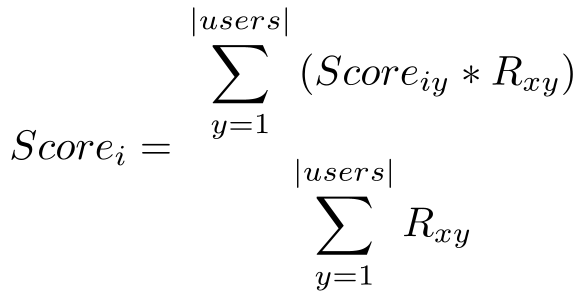
This formula effectively shifts the recommendation engine from "What is similar to my past?" to "What is the momentum of my social circle?"
3. Psychological Scaffolding
The methodology is grounded in three pillars of social psychology:
- Social Conformity: The pressure to match group expectations to stay integrated.
- Social Comparison: Looking to others when uncertain about what to think or do.
- Social Facilitation: Increased motivation when we see others performing a behavior we are already interested in.
Experiments & Results: Putting Facebook to the Test
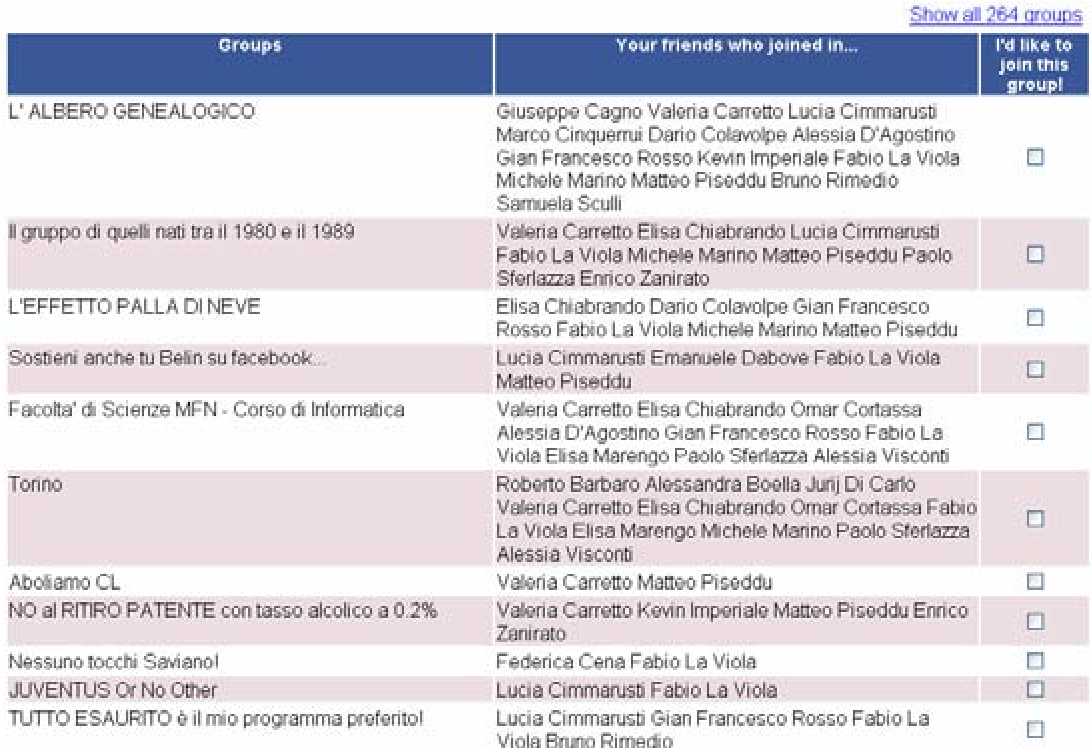
The researchers tested SoNARS on 45 Facebook users, tasking the algorithm with recommending "Facebook Groups" to join.
- Precision (0.67): More than two-thirds of the top 30 suggested groups were items users actually wanted to join.
- Accuracy (0.80): The system was highly effective at distinguishing between items a user would and would not find interesting based on their network's "trend."
One striking takeaway from the results is the Recall (0.5). While the algorithm is very accurate at identifying what you will like, the social-first approach might miss niche interests that your friends haven't discovered yet—highlighting the potential for a "hybrid" model that combines personal history with social trends.
Critical Analysis & Conclusion
SoNARS proves that in the era of Web 2.0 (and beyond into Web 3.0/Social Graphs), an algorithm that ignores the "physics" of social influence is incomplete.
Takeaways:
- Context Matters: Your interests are dynamic and context-dependent.
- Relationship Weighting: Not all social ties are equal; interaction frequency is a valid proxy for influential power.
Limitations: The current model doesn't account for Trust or Reputation (e.g., a friend might be a close contact but a "bad" source for movie advice). Future iterations involving FOAF (Friend of a Friend) and explicit trust modeling could refine the quality of recommendations even further.
By bridging the gap between social psychology and computer science, SoNARS offers a blueprint for more "human-centric" AI that understands not just what we buy, but why we belong.