
SONIC: Breaking the Walled Gardens of Social Media through Protocol Federation
SONIC: Bridging the Gap between Different Online Social Network Platforms
SONIC (SOcial Network InterConnect) is a decentralized communication protocol designed to enable seamless cross-platform interaction between heterogeneous Online Social Networks (OSNs). By establishing an open federation (OSNF), it allows users on different platforms (e.g., Facebook-like vs. open-source pods) to communicate directly and migrate profiles without losing social connections.
TL;DR
The SOcial Network InterConnect (SONIC) protocol is a bold architectural shift aiming to transform the internet from a collection of isolated social "islands" into a unified, heterogeneous federation. It enables users on different platforms to message, like, and share content seamlessly while supporting full profile migration without breaking social ties.
Strategic Positioning: This work bridges the gap between purely centralized giants (Facebook, LinkedIn) and fragmented decentralized projects (Diaspora, Friendi.ca), positioning itself as the "SMTP of Social Networking."
The Problem: The High Cost of Leaving
The modern social web suffers from a "winner-takes-all" dynamic. Because social value is tied to the Social Graph (your list of friends), users are held hostage by platform operators. If you leave a platform because of privacy concerns, you lose your digital relationships.
Existing "open" solutions like Diaspora or Friendi.ca attempted to fix this, but they often created their own smaller silos or relied on cumbersome protocols that failed to allow deep, cross-platform interaction (like group commenting across different service providers).
Methodology: Decoupling Identity from Infrastructure
The core innovation of SONIC is the separation of the Social Account into two distinct layers:
- Social Profile: The actual data (posts, photos, friends list) hosted on a Platform.
- Social Record: The metadata required to find you (Global ID, location, public keys) stored in a Global Social Lookup System (GSLS).
The Federation Concept
In SONIC, when Alice (on Platform A) wants to see Bob’s post (on Platform B), her server fetches the data directly via the SONIC API. To the user, it looks like a single integrated experience.
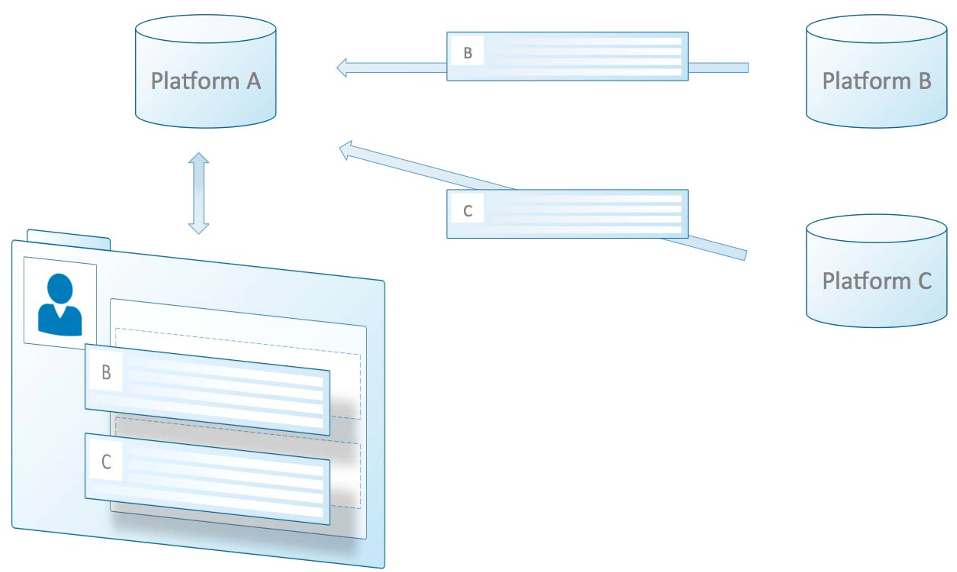 Fig 1. Information from remote profiles is embedded directly into the local UI, making platform boundaries transparent.
Addressing Content Integrity: Local vs. Remote
A major challenge in federated systems is: Who owns a comment on a foreign post? SONIC classifies content into:
- Local Content: Stored on the author's platform (e.g., your own status update).
- Remote Content: Stored on the target platform but signed by the author (e.g., your comment on your friend's photo).
This cryptographic signing ensures that even if Platform B hosts your comment, they cannot alter your words without invalidating the signature.
Core Features Comparison
The authors conducted a meticulous analysis of the "Core OSN Featureset" across major players (Facebook, Google+, vKontakte, etc.) to ensure SONIC supports the essential interactions that users expect.
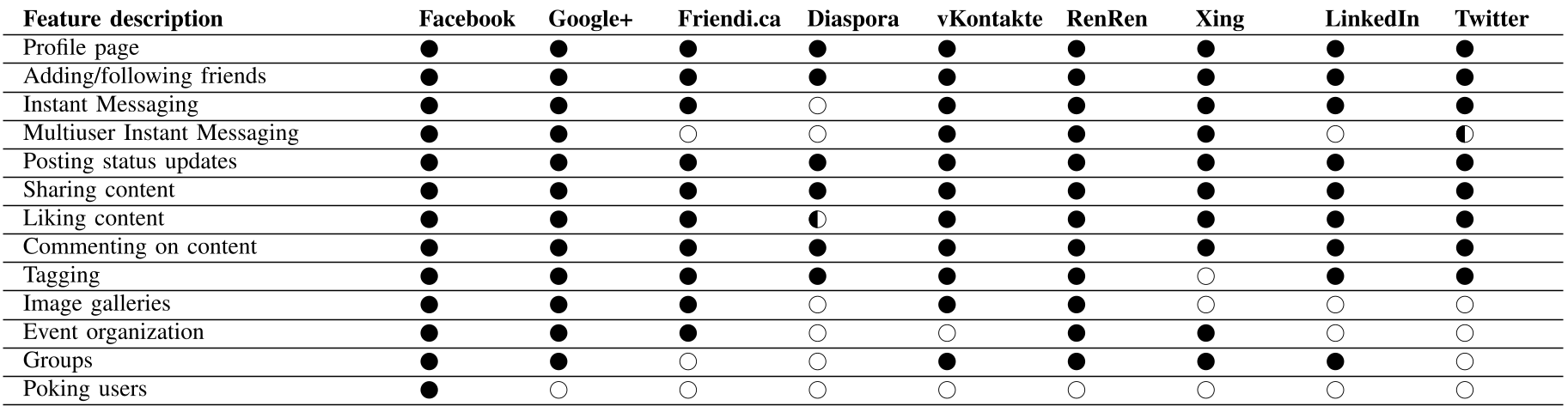 Table 1. SONIC targets the intersection of features supported by all major social networks, ensuring high compatibility.
Experimental Validation: Performance Wins
The researchers didn't just write a spec; they implemented SONIC in Friendi.ca and a custom PHP framework. The results were startling:
- Latency: Average response time for inter-platform requests dropped by 54.92% compared to the older DFRN protocol.
- Efficiency: Payload size (data overhead) was reduced by 52.8%.
This proves that decentralization doesn't have to come at the cost of performance. By using efficient JSON-based REST APIs and modern cryptographic standards, SONIC outperforms its predecessors.
Critical Analysis & Conclusion
The Takeaway
SONIC provides a roadmap for Social Sovereignty. By making Global IDs independent of the platform's domain (unlike an email address which is tied to @gmail.com or @outlook.com), SONIC allows a user to move their entire digital life from a "Privacy-Invasive OSN" to a "Privacy-First OSN" as easily as switching a SIM card.
Limitations & Future Work
- Adoption Hurdle: The success of SONIC relies on platform operators wanting to open up. Giants like Facebook have zero financial incentive to support a protocol that breaks their lock-in.
- Moderation: While the protocol handles data exchange, it does not yet address the complex legal and social challenges of cross-platform content moderation and "bad actor" banning.
Final Thought: SONIC is a technically sound architecture that moves us closer to a "Right to Data Portability." The next step is for the developer community to integrate these standards into smaller, niche networks to build a federation that eventually becomes too large for the giants to ignore.