
SOQAS: Bridging the Gap to High-Quality Experts in Dynamic Social Networks
SOQAS: Distributively Finding High-Quality Answerers in Dynamic Social Networks
This paper introduces SOQAS, a distributed SOcial network-based Question Answering System designed to find high-quality answerers in k-hop dynamic social networks. By leveraging profile information exchange and social referral chains, SOQAS optimizes answerer selection and question routing to maximize expertise levels and minimize response latency.
TL;DR
Finding the right person to answer a specialized question is hard, especially when they aren't in your immediate circle. SOQAS (SOcial network-based Question Answering System) is a distributed framework that maps out expertise across a -hop social network. By accounting for when users are actually online and intelligently routing questions through "social referral chains," it achieves a 42% increase in answer quality and a 27% reduction in wait time compared to current best practices.
The "Invisible Expert" Problem
When you have a non-factual question—like "How do I debug this specific kernel panic?"—Google often fails, and Quora might take days. Social networks are naturally better because of the inherent trust and contextual knowledge between friends.
However, two massive obstacles remain:
- The Horizon Limit: You only know the skills of your direct friends (1-hop). The perfect expert might be your friend's friend (2-hop), but you have no way of knowing they exist.
- Temporal Dynamics: People aren't bots. They go online and offline. If you route a question to a "high-degree" node who is currently asleep for the next 8 hours, your response rate plummets.
Methodology: Mapping Expertise and Predicting Availability
SOQAS transforms a static social graph into a dynamic, information-aware network using two primary protocols.
1. BuildNIT: Distributed Knowledge Mapping
Instead of a central server, every user in SOQAS maintains a Neighbors Information Table (NIT). Through a gossip-like protocol, users exchange profile keywords and "hop-distances." This allows an asker to "see" the expertise landscape up to hops away. Importantly, this exchange includes online time intervals, allowing the system to model when a specific path is actually "open."
2. SearchNIT: Intelligent Routing
When a question arises, SOQAS doesn't just flood the network. It uses a Vector Space Model (TF-IDF) to score potential answerers in the -hop radius. Once the top-K experts are identified, it selects the Optimal Relays.
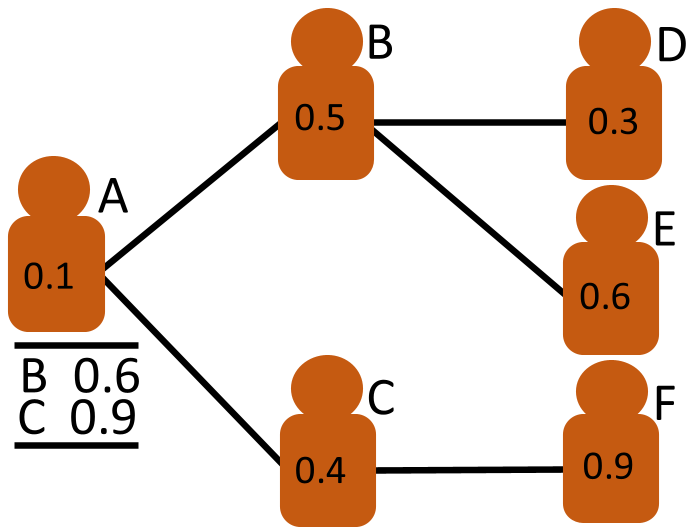 Figure 1: Illustration of how User A targets User F (expert) via Relay C based on NIT data.
The tie-breaking logic for relays is remarkably practical:
- If multiple neighbors reach the same expert, pick the one with the lowest response time.
- If some are offline, pick the one who wakes up first.
- Favor shorter paths to reduce the chance of the question being dropped.
Experimental Results: Slaying the Baselines
The authors tested SOQAS using a trace-driven simulation based on real Facebook datasets (ranging from 408 to 1,252 users). They compared it against Similarity-based, Degree-based, and Random routing schemes.
Performance Highlights:
- Expertise Level: SOQAS achieved expertise scores significantly closer to the "Upper Bound" (theoretical maximum knowledge in the network) than any other method.
- Response Rate: SOQAS maintained a near-93% response rate for questions, whereas others hovered around 65-68%.
- Latency: By picking relays based on online status, the median response time dropped from ~9 hours to just 5.5 hours.
 Figure 2: CDF of expertise levels showing SOQAS (blue) consistently reaching higher-quality answerers.
Critical Insight: Why Does It Work?
The secret sauce of SOQAS isn't just knowing who is an expert, but how to get to them. Previous systems like SOS or iASK focused heavily on similarity or node degree. SOQAS’s realization that buffered time (waiting for a user to come online) is the primary bottleneck in social QA is what drives the 27% reduction in response time. It effectively treats the social network as a Delay Tolerant Network (DTN).
Conclusion & Future Outlook
SOQAS effectively proves that decentralized expert search is viable even in highly volatile, dynamic networks. However, the current model assumes "truthfulness" in user profiles. In a real-world deployment, incentive mechanisms (rewarding relays for successful introductions) and privacy-preserving profile matching (like Bloom filters) would be the next logical steps to ensure user adoption and security.
Key Takeaway: In the future of the decentralized web, your "social reach" won't just be about how many friends you have, but how effectively your local node can map the expertise of your extended network.