
SOQAS: Redefining Distributed Intelligence in Dynamic Social Networks
SOQAS: Distributively Finding High-Quality Answerers in Dynamic Social Networks
The paper introduces SOQAS (Social network-based Question Answering System), a distributed framework designed to find high-quality answerers in k-hop dynamic social networks. By leveraging profile information exchange and social referral chains, it identifies experts with high expertise levels and optimal relays to improve response rates and reduce latency.
TL;DR
Finding the right person to answer a specialized question is hard, especially when they aren't in your immediate circle. SOQAS (Social network-based Question Answering System) solves this by creating a distributed "map" of expertise across -hop social neighbors. It doesn't just find an expert; it finds the best expert and the fastest path to them, even in dynamic networks where people log in and out at unpredictable times.
Background & Motivation
Modern search engines like Google excel at "factual" queries but struggle with "nuanced" or "opinionated" questions. While social platforms like Quora exist, they often suffer from low trust and high anonymity.
The authors identify a critical gap: The "1-hop" Limitation. Most social Q&A systems rely on your direct friends. However, your best answerer might be a "friend of a friend." Previous attempts to reach these experts failed because they ignored the dynamic nature of humans (we aren't online 24/7) and lacked a distributed way to find high-quality experts without flooding the entire network with spam.
Methodology: The Core Protocols
SOQAS operates through two primary mechanisms that allow the network to "think" collectively without a central server.
1. BuildNIT (Knowledge Awareness)
Nodes share condensed profile information (keywords) with their neighbors. Using a Gossip Protocol, this information propagates up to hops. Each node maintains a Neighbors Information Table (NIT), effectively knowing "Who knows what" in its extended neighborhood.
2. SearchNIT (Intelligent Routing)
When a question arises, SOQAS performs two sub-tasks:
- Expert Identification: It calculates the expertise level () using tf-idf and cosine similarity between the question keywords and node profiles.
- Optimal Relay Selection: This is the "secret sauce." Instead of just sending the question to any friend, it picks a relay who is currently online and has the shortest path to the identified expert.
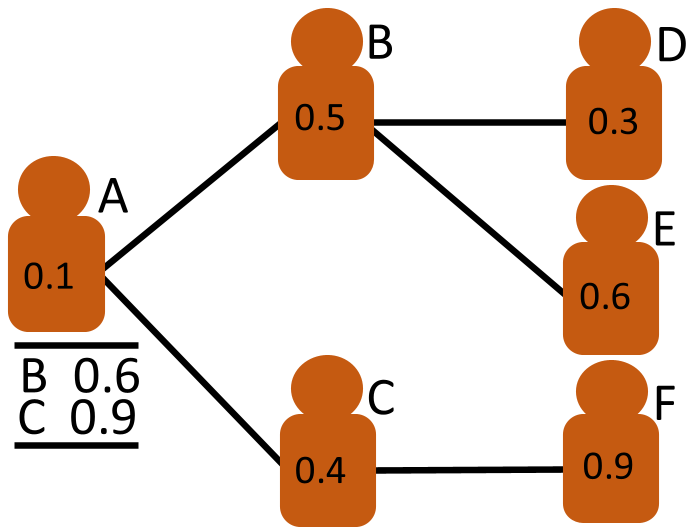 Figure 1: In this example, User A uses NIT entries to realize that while neighbor B seems okay, neighbor C can reach an expert (F) with a much higher expertise level (0.9).
Experimental Performance
The researchers conducted extensive trace-driven simulations using three Facebook datasets (Small, Medium, Large size).
Key Breakthroughs:
- Expertise Quality: SOQAS achieved expertise levels over 42% higher than degree-based or similarity-based routing. It stays remarkably close to the theoretical "Upper Bound" (knowing the whole network).
- Speed & Reliability: By considering "Online Intervals," SOQAS ensures questions don't get stuck in the inbox of an offline user. It reduced response times by up to 27%.
- Scalability: Even as the network grew to 1,200+ nodes, the overhead remained moderate, with 80% of links carrying peak traffic of less than 30 kbps.
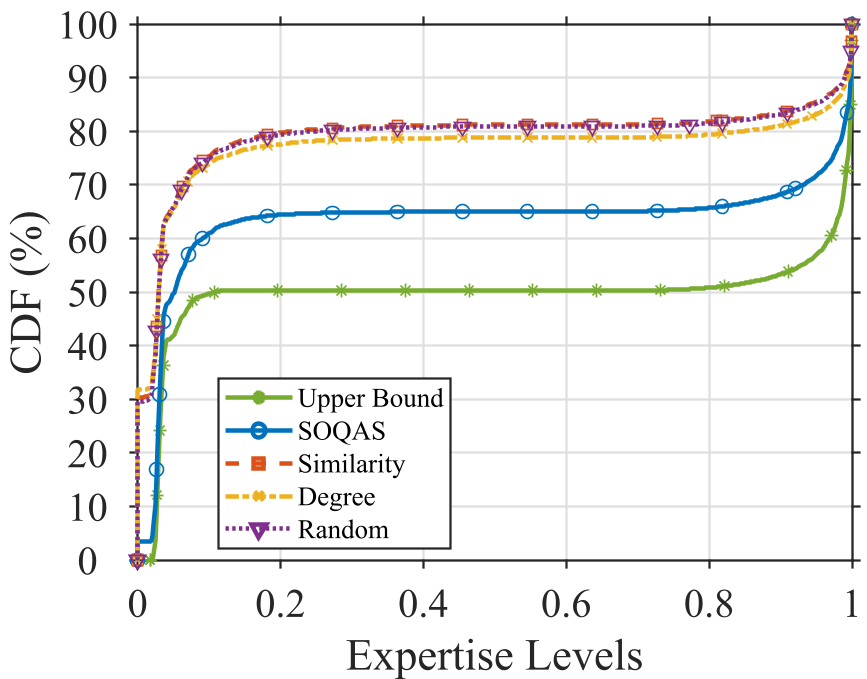 Figure 2: The CDF charts show that SOQAS (red line) consistently delivers higher response rates and expertise levels compared to traditional baselines.
Critical Analysis & Conclusion
SOQAS proves that metadata exchange beats raw flooding. By maintaining a localized view of a global network, users can navigate social ties with surgical precision.
Limitations:
- Privacy: Sharing profile keywords, even if hashed, carries risks. Future iterations need Differential Privacy or Secure Multi-Party Computation.
- Incentives: Why should a stranger (a 3rd-hop connection) answer your question? The system assumes altruism, but a real-world deployment would likely need a "Social Credit" or "Token" economy.
The Takeaway: SOQAS isn't just a Q&A tool; it's a blueprint for Decentralized Information Retrieval. It enables a smarter, human-in-the-loop internet where expertise is discovered through trust-based referral chains rather than opaque central algorithms.