
SOR: Transforming Social Networks into Privacy-Preserving Routing Engines
SOR: A Protocol for Requests Dissemination in Online Social Networks
The paper introduces SOR (Social Online Routing), a novel request dissemination protocol for Online Social Networks (OSNs). By utilizing a multi-circle privacy framework and individualized Social Priority (SP) metrics, SOR enables efficient path-finding for social favors while maintaining data sensitivity through onion-style encryption.
TL;DR
The Social Online Routing (SOR) protocol introduces a mechanism for disseminating requests (like favors or endorsements) through personal friend networks. By combining social characteristics (priority) with cryptographic privacy circles, it achieves lower latency than traditional shortest-path algorithms while ensuring users only share what they trust.
Background: The Social Routing Dilemma
In the physical world, asking for a favor often involves a chain of acquaintances. In the digital world of Online Social Networks (OSNs), we lack a formal protocol for this. Current systems either blast requests to everyone (spamming) or require total transparency of one's social graph to find the "best" path—a nightmare for privacy.
The authors argue that social routing is fundamentally different because:
- Individualized Priority: You respond to your best friend faster than a distant colleague.
- Trust Circles: You might share your "availability" with close friends but only your "existence" with the public.
Methodology: The SOR Architecture
The SOR protocol treats every user as a "social router." To make this work without compromising privacy, the architecture is split into five distinct managers:
- Connectivity Manager: Handles who is connected to whom (CMM messages).
- Social Priority Manager: Uses Singular Value Decomposition (SVD) to weigh factors like gender, degree centrality, and closeness to calculate an "In-Social Priority" (iSP).
- Queues Manager: Tracks the real-time load of a node (QMM messages).
- Routing Estimator & Request Manager: The "brains" that decide the path based on the available data.
Multi-Circle Privacy
Unlike the internet’s BGP protocol, SOR uses separate encryption keys for connectivity, social priority, and queue status. A node might know a path exists (CMM) but have no clue about the congestion (QMM) or the social bond (SMM) on that path unless they are in the correct trust circle.
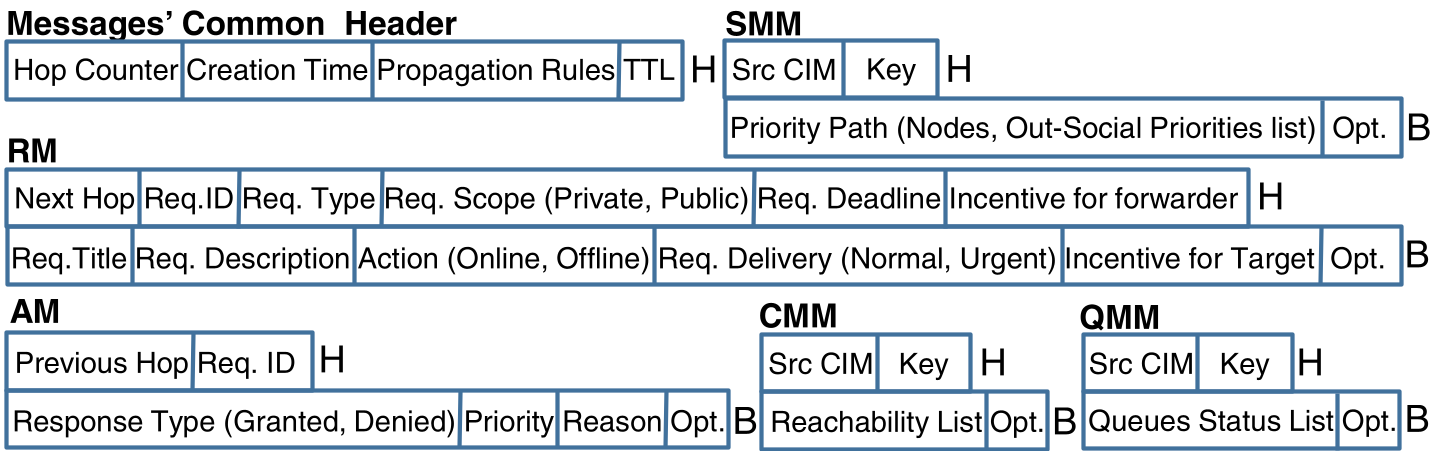 The message structure utilizes separate headers and bodies (H/B) to allow onion-routing-style decryption, where intermediate nodes only see what they need to forward the request.
The Three Levels of Cognoscenti
SOR proposes three algorithms based on how much "knowledge" a node has:
- CSP (Conventional Shortest Path): Ignores social context; just looks at hop counts.
- SPBS (Static Social-Priority-Based): Factors in social bonds but assumes the network isn't "busy."
- SPBD (Dynamic Social-Priority-Based): The most advanced version; it factors in social priority AND real-time queue lengths.
Experimental Insights
Testing on real Google+ datasets (ranging from 54 to over 2,200 nodes) revealed a clear trend: Social context wins.
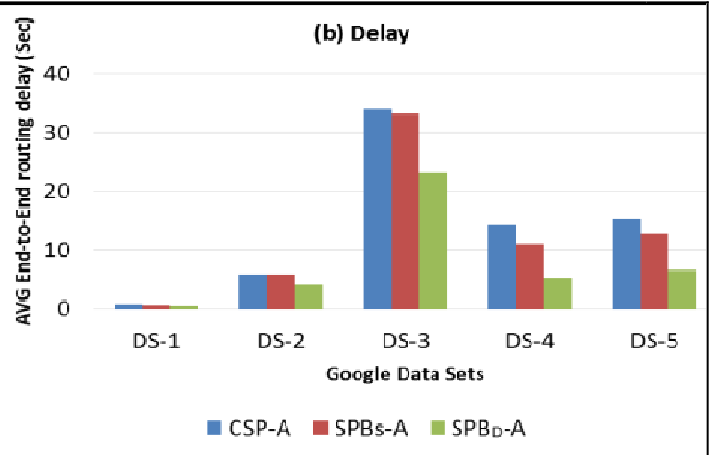 Figure 3(b) shows that SPBD (the green bar) consistently maintains the lowest average end-to-end delay across different graph sizes.
In small graphs, the difference is negligible because there are fewer path options. However, as the network grows (DS-4 and DS-5), the Dynamic Social-Priority-Based (SPBD) algorithm dramatically outperforms traditional Dijkstra-based approaches. This proves that knowing who is likely to prioritize a request is more important than simply finding the shortest path in a complex social web.
Critical Analysis & Future Outlook
Takeaway: SOR successfully bridges the gap between social psychology and network engineering. By formalizing "In-Social Priority" (iSP), the paper provides a mathematical way to handle the "favor-asking" behavior that sustains human societies.
Limitations: The paper mentions an "Incentive" system for forwarders but does not describe the schema in detail. In a real-world deployment, without a robust economic or social incentive (like reputation points), users might still be reluctant to act as routers for others' requests.
The Road Ahead: As we move toward a more decentralized web (Web3), SOR’s approach to multi-circle privacy and metadata-based routing could be a blueprint for decentralized social protocols where users regain control over their social footprint.