
SOREC: Enhancing Sociology with Semantic Parsimony and Machine Learning
SOREC: A Semantic Content-Based Recommendation System for Parsimonious Sociology Theory Construction
The paper introduces SOREC, a semantic content-based recommendation system designed to support parsimonious theory construction in sociology. Using an XGBoost classifier fueled by Transformer-based sentence embeddings and multi-level text features, it achieves 86.16% accuracy in identifying semantically equivalent sociological definitions.
TL;DR
Constructing a scientific theory requires "Parsimony"—the art of using the fewest definitions possible to explain a phenomenon. In sociology, human error often leads to redundant definitions. SOREC (SOciology RECommender) is a new AI-driven system that identifies semantically identical definitions using Transformer embeddings and XGBoost, reaching 86.16% accuracy and facilitating cleaner, more logical theory building.
The Problem: The Hidden Complexity of Sociological Definitions
In social sciences, a "Good Theory" must be parsimonious. However, theorists often create "new" definitions for concepts that already exist under different names. This redundancy violates the principle of Occam’s Razor and weakens the logical integrity of the field.
Generic NLP tools often fail here. For example, the term "ambivalence" in a sociological context has specific nuances that general-purpose models like WordNet might miss. Prior work used Latent Semantic Analysis (LSA), but these "bag-of-words" methods fail to capture the deep contextual relationship between complex, multi-sentence definitions.
Methodology: A Multi-Headed Feature Strategy
The authors developed a three-tiered feature extraction pipeline to feed an XGBoost classifier:
- Descriptive Features (DF): Basic metrics like character count, word count, and length differences.
- Tokenized Features (TF): Edit distances (Levenshtein) and overlap ratios between sorted and unsorted token sets.
- Embedding Features (EF): The "heavy hitter" of the system. Using the Universal Sentence Encoder (Transformer), definitions are mapped into a 512-dimensional vector space.
The system then calculates the "distance" between definitions using seven different metrics, including Cosine, Manhattan, and Canberra distances, as well as statistical measures like Skewness and Kurtosis.
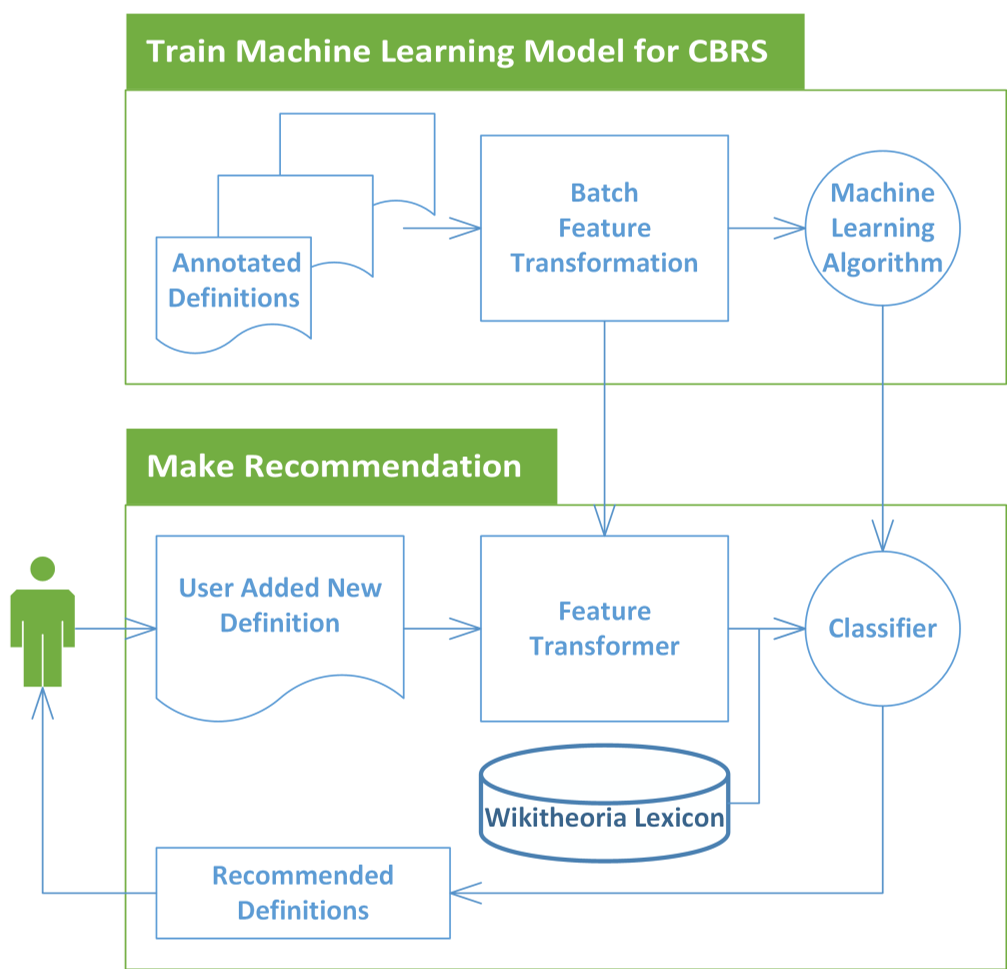 Figure 1: The SOREC Recommendation Architecture, showing the flow from raw definitions to similarity prediction.
Why This Works: XGBoost Meets Transformers
The magic happens in the fusion. While Transformers understand context, the XGBoost model acts as a sophisticated judge, learning which specific distance metrics are the most reliable indicators of "similarity" in a sociological context.
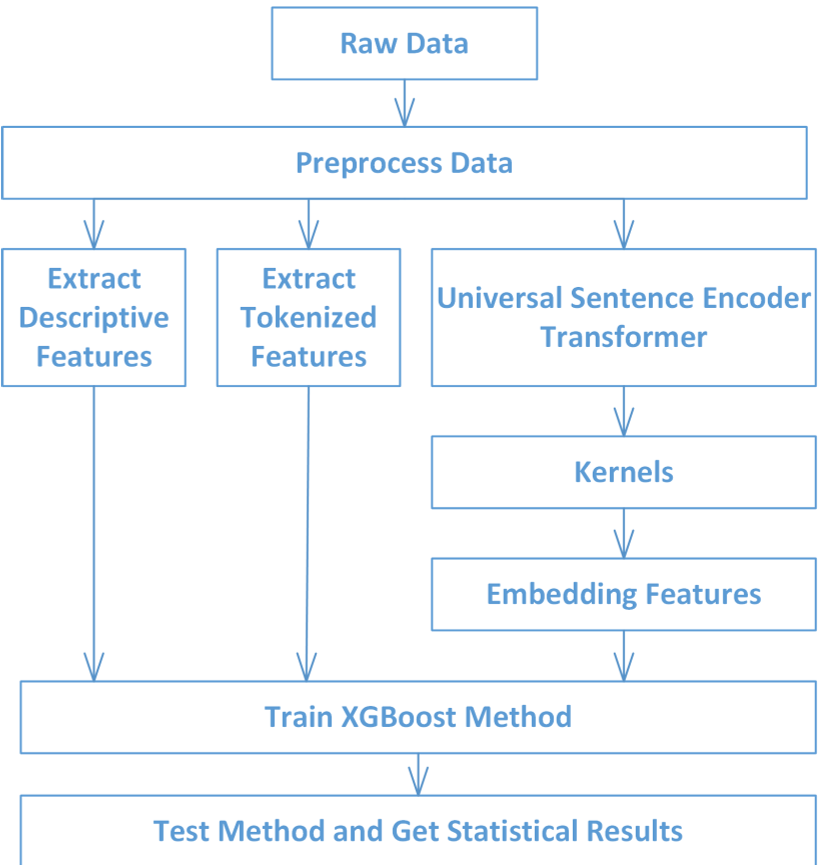 Figure 2: The Prediction Workflow illustrating the concatenation of diverse feature sets.
Key Experimental Insights:
- The Power of Concatenation: Using just descriptive features (DF) yielded only ~69% accuracy. Adding Embedding Features (EF) pushed that to over 86%.
- Transformer vs. Word2Vec: The Transformer-based embedding outperformed the older Word2Vec (Google News) approach by a significant 2% margin across all metrics.
- Domain Sensitivity: The model was evaluated on a custom dataset of 2,235 pairs annotated by expert sociologists, ensuring the "ground truth" reflects actual theoretical expertise.
| Feature Set | Precision | Recall | F-measure | Accuracy |
|---|---|---|---|---|
| DF (Basic) | 0.70 | 0.69 | 0.5868 | 0.6919 |
| TF (Tokens) | 0.77 | 0.76 | 0.6936 | 0.7633 |
| Combined (DF-TF-EF) | 0.86 | 0.86 | 0.8442 | 0.8616 |
Critical Analysis & Conclusion
SOREC marks a significant shift from "heuristic-based" theory construction to a "data-driven" approach. By deploying this on the Wikitheoria platform, the researchers provide a real-world tool for sociologists to audit their theories for redundancy.
Limitations: Small specialized datasets (2,235 pairs) are a start, but the system's performance on highly abstract or completely new sociological paradigms remains to be tested.
Future Work: The authors suggest this logic can be ported to Psychology and Criminology, potentially leading to a "Cross-Disciplinary Semantic Web" where theories across different social sciences are unified through shared, non-redundant definitions.
Summary Takeaway
SOREC proves that even in fields as "human-centric" as sociology, machine learning can enforce logical rigor through parsimony, helping scientists build clearer, more efficient frameworks for understanding society.