
SORT: Maximizing Mobile Q&A Efficiency through Social Intelligence
SORT: SOcial HelpeR SelecTion Scheme for Mobile Question Answering Systems
The paper introduces SORT (SOcial helpeR selecTion), a distributed and light-weight helper selection scheme for mobile Social Network-based Question Answering (SNQA) systems. It utilizes a multi-attribute decision method to identify optimal 1-hop friends for question forwarding, outperforming state-of-the-art methods like SocialQ&A and SOS in response rate and speed.
TL;DR
The paper presents SORT, a light-weight selection scheme designed for mobile Social Network-based Question Answering (SNQA). By focusing on 1-hop social attributes—specifically "Capability" and "Cooperativeness"—and using advanced decision-making algorithms, the authors achieved double-digit improvements in response rates and speed over existing SOTA methods, all while drastically reducing the energy overhead typical of multi-hop systems.
Problem & Motivation: The Energy-Efficiency Paradox
Why do we still struggle with online questions? Community-based platforms like Yahoo! Answers or Quora suffer from high "no-answer" rates (up to 82.4%) and a lack of trust between anonymous users. While Social Network-based Q&A (SNQA) solves this by routing questions through friends, it introduces a technical wall: Resource Constraints.
Previous distributed systems required users to exchange data with friends up to 4 hops away to find the "perfect" answerer. However, research shows that data exchange with a 4-hop friend consumes 20.3 times more energy than with a 1-hop neighbor. For mobile users, this is a non-starter. The core challenge was: Can we achieve SOTA performance using only local, 1-hop information?
Methodology: Capability meets Cooperativeness
The SORT scheme operates on the intuition that a good helper isn't just someone who knows the answer, but someone who is willing to help and is well-connected.
1. Defining the Selection Metrics
SORT evaluates two critical parameters for every 1-hop friend:
- Capability (): Computed using the friend's degree (number of connections) and the similarity between the question and the friend’s profile.
- Cooperativeness (): Measured via historical response times, social closeness (mutual friends), and shared interests.
2. The TOPSIS Decision Engine
Since these metrics have different units and conflicting priorities (e.g., you want low response time but high similarity), the authors used the Multi-Attribute Decision Method (TOPSIS). This allows the system to rank friends by calculating their "distance" from an ideal best solution and an absolute worst solution.
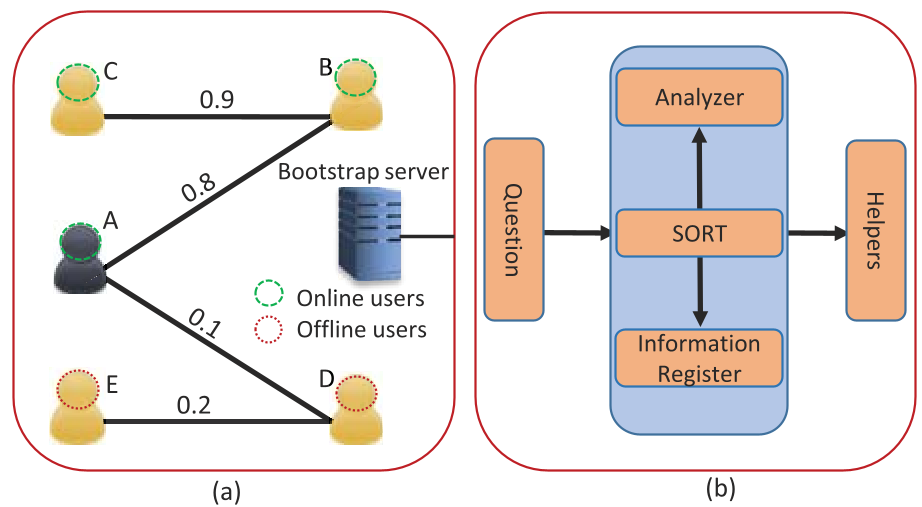 Figure 1: (a) The dynamic question forwarding process; (b) The application-level design of SORT.
Experiments: Proving the 1-Hop Advantage
The authors conducted trace-driven simulations using a combined dataset from Facebook (2,543 users, 14,115 links) and Cross Validated (Stack Exchange).
Key Performance Wins:
- Higher Response Rate: SORT reached a 75% response rate for nearly 96% of questions, compared to only 73.8% for SocialQ&A and 66.7% for SOS.
- Quality of Answers: The "Best-Answer Rate" (answers with 5+ votes) was 13% higher than the top baseline.
- Reduced Latency: SORT decreased response time by ~14% because its "Cooperativeness" metric explicitly penalizes slow responders.
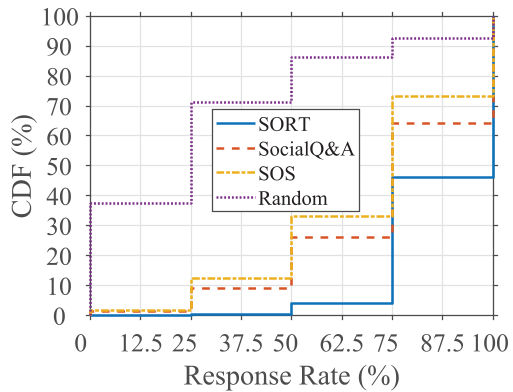 Figure 2: CDF of response rates showing SORT (solid blue line) consistently outperforming baselines.
Robustness under Load
Even when the number of available answerers in the network dropped to a mere 1%, SORT maintained its lead. Interestingly, the study found that a 3% density of answerers is the "sweet spot" for maintaining a functional SNQA system.
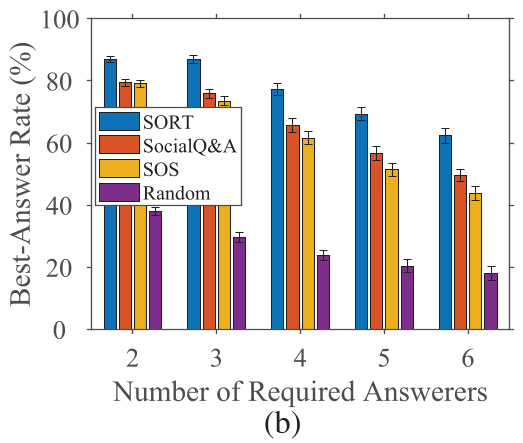 Figure 3: Performance stability across varying fractions of available answerers.
Critical Analysis & Conclusion
SORT proves that context-aware local routing is more effective than blind global routing. By quantifying human social behaviors (cooperativeness) and network topology (degree) into a lightweight mathematical framework, SORT overcomes the mobile "energy barrier."
Limitations: The current model relies on users accurately sharing their interests and availability. In a real-world deployment, privacy concerns might limit the amount of profile data users are willing to "exchange" even with 1-hop friends.
Future Outlook: As decentralized social protocols (like Lens or Farcaster) gain traction, SORT’s logic could provide a foundational layer for P2P knowledge sharing without the need for a central authority.