
Sort-Union: Optimizing the Economic Efficiency of Sentiment Analysis in Data Streams
Using Sort-Union to Enhance Economically-Efficient Sentiment Stream Analysis
This paper introduces a "Sort-Union" enhancement for economically-efficient sentiment stream analysis on Twitter. By integrating frequency-based pruning with existing Pareto and Kaldor-Hicks sampling criteria, the authors significantly reduce training set sizes while maintaining or improving classification accuracy.
TL;DR
Real-time sentiment analysis on Twitter is a race against sentiment drift and resource constraints. This paper introduces a "Sort-Union" strategy that enhances existing selective sampling methods (Pareto and Kaldor-Hicks) by filtering messages based on frequency. The result? A classifier that is faster, uses significantly fewer training resources, and remains robust against shifting opinions.
The Motivation: Why Sampling Isn't Enough
In the high-velocity world of Twitter, processing every tweet is computationally expensive and often counterproductive. "Sentiment Drift"—the phenomenon where users change their opinions suddenly due to global events—means that a classifier trained on last week's data might be useless today.
While prior works utilized Pareto Efficiency (where no message can be made more relevant without making another less relevant) and Kaldor-Hicks criteria to sample data, these "economically efficient" sets still contain noise. The authors identified a crucial gap: not all "relevant" messages are equally informative. High-frequency messages often carry the "consensus" sentiment that is more vital for training robust models.
Methodology: The Sort-Union Mechanism
The core innovation lies in a two-step refinement of the training set at each time step .
1. Sorting by Frequency
The algorithm calculates the frequency of each message . Frequency here is defined as the sum of occurrences of its constituent terms within all messages of the same sentiment class. To keep processing overhead low, they employ a Least-Significant-First (LSF) Radix Sort, ensuring the sorting process doesn't become a bottleneck itself.
2. The Union Operation
To balance recency (messages that just arrived) and frequency (messages that are most representative), the authors take the top 50% of the most recent messages and the top 50% of the most frequent messages. By taking the union of these two subsets, they ensure the training set remains small while capturing both the latest trends and the most statistically significant data points.
 (Note: Figure demonstrates the flow from microblog streams to the selective sampling and Sort-Union layers)
Experimental Results: Leaner and Faster
The authors tested their approach on three standard datasets: Obama-McCain, Sanders, and Stanford. The performance metrics were Mean Square Error (MSE), Execution Time, and Training Set Size.
Key Findings:
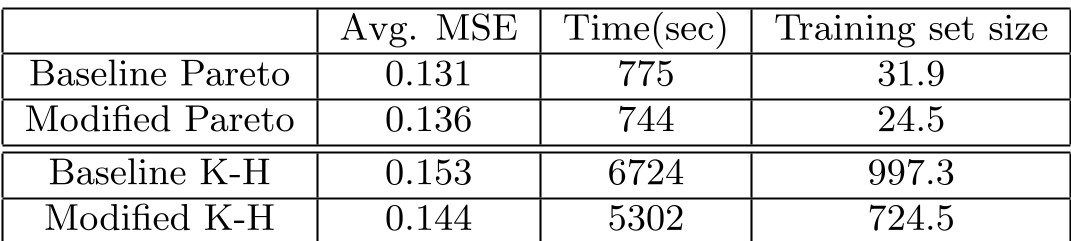
- Efficiency Gains: For the Sanders dataset, the modified Kaldor-Hicks algorithm reduced the training set size from 997.3 to 724.5 units, leading to a 21% reduction in execution time.
- Accuracy Persistence: Despite reducing the data, the MSE stayed nearly identical or improved, proving that the pruned messages were largely redundant or noisy.
- Pareto Robustness: In the Stanford dataset, the Modified Pareto approach outperformed the baseline across all metrics, showing that frequency-based pruning helps even highly optimized sampling methods.
| Dataset (Sanders) | Avg. MSE | Time (sec) | Training Set Size |
|---|---|---|---|
| Baseline Pareto | 0.131 | 775 | 31.9 |
| Modified Pareto | 0.136 | 744 | 24.5 |
| Baseline K-H | 0.153 | 6724 | 997.3 |
| Modified K-H | 0.144 | 5302 | 724.5 |
Critical Insights & Conclusion
The Sort-Union approach addresses a fundamental trade-off in stream mining: Quantity vs. Quality. By viewing training data through the lens of economic efficiency, we can treat "computational budget" as a finite resource to be optimized.
Limitations: The paper notes one instance (Sanders dataset with PESS) where MSE slightly increased. This suggests there is a "lower bound" to training set size; once you prune beyond a certain optimal point, you begin to lose vital variance in the data.
Future Outlook: This technique could be highly applicable to other high-velocity streams beyond text, such as financial market signals or IoT sensor data, where identifying the "most frequent" patterns within "economically relevant" windows is key to real-time responsiveness.