
Beyond the Black Box: Infusing Psychological Insight into Speech Emotion Recognition
Finding important sound features for emotion evaluation classification
The paper introduces a novel feature selection approach for Speech Emotion Recognition (SER), specifically focusing on binary emotion evaluation (positive vs. negative). By combining machine learning weights from SVM and Neural Networks with psychological heuristics, the authors aim to identify the most robust acoustic features for human-computer interaction.
TL;DR
Recognizing human emotions from speech is a notorious challenge for AI. This paper presents a novel approach that doesn't just rely on raw data; it bridges the gap between Machine Learning (SVM/MLP) and Behavioral Psychology. By weighting sound features through both model performance and psychological heuristics, the researchers identified a potent subset of features that balance computational efficiency with classification accuracy.
Background: The Complexity of Human Emotion
In the realm of Human-Computer Interaction (HCI), "Emotion Perception" is often the missing link. While computers are excellent at transcribing what we say, they struggle with how we say it. The authors focus on the Evaluation dimension of the Activation-Evaluation space—essentially a binary classification of whether an emotion is Positive or Negative.
The Problem: Data Overload vs. Feature Scarcity
Existing research often falls into two traps:
- Feature Explosion: Extracting dozens of features (Jitter, Shimmer, Pitch, etc.) increases model complexity and latency.
- Over-Simplification: Standard automated feature selection tools (like "Exhaustive Search") often strip the data down to just one or two features, such as "Pitch Mean," losing the nuance of the emotional expression.
Methodology: A Hybrid Ranking Strategy
The core innovation lies in a three-step weighting process to select the most "important" features:
- SVM & MLP Weighting: The authors trained a Support Vector Machine (using SMO) and a Multilayer Perceptron. They extracted the internal weights assigned to each of the 27 acoustic features.
- Psychological Modulation: Instead of taking these weights at face value, they introduced a parameter based on psychological studies (e.g., work by Scherer and Picard). Features like "Pitch Variation" and "Tempo" were given higher priors because humans naturally use them to signal valence.
- The Weighted Formula: This ensured that the final feature set was both mathematically relevant and psychologically grounded.
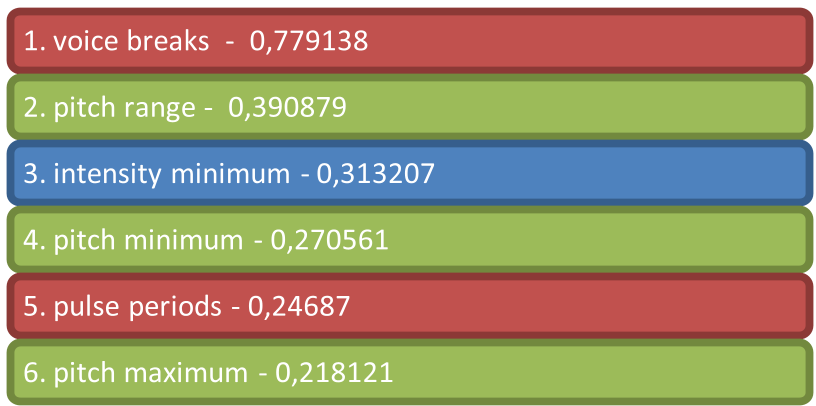 Figure 1: The ranking of features derived from the novel approach, highlighting the dominance of Pitch (Green) and Tempo (Red) features.
Experiments & Results
The researchers tested their approach using a Macedonian-language database. Key highlights include:
- Peak Performance: A full-feature SVM model reached 88% precision.
- Efficiency Trade-off: Their "New Approach" feature set achieved 68% precision with a fraction of the computational load.
- Superiority over Defaults: This method outperformed standard algorithms like OneR (52%) and ReliefF (64%), proving that "expert knowledge" still holds significant value in the age of ML.
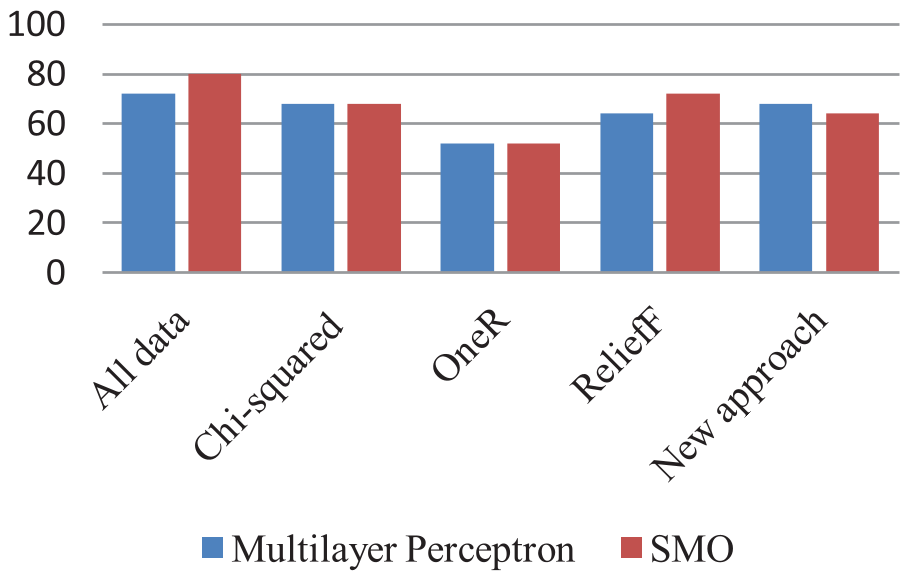 Figure 2: Performance comparison showing that while the all-feature set is most accurate, the "New Approach" provides a superior balance compared to other selection methods.
Critical Insight: Why This Matters
The most striking takeaway is the dominance of Pitch and Tempo. While common sense might suggest intensity (loudness) is key, the psychological/ML hybrid ranking reveals that the contour of the pitch and the speed of speech are much more reliable indicators of whether a speaker is pleased or frustrated.
Conclusion & Future Outlook
This work sets a foundation for Empathic Machines. By narrowing down the 27 features to a vital few, we move closer to emotion-aware systems that can run on low-power devices, such as companion robots or mobile medical assistants. The next frontier? Moving beyond binary "Positive/Negative" labels to the full spectrum of the "Lövheim Cube of Emotions."
Takeaway for Researchers
Don't let your feature selection be purely data-driven. In domains like affect recognition, Inductive Biases—derived from decades of human psychology—are often the key to moving from a "black box" to a robust, interpretable model.