
SOUP: Reclaiming Social Media Privacy through Decentralized Mirror Selection
SOUP: An Online Social Network By The People, For The People
SOUP (Self-Organized Universe of People) is a decentralized online social network (DOSN) middleware that eliminates the need for central servers by distributing encrypted user data across a peer-to-peer network. It achieves 99%+ data availability through a novel "mirror selection" algorithm that ranks peers based on social experience and online patterns.
TL;DR
SOUP (Self-Organized Universe of People) is a peer-to-peer middleware designed to replace centralized social networks. By utilizing a sophisticated mirror selection algorithm based on "social experience," it achieves the high data availability of Facebook (99%+) without a central server, while remaining resilient against churn and malicious Sybil attacks.
Background: The Privacy Trap of Centralization
Modern Online Social Networks (OSNs) act as "data silos." When you upload a photo to a centralized platform, you surrender its physical control. If the provider changes its policy or suffers a leak, your privacy is compromised. Current decentralized alternatives (DOSNs) often struggle with a "reliability paradox": if you aren't online, your data disappears unless you pay for a server or have extremely reliable friends.
SOUP breaks this paradox by treating every user's device as a potential "mirror" for someone else's data, using algorithmic trust to ensure high availability for everyone—even those with few friends or poor internet connections.
The Core Mechanism: Smart Mirror Selection
The "secret sauce" of SOUP is how a user decides which peers should store their data replicas. This is handled via two distinct modes:
- Bootstrapping Mode: For new users, recommendations are gathered from any contacted node to quickly find reliable mirrors and gain a foothold.
- Regular Mode (The Knowledge Base): Once established, users collect Experience Sets from their friends. If Friend A successfully retrieves your profile from Mirror B, that "success" increases Mirror B's rank in your local knowledge base.
This creates a feedback loop where reliable, high-uptime nodes naturally rise to the top of the ranking, regardless of their social status.
 Figure: The multi-layered architecture of a SOUP node, separating social logic from networking and security.
Defending Against "The Sybil"
A common pitfall for P2P systems is the Sybil Attack, where an adversary creates thousands of fake identities to flood the system. SOUP introduces Protective Dropping. Each node calculates a "dropping score" for the data it hosts. If a piece of data is found on too many nodes without being officially listed in the DHT (suggesting a flood), or if it belongs to an identity with no social ties, it is the first to be deleted when storage runs low.
Performance and Real-World Validation
In tests across massive datasets like the Facebook social graph (90k nodes), SOUP proved it could maintain 99.5% availability with a surprisingly low overhead—typically only 6.5 replicas per user.
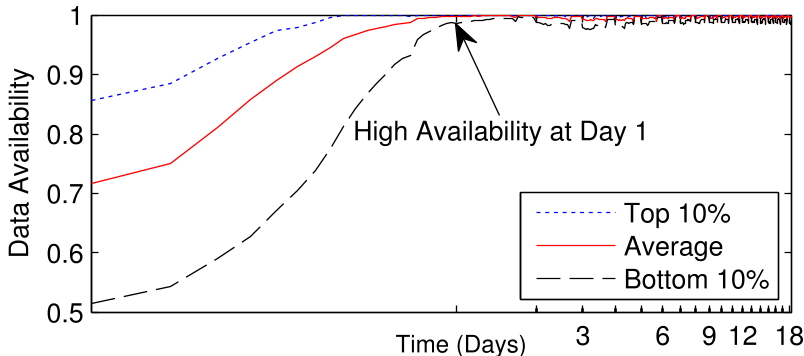 Figure: SOUP demonstrates robustness, maintaining high availability for all users regardless of their social connectivity or individual online probability.
Key Technical Achievements:
- Mobile Friendly: Mobile devices are exempted from heavy DHT maintenance tasks, acting as "clients" that relay via gateway nodes to save battery and bandwidth.
- Fine-Grained Privacy: By using Attribute-Based Encryption (ABE), users can share a photo with only people labeled "Close Friends" or "Family" without the mirrors (who store the data) ever being able to see the contents.
- Resiliency: Even if 50% of the network is compromised or malicious, legitimate users still maintain over 90% data availability.
Critical Insight: Why This Matters
The most profound takeaway from the SOUP paper is the decoupling of Availability from Popularity. In many previous systems, if you weren't a "power user" with 500+ friends, your data was likely to go offline. SOUP proves that through peer-experience sharing, we can build a "Universe of People" where privacy and reliability are distributed democratically.
Conclusion
SOUP is more than a research prototype; it is a proof-of-concept for a post-Facebook era. It addresses the technical hurdles of decentralization—overhead, churn, and security—while maintaining a user experience that rivals centralized platforms.
Note: This analysis is based on "SOUP: an online social network by the people, for the people" published in Middleware '14.