
Identifying the Culprits: Strategic Source Detection of Misinformation in Social Networks
Sources of misinformation in Online Social Networks: Who to suspect?
The paper investigates the "k-Suspector" problem, which aims to identify the top k originators of misinformation in Online Social Networks (OSNs). The authors propose three main algorithms—Imeter-Sort, Influence-Sort, and Influence-Greedy—to trace back sources from a set of infected nodes under the Independent Cascade (IC) model.
TL;DR
Online Social Networks (OSNs) are breeding grounds for misinformation. This paper tackles the k-Suspector problem: identifying the top original sources given a set of "infected" users. By leveraging the Reverse Diffusion Process and Submodular Optimization, the authors achieve up to 80% detection accuracy on large-scale networks like Facebook and Slashdot, even when multiple attackers strike simultaneously.
The Motivation: Why is Tracing Misinfo So Hard?
When a rumor goes viral, we only see the "victims"—the users who have already shared the false claim. Tracing it back to the source is like finding the first spark in a forest fire.
Existing methods struggle because:
- Scale: OSNs have millions of nodes and billions of edges.
- Multiple Points of Origin: Unlike many epidemiological models, misinformation is often pushed by multiple coordinated accounts at once.
- Incomplete Data: We rarely see every single infected user; some "infections" are hidden or unrecorded.
Methodology: Two Paths to the Source
The authors propose two distinct technical strategies:
1. Reverse Diffusion Process (The Heuristic Path)
If misinformation spreads forward through neighbors, can we "trace" it back? The authors propose RDP. They calculate an Imeter score for each node.
- A "reverse flow" starts from infected nodes and moves backwards.
- If multiple flows pass through a node, its Imeter score increases.
- High Imeter = High suspicion.
2. The k-Influence Problem (The Optimization Path)
The authors redefine the problem: Who are the nodes that best "explain" the current infection? They look for a set that maximizes the expected number of currently infected nodes.
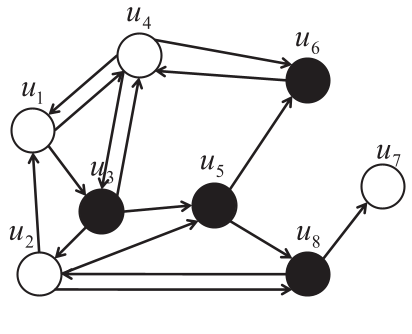
This is mathematically framed as the k-Influence problem. The authors prove this problem is NP-hard but demonstrate that the objective function is submodular and monotone. This allows for the use of a Greedy Hill-Climbing algorithm (Influence-Greedy) that guarantees a solution within of the optimal.
Experimental Results: High Accuracy vs. High Speed
The researchers tested their models against Facebook, Epinions, and Slashdot datasets.
| Dataset | Nodes | Edges |
|---|---|---|
| 90,269 | 1,823,331 | |
| Epinions | 75,879 | 508,837 |
| Slashdot | 77,360 | 905,468 |
Key Findings:
- Accuracy: The
Influence-Greedyalgorithm is the champion, detecting over 80% of attackers in certain scenarios. - Efficiency: While
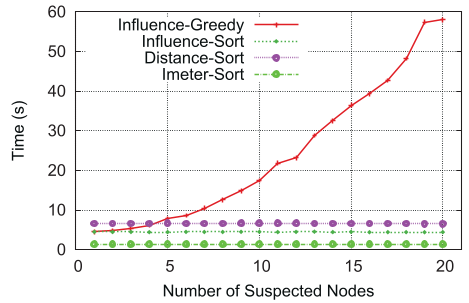
Influence-Greedyis accurate, it is computationally heavy.Imeter-Sort(Ranking-based) provides a "best of both worlds" scenario—it is nearly as accurate as the greedy method but runs in a fraction of the time, making it suitable for real-time monitoring. - Resilience: In cases of "Multiple Attacks" (different waves of rumors from the same source), the algorithms' performance actually improves because more data points help triangulate the source.
Deep Insights & Critical Analysis
The Power of Influence
The most profound insight here is the duality between influence maximization (marketing) and source detection (forensics). The nodes that are best at spreading a message are also the most likely culprits when a message is found to be malicious.
Limitations
- Model Dependence: The work relies heavily on the Independent Cascade (IC) model. While standard, real-world human behavior in OSNs might be more complex (e.g., the "Threshold Model").
- Data Sparsity: As shown in Section VI, when 70% of the infected data is missing, accuracy drops significantly (down to ~20%). Tracing sources in an adversarial environment where users hide their activity remains an uphill battle.
Conclusion
This paper provides a robust framework for OSN administrators to "follow the breadcrumbs" of misinformation. By combining probabilistic reverse tracing with submodular optimization, it moves the field beyond simple heuristics toward a mathematically grounded investigation strategy. For future work, integrating these models with Graph Neural Networks could potentially bridge the gap when data is incomplete.