
Space Cloudlet: Leveraging Social Ties to Conquer Satellite Latency
Space Cloudlet Aided Caching Placement Strategy for Remote Mobile Social Networks
This paper proposes a social-relationship-aware caching placement strategy for remote mobile social networks (MSNs) using "space cloudlets" (satellite-linked base stations). The authors introduce a greedy algorithm that leverages social ties to designate helpers and proactively cache content, achieving a near-optimal (1 - 1/e) approximation for minimizing retrieval latency.
TL;DR
In remote regions like deserts or islands, the internet arrives via satellite—meaning long wait times. This paper introduces a Social-Aware Caching Strategy that identifies influential local users as "helpers" and proactively stores popular content on their devices. By transforming the placement problem into a monotone submodular optimization, the authors achieve a 20% reduction in latency using a greedy algorithm with a provable performance guarantee.
Background: The Satellite Bottleneck
For remote Mobile Social Networks (MSNs), the "Backhaul" is the enemy. Every content request that misses the local cache must travel to a remote cloud via a satellite link, incurring a massive delay constant (). While "Space Cloudlets" (edge servers attached to satellite terminals) help, they have limited storage.
The author's core insight is that humans are social animals. Users in the same remote community likely want to watch the same videos or access the same news. If we can pick the "social leaders" to act as local caches (helpers), we can offload traffic via D2D (Device-to-Device) connections, which are much faster than satellite-linked base stations.
Methodology: Social Distance & Submodularity
The paper's technical core is two-fold: identifying who should cache and what they should cache.
1. Social Aware Helper Designation
Instead of picking helpers randomly, the authors calculate a Social Distance Matrix (). This uses:
- Adamic-Adar Index: Measuring similarity based on shared neighbors.
- Betweenness Centrality: Measuring how much information flows through a specific user node.
The top-tier users in this social graph are designated as helpers.
2. The Greedy Optimization
The caching placement problem is notoriously NP-hard. However, the authors prove that the latency reduction function is monotone submodular. This is a "mathematical superpower" because it guarantees that a simple Greedy Algorithm—which always picks the file that gives the best immediate latency reduction—will provide a solution at least 63.2% () as good as the theoretical optimum.
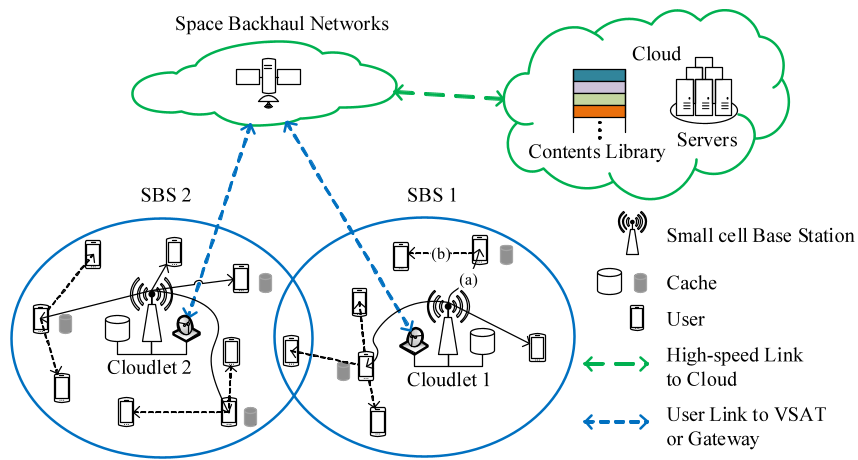 Figure 1: The architecture showing Space Cloudlets and social-aware D2D offloading.
Performance and SOTA Comparison
The algorithm was tested against two standard baselines: Random caching and Most Popular caching.
- Latency Win: The proposed greedy approach outperformed "Most Popular" by 20% at moderate cache capacities.
- The "Crowdedness" Insight: Interestingly, the authors found that simply adding more helpers doesn't always help. As the number of helpers increases, the D2D bandwidth for each user actually drops (network congestion), meaning there is a "Sweet Spot" for the number of helpers in a community.
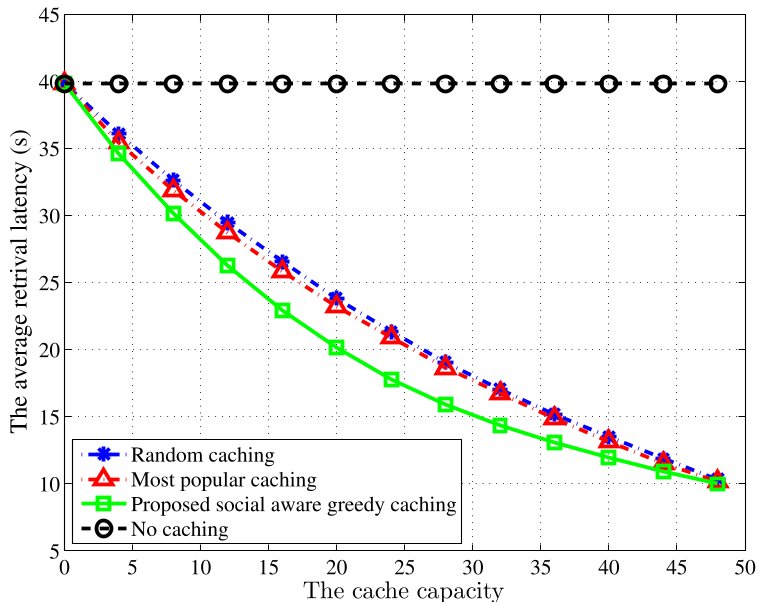 Figure 2: Average latency vs. Cache Capacity. Note the significant gap between the proposed greedy approach and traditional methods.
Critical Analysis & Conclusion
This work elegantly bridges social science (graph theory) and network engineering (optimization). Most research treats the "Edge" as a purely physical layer; this paper argues that the human layer is just as important for predicting demand.
Limitations: The current model assumes transmission rates are fixed and users are stationary. In the real world, user mobility would cause social ties (and signal strength) to fluctuate, which might require a more dynamic, perhaps Reinforcement Learning-based, approach to caching.
Final Takeaway: If you are building networks for the "next billion" users in unconnected areas, don't just look at the signal strength—look at their social circles.