
Beyond Geometry: Teaching Robots the "Language Game" of Cultural Space
A first prototype of a space model of cultural meaning by natural-language human-robot interaction
This paper introduces a first prototype of a "Space Model of Cultural Meaning," a hybrid perception system that enables humanoid robots to learn the subjective and cultural significance of physical environments through natural-language and non-verbal interaction. Utilizing the Romeo robot and machine learning (Orange/Python) in a trial with over 250 participants, the researchers demonstrate that robots can move beyond geometric data to grasp human-centered spatial contexts like "mood" or "function."
TL;DR
Researchers at the Vienna University of Technology are bridging the gap between how humans feel about their homes and how robots "see" them. By moving away from purely geometric data, they've developed a prototype that allows a humanoid robot named Romeo to learn the cultural and personal meanings of objects—like knowing a "wardrobe" is where we keep "cold" weather clothes—through simple, natural-language conversations.
The Perception Paradox: Why Robots Feel Like Strangers
Current SOTA robotics excel at Object Detection and Semantic Scene Labeling. A robot can identify a "chair" by its geometry or a "fire extinguisher" by its color. However, as the authors point out, human space is not made of numbers; it is made of meanings, associations, and habits.
The problem is a structural otherness: if a robot only understands space through Euclidean coordinates, it remains a "technical servant" rather than a "companion." It cannot participate in the Language Games (a concept from philosopher Ludwig Wittgenstein) that define our daily lives. To fix this, we need a hybrid model where the machine is "domesticated" through interaction.
Methodology: The "Space Game"
The researchers developed a trans-disciplinary approach combining architecture, automation, and philosophy. They treat the robot as a "Companion Species" (derived from Donna Haraway), emphasizing shared responsibility and co-evolution.
The Technical Pipeline
- Interaction: The robot points at an object (using gestures or a flashlight).
- Voice Processing: Human responses are captured via Google Cloud Speech and analyzed through WordNet to identify grammatical structures.
- Machine Learning: Using the Orange library in Python, the system categorizes terms into "Name," "Function," and "Features."
- Spatial Mapping: These meanings are tied to the robot's coordinate system, creating a "Space Model of Cultural Meaning."
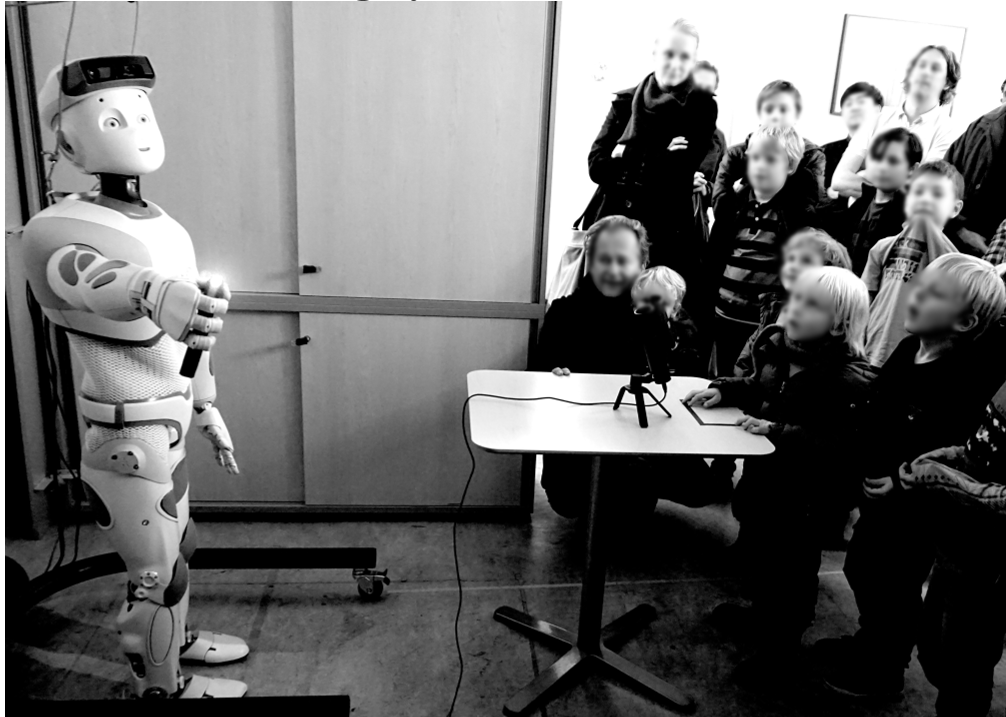 Figure 1: Robot Romeo engaging in the experimental "Space Game" interaction.
Real-World Trial: The Long Night of Robots
The system was put to the ultimate stress test: a public event with over 1,000 visitors. The researchers captured 258 distinct interactions, observing how people talked to Romeo.
- Speech Adaptation: Users treated the robot like a social agent, some speaking slowly (as to a toddler) and others trying to engage in complex counter-questions.
- Emergent Meanings: The ML system correctly identified non-obvious cultural links. For instance, the "overhead light" was associated with "darkness" (its purpose is to alleviate it), and "wardrobe" with "cold."
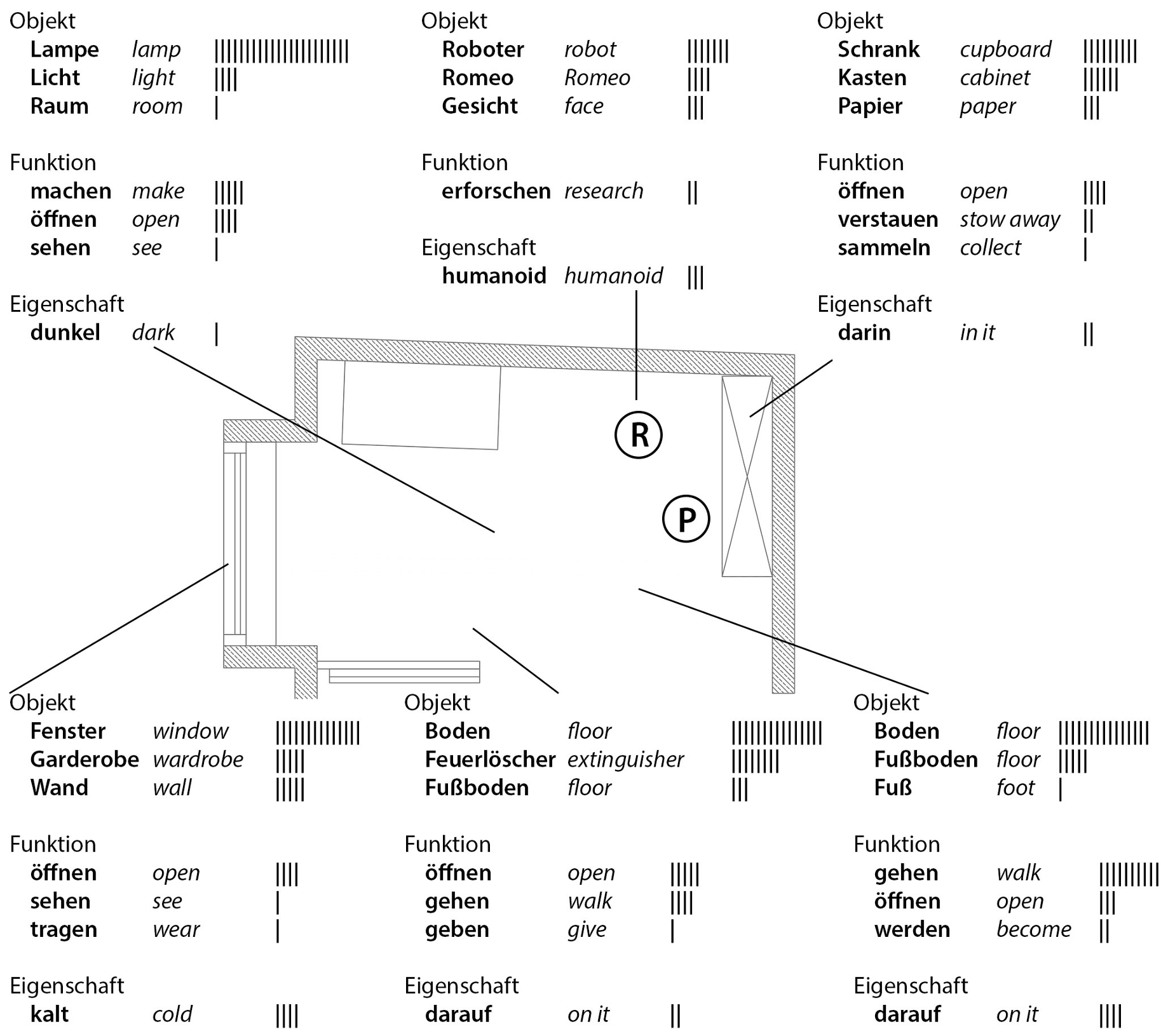 Figure 2: A floor plan representing the accumulated cultural meanings of the experimental area.
Critical Insight: The "Third Space"
The core contribution of this work is the realization that a robot’s world model shouldn't just be a copy of human perception, nor a purely mathematical grid. Instead, it should be a Hybrid Space Model—a third interpretation generated between the human and the machine.
Limitations and Future Horizon
While a successful first prototype, the study identifies several hurdles:
- Ambiguity: The robot sometimes confused "fire extinguisher" with "floor" due to imprecise pointing.
- Privacy: As robots learn our intimate "meaning maps," who owns that data? The authors flag this as a critical future research area.
- Dynamic Time: Cultural meanings change with seasons and years; the next step is adding time as a fourth dimension to the model.
Conclusion
This paper is a significant departure from standard HRI (Human-Robot Interaction) papers that focus solely on task efficiency. By injecting Artistic Research and Philosophy into the loop, the authors show that for a robot to move "naturally" in our social space, it must first learn to speak our language of meaning.
Takeaway for the Industry: The next generation of smart home AI shouldn't just map your rooms—it should learn what those rooms mean to you.