
Exploring Space Syntax: How Wi-Fi Analytics Reveal the Hidden Dynamics of Entrepreneurial Success
Exploring space syntax on entrepreneurial opportunities with Wi-Fi analytics
The paper introduces a Wi-Fi analytics solution utilizing wearable badges and gateways to study the impact of spatial configuration on social networking at large-scale industrial events. By tracking the spatio-temporal trajectories of 2.5K+ attendees, including specific cohorts of investors and entrepreneurs, the authors demonstrate how designated zones influence the formation of social ties.
TL;DR
Is the architectural layout of a conference venue sabotaging your networking goals? This study by Nokia Bell Labs uses custom Wi-Fi badges to track investors and entrepreneurs at a massive industrial exhibition. The findings reveal a stark contrast in behavior: while investors stay cocooned in private lounges ("Caveman" behavior), entrepreneurs are forced into long, often fruitless journeys across the venue. The research suggests that "informal hubs" like coffee bars provide better ROI for social capital than structured networking sessions.
Problem & Motivation: The Architecture of Opportunity
In the world of startups, social capital—who you know—is often more valuable than human capital. While we know events are hubs for building these ties, we rarely look at the spatial syntax: the way a building's layout constrains or enables encounters.
Existing research has focused on what people say, but this paper asks where they go. Prior tracking attempts using Bluetooth often suffered from low participation, while GPS fails indoors. The authors sought a non-invasive way to map the movement of over 2,500 people to see if the "spatial lens" could explain why some people leave an event with a pocketful of business cards while others leave empty-handed.
Methodology: Passive Sniffing and Smart Badges
The researchers developed a two-tier tracking system:
- Passive Monitoring: 29 Raspberry Pi-based gateways captured anonymous "probe requests" (the signals your phone sends when searching for Wi-Fi) from thousands of devices.
- Wearable Wi-Fi Badges: 61 key participants (34 investors, 27 entrepreneurs) wore custom credit-card-sized badges that emitted signals systematically.
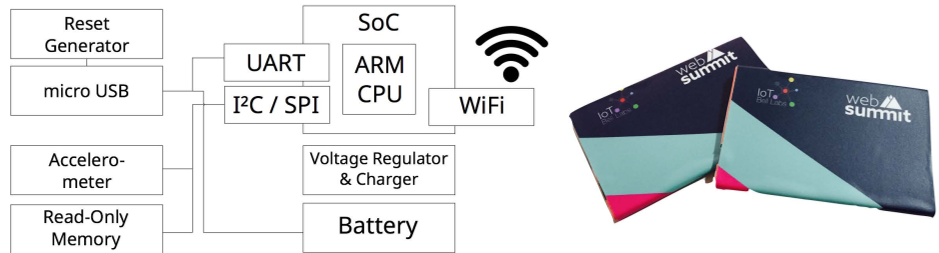 Figure 1: The custom Wi-Fi badge design (left) and the deployed Wi-Fi gateway (right).
By using SVM (Support Vector Machine) classification to analyze the Signal Strength (RSSI) across multiple gateways, they achieved a high-fidelity mapping of which "Zone" a person was in at any given minute.
Experiments & Results: Cavemen vs. Explorers
The results exposed a fundamental divide in how different social "classes" use space:
- The Caveman Investor: Investors displayed high "behavioral homophily." They stayed in their protected "caves" (the Investors' Lounge), only making short, sporadic "hunting" trips to other zones.
- The Entrepreneurial Explorer: Entrepreneurs were far more mobile, visiting more distinct zones and taking longer paths. However, their Index of Isolation was high—they were effectively segregated from the people they needed to meet most.
 Figure 2: Heatmap showing the density of movement. Note the heavy concentration in specific "Demo" zones and the isolation of restricted lounges.
The Coffee Bar Insight: The data showed that "Zone 3" (a coffee bar) was a critical bridge. Entrepreneurs who spent time in this informal, high-entropy zone were significantly more likely to later be found in the restricted Investors' Lounge, suggesting that informal settings catalyze the "elemental encounters" needed to break through social barriers.
Critical Analysis & Conclusion
Takeaway
The design of an event space is not neutral; it is an active participant in social engineering. To foster innovation, organizers must move away from rigid, segregated lounges and toward a "multi-instance" private zone model. By placing small, semi-private meeting spots tangent to high-traffic public paths, you force different groups to collide naturally.
Limitations
- Sample Size: While 2.5K attendees were tracked anonymously, the "ground truth" relies on only 61 badge-wearing participants.
- Correlation vs. Causation: Co-location doesn't always equal a meaningful conversation. However, it is the first necessary step for "elemental encounters."
Future Work
The next frontier is extending this "Space Syntax" beyond functionality to examine how factors like ceiling height, lighting, and furniture (e.g., bean bags vs. formal tables) influence the willingness of a CEO to talk to a first-time founder.