
Strategic Influence: Mastering Space-Time Budget Allocation in Social Networks
Space-time budget allocation for marketing over social networks
This paper addresses the "Space-time budget allocation" problem in social networks, where an external marketer aims to sway agent opinions toward a desired value under a finite budget. It utilizes a linear-impulsive hybrid systems framework to bridge continuous-time opinion evolution with discrete-time marketing campaigns, achieving SOTA results in strategic targeting.
TL;DR
How do you influence a whole network with a limited budget? This paper moves beyond simple "broadcasting" to a sophisticated hybrid system approach. By treating marketing as impulsive interventions in a continuous-time social flow, the authors prove that the most efficient way to change minds is to target the "central" nodes as early as possible using a water-filling allocation strategy.
Motivation: The Limits of Social Broadcasting
In digital marketing, the default "Broadcasting" strategy—spending an equal amount on every user—is often the least efficient. In a network where opinions flow between neighbors (like the DeGroot model), individuals are not equal. Some are "influencers" (central nodes), and others are "followers."
The authors argue that a marketer's budget is a precious resource that must be allocated across two dimensions:
- Space: Which agents should receive the marketing spend?
- Time: How should the budget be distributed across multiple campaign windows?
The core insight is that social networks have an inherent Inductive Bias defined by their topology (Laplacian matrix). By understanding this, a marketer can "nudge" the network at key nodes to let the natural social dynamics do the rest of the work.
Methodology: A Hybrid Control Approach
The paper models the network as a linear-impulsive system.
- Natural Flow: Between campaigns, opinions evolve via standard consensus dynamics ().
- The Impulse: At discrete time , the marketer applies an action , which shifts the opinion toward the target .
The Water-Filling Insight
The authors demonstrate that spatial allocation follows a "water-filling" logic. If you have a fixed budget for a single campaign, you shouldn't spread it thin. Instead, you rank agents by their centrality-weighted potential gain and fill them up to the maximum possible influence one by one until the budget is exhausted.
 The visual representation of the network graph where node size indicates centrality.
Experiments and Results
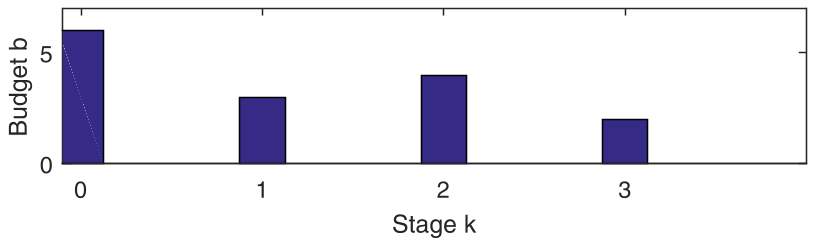
The researchers tested their theories using a 15-agent network over 4 campaign stages.
Short-Stage vs. Long-Stage Dynamics
In "Long-Stage" scenarios (where campaigns are far apart), the network reaches a temporary consensus between nudges. The authors developed a Dynamic Programming (DP) algorithm to solve this efficiently.
- Result: The optimal strategy consistently prioritized "front-loading" the budget—investing heavily at the start (Stage 0 and 1) to set the network on the right trajectory early.
- Efficiency: Targeted targeting achieved lower error (distance to target opinion) than broadcasting while using the same total budget.
 Opinion evolution over time. Note the "jumps" (impulses) at each campaign stage followed by convergence.
Key Data Point
For the tested 15-agent network, the algorithm selected a subset of high-centrality nodes (e.g., agents 3, 7, and 9) repeatedly, rather than rotating through the network. This proves that centrality is the primary driver of ROI in opinion control.
Critical Analysis & Conclusion
Takeaway
The most effective way to manage a social network's opinion is not to be loud everywhere, but to be strategically intense at the center. The paper's proof that a binary action (either 0 or max influence) is often optimal simplifies the decision-making process for real-world marketers.
Limitations & Future Work
- Static Topology: The network graph is assumed to be fixed. In reality, followers may unfollow someone if their opinion becomes too radical.
- Single Marketer: The model assumes a monopoly on influence. Future research should integrate a "Game Theory" perspective where two competitors fight for the same budget-constrained space.
By formalizing the "Space-Time" trade-off, this work provides a rigorous control-theoretic foundation for what many social media managers have known intuitively: focus on the influencers, and do it early.