
Unmasking the Colluders: A Heterogeneous Embedding Approach to Crowdsourcing Security
A spam worker detection approach based on heterogeneous network embedding in crowdsourcing platforms
This paper introduces a novel spam worker detection approach using Heterogeneous Network Embedding (HNE) to identify collusive behaviors in crowdsourcing platforms. By modeling three distinct collusion patterns and employing a variable-length random walk based on node centrality, the method transforms detection into a node classification task via HIN2Vec and One-class SVM.
TL;DR
Crowdsourcing platforms are under siege by "spam workers" who use sophisticated collusion to maintain high reputation scores while delivering low-quality work. This paper moves beyond simple reputation tracking by modeling these interactions as a Crowdsourcing Heterogeneous Network (CHN). By leveraging HIN2Vec embeddings and a novel variable-length random walk, the authors achieve a 93% F1-score in detecting spammers across mixed collusion patterns while slashing training time by 85%.
The "Good Reputation" Paradox
In platforms like Amazon Mechanical Turk, reputation (Direct Trust) is everything. However, a high score is no longer a guarantee of quality. Spammers have evolved:
- Requester-oriented collusion: Spammers work on "fake" tasks published by partner requesters to get easy 5-star ratings.
- Worker-oriented collusion: Spammers plagiarize answers from high-ability "partner" workers.
- Mixed patterns: A combination of both, creating a complex web of trust that traditional scalar-based metrics cannot penetrate.
Existing solutions are either too expensive (manual verification) or too naive (ignoring the network structure of these attacks).
Methodology: From Direct Trust to Heterogeneous Graphs
The core insight of this paper is that spammers and normal workers have fundamentally different "neighborhood signatures" in a graph. A normal worker has stable, diverse trust relations; a spammer has "pulsing" or highly specific paths through their accomplices.
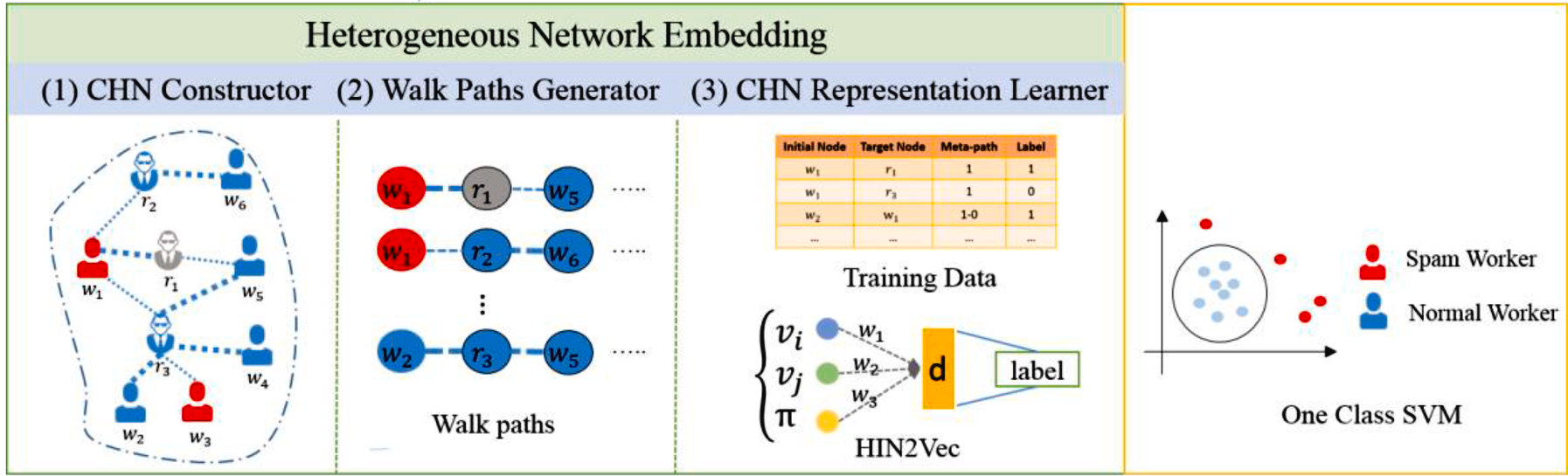
1. Constructing the CHN
The authors define a Heterogeneous Information Network where:
- Nodes: Workers and Requesters.
- Edges: Classified as Highly Trusted (High DT) or Lowly Trusted (Low DT) based on a threshold (optimum found at 0.45).
2. Variable-Length Random Walk (The Efficiency Engine)
Standard graph embeddings use fixed-length walks, which are redundant and slow. The authors introduced:
- Node Centrality Bias: Nodes with more neighbors get more walk starts to capture their influence.
- Stopping Probability: A random exit chance prevents over-sampling, which reduced the training burden from 544 minutes to just 83 minutes.
3. HIN2Vec + One-class SVM
The system treats detection as a node classification task. HIN2Vec learns the embedding by predicting metapaths, and a One-class SVM is used because, in the real world, we often only have labeled "good" workers (experts) and need to find the outliers.
Experimental Battleground
Using a simulated dataset built on the real DBLP co-authorship network, the authors tested against Baselines like AMT and CrowdDefense.
Visualizing the Separation
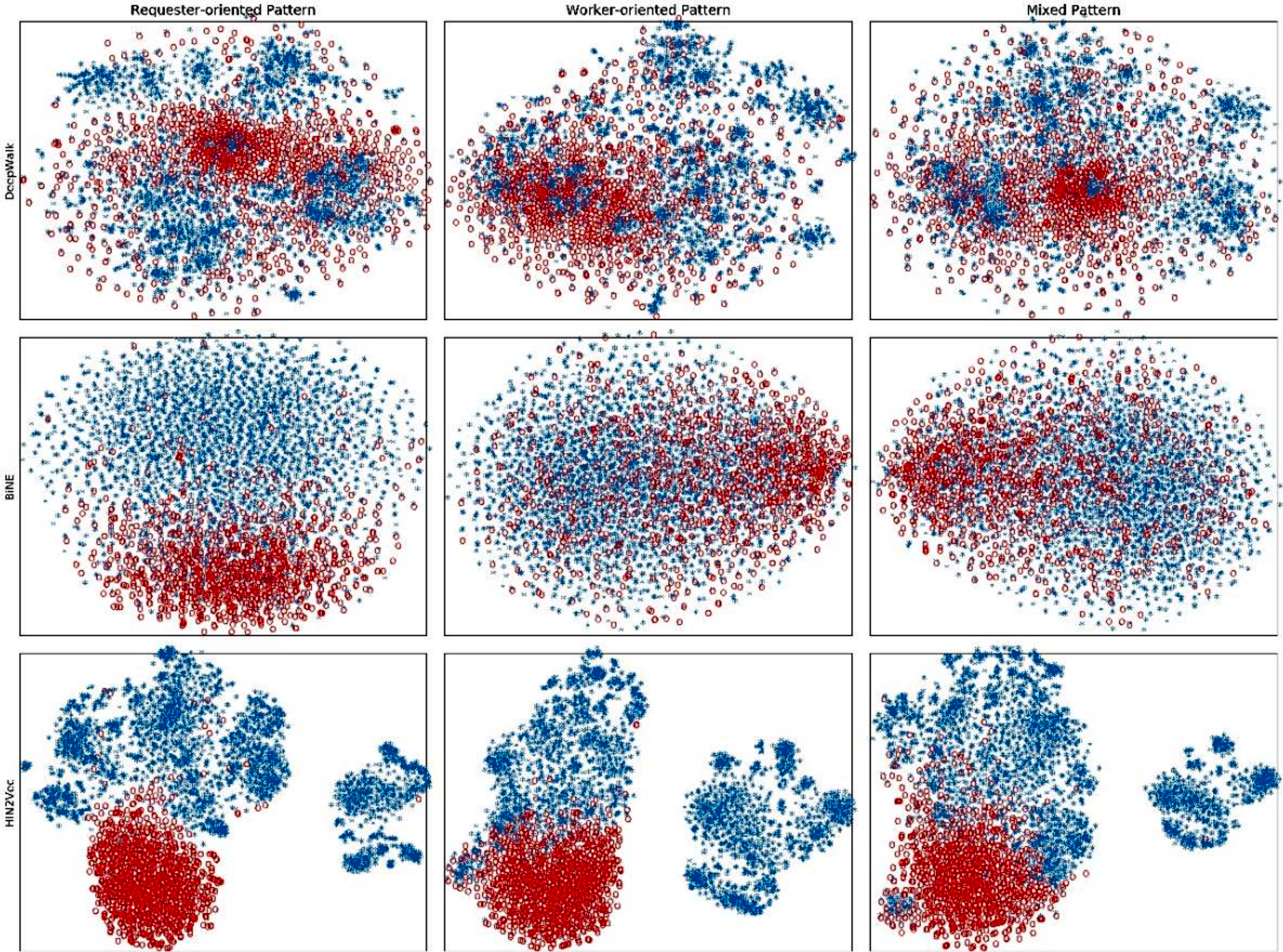
The t-SNE visualizations (Figure 8) prove that HIN2Vec creates much tighter, more separable clusters for spammers compared to homogeneous methods like DeepWalk or BiNE.
Key Result Findings:
- Performance: Constant F1-scores above 90% even as the fraction of spam workers increased.
- Ablation: Using node centrality and stopping probability simultaneously provided the best tradeoff between accuracy and speed.
Critical Analysis & Takeaways
Why it works: By encoding the type of edge (High/Low Trust) directly into the embedding, the model "sees" the unnatural clusters formed by collusion. A spammer's high reputation with a single requester looks mathematically different from a normal worker's high reputation across multiple honest requesters.
Limitations:
- The dataset is simulated. While based on the real DBLP structure, real-world spammer behavior might be even more adaptive (e.g., adversarial attacks against the embedding).
- The "Mixed Pattern" remains the hardest to detect, as these sophisticated agents mimic normal connectivity more closely.
Future Outlook: The next step for this research is likely moving into Dynamic Graphs. If spammers change their behavior over time to evade detection, a static embedding like HIN2Vec might need to be replaced by a Temporal GNN. Overall, this paper provides a robust blueprint for securing crowdsourcing platforms against organized dishonesty.